Why Sustainable Project Management Matters
Project teams no longer work with schedule, cost, and scope as the only measures of success. Environmental impact, social responsibility and long-term economic value are becoming part of everyday project decisions, from how resources are sourced to how stakeholders are engaged. Sustainability now touches planning, procurement, risk management, and delivery in ways it simply didn't a decade ago. For professionals who want to build credibility in this space, the Certified Sustainable Project Professional (CSPP)™ Certification has become a natural point of interest. This article looks at what the certification involves, why sustainability is gaining ground in project management and how professionals can prepare for it in a practical, realistic way.
What Is the Certified Sustainable Project Professional (CSPP)™ Certification?
The CSPP™ Certification is built around the idea that project professionals need more than technical delivery skills they need the ability to weigh environmental, social, and economic factors when making project decisions. It's designed for people already working in or around project environments who want a structured way to bring sustainability thinking into their day-to-day role. Rather than treating sustainability as a side topic, the certification positions it as something that runs through planning, procurement, execution and stakeholder management. It's worth being clear that earning a certification is a professional-development step, not a guaranteed route to a promotion or a new job; its real value comes from how the knowledge is applied. Professionals exploring this path often start by reviewing a CSPP™ certification training programme to understand the structure before committing time to preparation.
Why Sustainability Is Becoming Important in Project Management
Sustainability is showing up in project decisions in ways that go beyond compliance. It shapes how resources are planned and used, how procurement decisions weigh supplier practices, and how risk registers now include environmental and social exposure alongside the usual cost and schedule risks. Stakeholders clients, investors, communities, regulators are asking sharper questions about environmental footprint and social impact than they were even a few years ago. What's changed is the framing: sustainability isn't a separate checklist item anymore. It's becoming woven into how organizations judge whether a project actually created long-term value, not just whether it was delivered on time and on budget.
Key Sustainability Concepts Project Professionals Should Understand
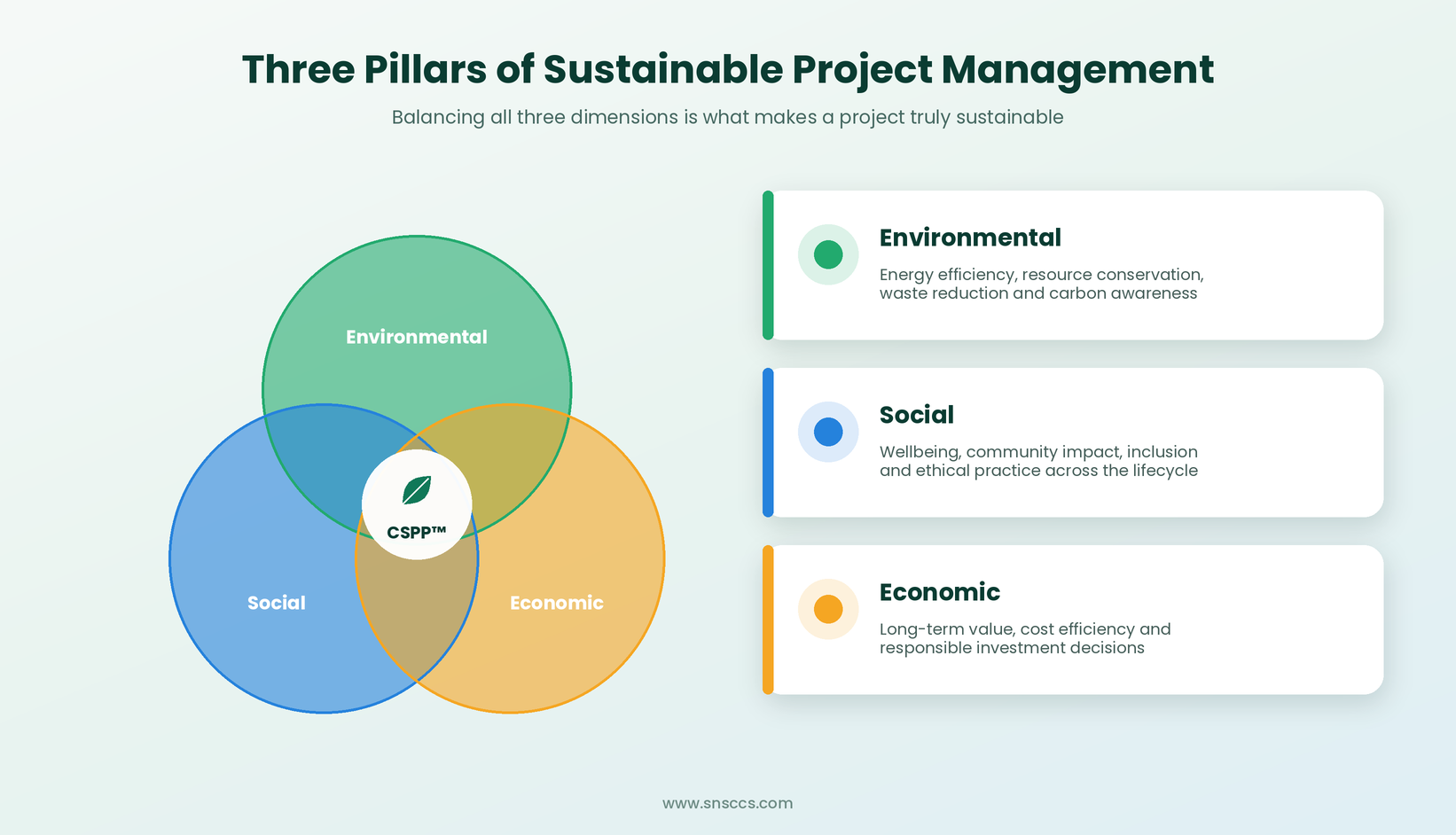
Sustainable project management generally rests on three connected dimensions:
Environmental sustainability covers energy efficiency, resource conservation, waste reduction, and carbon-related considerations during planning and execution.
Social sustainability looks at employee wellbeing, community impact, diversity and inclusion and ethical practices across the project lifecycle.
Economic sustainability focuses on long-term value creation, cost efficiency, responsible investment decisions and outcomes that hold up beyond the project's closure date.
None of these dimensions works well in isolation. A project that cuts costs at the expense of community relationships or reduces environmental impact while ignoring long-term financial viability, isn't really sustainable it's just optimized for one variable. Balancing all three is the harder, more useful skill.
How CSPP™ Can Connect Sustainability With Project Management
The certification's real strength is in how it maps sustainability onto familiar project areas rather than treating it as a separate discipline:
| Project Area | Sustainability Consideration |
|---|---|
| Planning | Long-term environmental and social impact |
| Procurement | Responsible sourcing |
| Risk | Sustainability-related risks |
| Execution | Efficient resource use |
| Stakeholders | Community and stakeholder expectations |
| Closing | Measuring outcomes and lessons learned |
Seen this way, sustainability isn't an add-on module it's a lens applied to decisions project managers are already making. That's part of why professionals looking at structured CSPP™ preparation tend to find the content easier to connect to real project work than a purely theoretical course would be.
Who Should Consider CSPP™ Certification?
The certification tends to attract a fairly broad group: project managers, project coordinators, program professionals, PMO staff, consultants, operations professionals and anyone working on ESG or sustainable business initiatives. Sustainability specialists who want a project-management framing of their existing knowledge also fit well here. Whether it's the right step depends on a person's current experience, where they want their career to go and how central sustainability is to the work they do or want to do. It's less about ticking a box and more about whether the content addresses gaps a professional is already noticing in their own projects something worth thinking through, possibly with input from a career advisory conversation before enrolling.
Skills You Can Develop Through Sustainable Project Management
Studying this material tends to build capabilities like sustainability planning, environmental risk awareness, sustainable procurement, and impact assessment alongside softer skills such as stakeholder engagement, ethical leadership, and long-term value thinking. These aren't replacements for core project-management skills like scheduling or budgeting; they sit alongside them. A project manager who understands both scope and sustainability risk is simply working with a fuller picture, which tends to make project decisions more defensible when questioned by clients, boards or regulators down the line.
CSPP™ Certification and the Future of Project Management
Sustainability considerations are showing up across construction, infrastructure, technology, energy, manufacturing, and supply chain projects not just in sectors traditionally associated with environmental concerns. Projects are increasingly judged on broader impact, not only on whether they hit scope, schedule, and budget targets. This shift is pushing project professionals toward a working knowledge of sustainability principles in much the same way that risk management or stakeholder engagement became standard expectations over the past two decades. Organizations building out PMO delivery functions are already factoring sustainability criteria into how they evaluate and report on project portfolios.
How to Prepare for CSPP™ Certification
A realistic preparation path usually looks something like this:
- Understand the certification's eligibility and requirements before committing time.
- Review the official exam or certification framework in detail.
- Study sustainability principles independently of project-management theory first.
- Connect those principles back to real project scenarios and decisions.
- Use official preparation resources where they're available.
- Practice applying sustainability thinking to case studies or past projects.
- Review weaker areas before sitting the assessment.
It's worth confirming current eligibility rules, exam format, and prerequisites directly through official certification channels before finalizing a study plan, since these details can change. Professionals who prefer guided preparation rather than self-study often look at CSPP™ live classes to work through the material with an instructor rather than piecing it together alone.
CSPP™ vs Traditional Project Management Knowledge
| Traditional PM Focus | Sustainable PM Focus |
|---|---|
| Scope | Scope + broader impact |
| Cost | Cost + long-term value |
| Schedule | Schedule + resource efficiency |
| Risk | Project risk + sustainability risks |
| Stakeholders | Stakeholders + communities |
| Resources | Resource efficiency |
The point isn't that sustainable project management replaces the traditional discipline it extends it. A project manager still needs to hit deadlines and manage budgets; sustainability adds another layer of judgment on top of that foundation.
How Professionals Can Apply Sustainability on Real Projects
In practice, this often looks like small, deliberate choices: selecting suppliers with responsible sourcing practices, cutting unnecessary resource consumption during execution, flagging environmental risks at the planning stage rather than after the fact, and engaging stakeholders early enough that concerns can actually shape decisions. Measuring sustainability-related outcomes and documenting lessons learned also matters without that record, it's hard to show improvement from one project to the next or to make the case internally for continuing the investment in sustainable practices.
FAQs
What is the Certified Sustainable Project Professional (CSPP)™ Certification?
It's a certification aimed at project professionals who want to formally build sustainability considerations environmental, social, and economic into how they plan and deliver projects.
Who is CSPP™ Certification designed for?
Project managers, coordinators, PMO staff, consultants and professionals working on ESG or sustainability initiatives who want to connect that work more directly to project management practice.
Why is sustainability important in project management?
Because stakeholders, regulators and organizations increasingly judge projects on more than schedule and cost long-term environmental and social impact is now part of that evaluation.
What skills are relevant to sustainable project management?
Sustainability planning, environmental risk awareness, sustainable procurement, stakeholder engagement and long-term value thinking, alongside standard project-management competencies.
How should professionals prepare for CSPP™ Certification?
By reviewing official eligibility and exam details first, studying sustainability principles and practicing how to apply them to real project scenarios before the assessment.
Bringing Sustainability Into Project Leadership
The connection between sustainability and project management is only getting stronger, and professionals who think beyond short-term delivery are better positioned for where the discipline is heading. Environmental, social and economic considerations are no longer optional extras they're becoming part of how project success gets defined. For professionals researching their next step, the Certified Sustainable Project Professional (CSPP)™ Certification is a credential worth understanding in depth, as project leadership itself continues to be redefined by what sustainable delivery actually means.