PfMP Exam Preparation
Introduction
The Portfolio Management Professional (PfMP) certification is one of the most respected credentials for professionals who manage collections of projects and programs aligned to organizational strategy. Unlike credentials focused purely on execution, PfMP recognizes the ability to make investment decisions, balance resources and connect day-to-day delivery with long-term business goals. This makes it a natural next step for experienced practitioners who already understand PMP certification work and want to move into strategic leadership.
Because the PfMP exam evaluates judgment, experience and strategic thinking rather than simple recall, a structured approach to PfMP exam preparation matters more than it does for many other certifications. This guide walks through what the exam covers, how to build a realistic study plan, which resources are worth the time and the mistakes that slow candidates down. By the end, readers should have a clear roadmap for approaching their PfMP journey with confidence.
What Is the PfMP Certification?
Overview of the PfMP Credential
The PfMP is a certification offered by the Project Management Institute (PMI) that validates a professional's ability to manage a portfolio of projects and programs in a way that supports an organization's strategic objectives. It sits above the PMP and PgMP in PMI's certification family, focusing less on individual project delivery and more on portfolio governance, prioritization and value creation across an entire organization.
Who Should Pursue the PfMP Certification?
The credential is designed for professionals who already operate at a strategic level, including:
- Portfolio Managers
- PMO Directors
- Senior Project Managers moving into broader oversight roles
- Program Managers
- Business Transformation Leaders
- Executives responsible for strategic initiatives and investment decisions
Professionals weighing whether this is the right next step in their career often find it useful to speak with a career advisory service before committing to the exam, since eligibility and long-term career fit both matter.
Benefits of Becoming PfMP Certified
PfMP-certified professionals are often better positioned to influence executive decision-making, since the certification signals fluency in strategic portfolio management, resource optimization and organizational strategy. It also distinguishes candidates in senior PMO and transformation roles, where the ability to prioritize competing initiatives is as important as delivering any single project. Organizations that want this capability across their leadership bench often invest in corporate training rather than leaving preparation entirely up to individuals.
Understand the PfMP Exam Before You Start Preparing
A common mistake among candidates is diving into study materials before understanding how the exam is actually structured. Before building a study plan, it helps to understand these core elements.
PfMP Exam Structure
The PfMP process is different from most PMI certifications because it includes both a panel review of a candidate's application and a multiple-choice examination. Candidates need to clear the panel review stage before they are permitted to sit for the exam itself.
Exam Domains
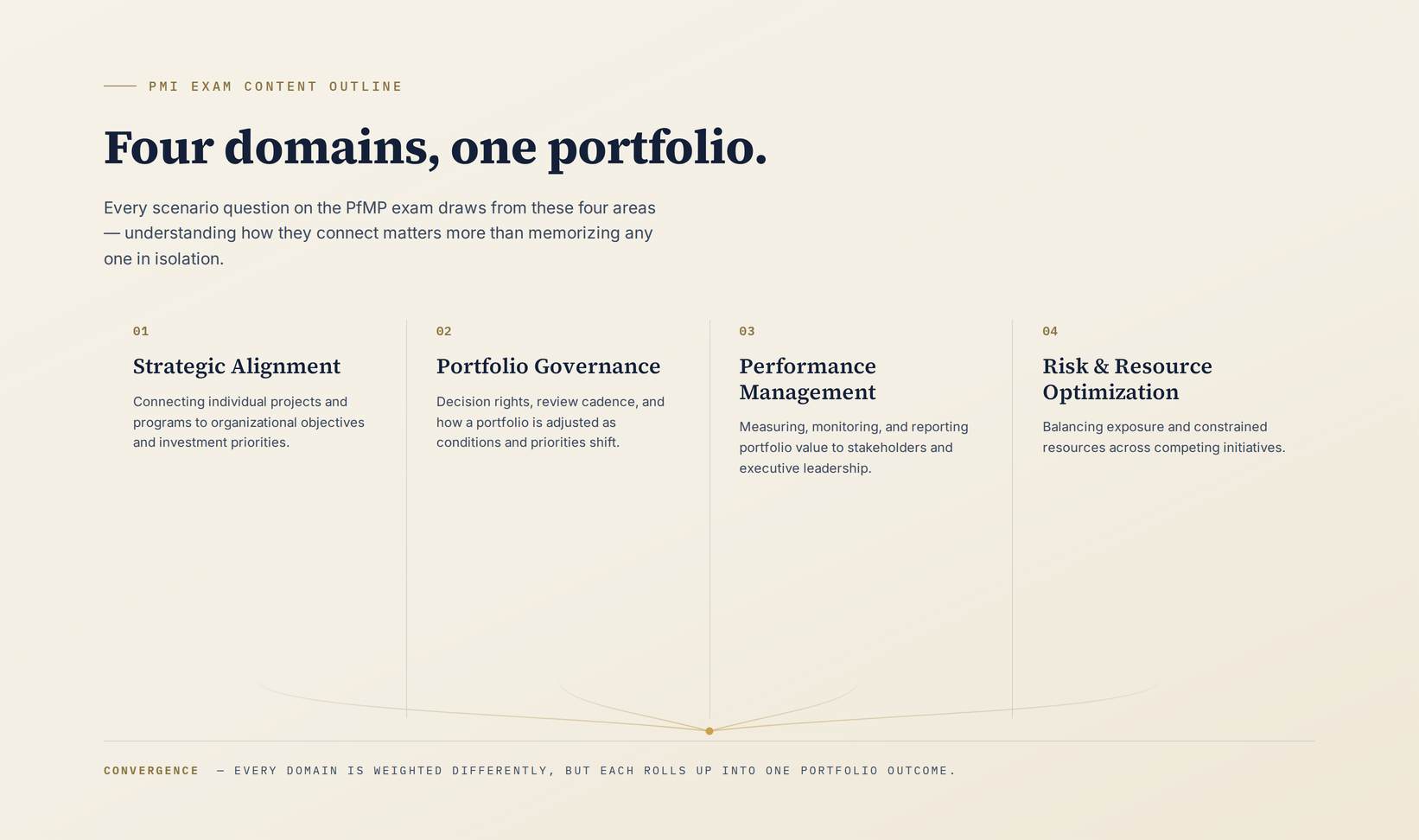
The multiple-choice exam is organized around the core domains of portfolio management, including strategic alignment, governance, performance management and risk and resource optimization. Each domain carries a different weight and understanding that weighting helps candidates decide where to spend the most study time.
Panel Review Process
PMI reviews each candidate's professional experience in portfolio management before granting exam eligibility. This step often catches candidates off guard, since it requires documented evidence of real portfolio decisions, not just project delivery experience. Reviewing the full PfMP certification requirements beforehand helps candidates confirm their experience actually qualifies before they invest time in the application.
Multiple-Choice Examination
Once eligibility is confirmed, candidates sit for a scenario-heavy, multiple-choice exam that tests applied judgment rather than memorized definitions.
Understanding the Exam Content Outline (ECO)
PMI's Exam Content Outline (ECO) is the closest thing to an official syllabus for the exam. It breaks down each domain, task and the knowledge or skill areas PMI expects candidates to demonstrate. Reviewing the ECO early, before selecting any other study material, gives candidates a map of exactly what they are responsible for knowing.
Create a Strategic PfMP Study Plan
A strong PfMP study plan looks different from a typical certification prep plan because it has to account for years of professional experience rather than just new information.
Evaluate Your Portfolio Management Experience
Before scheduling study time, candidates benefit from honestly mapping their own experience against each exam domain. Areas where real-world exposure is thin need more deliberate study; areas where daily work already overlaps with the domain need lighter review.
Build a Weekly Study Schedule
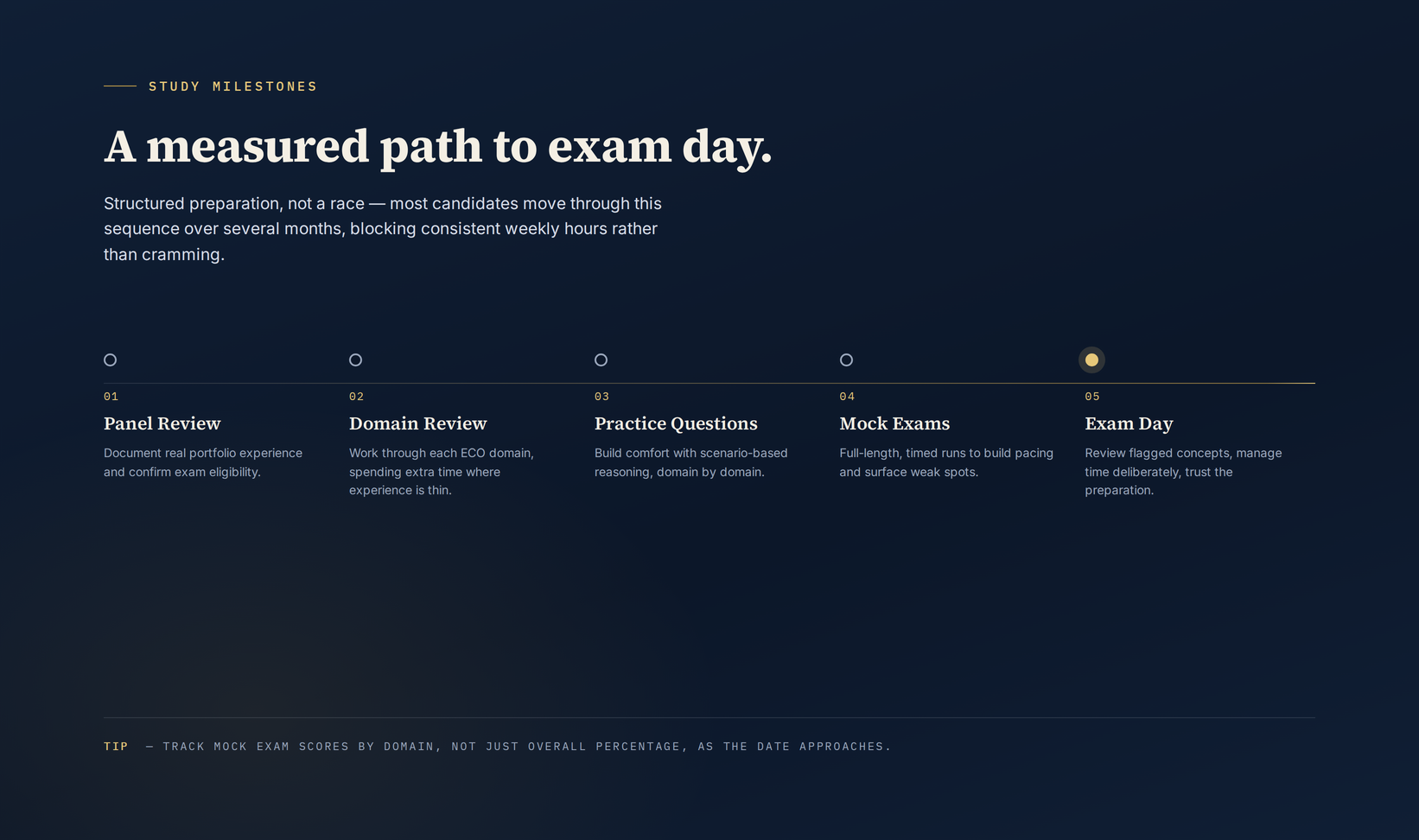
A realistic PfMP study plan usually spans several months rather than weeks given the seniority of the audience and the demands of full-time roles. Blocking consistent weekly hours, rather than cramming, tends to produce better retention of strategic concepts. Candidates who need more flexibility than a fixed class schedule allows sometimes prefer a self-study bundle that they can work through at their own pace.
Focus on Each Exam Domain
Rather than studying material in the order it appears in a textbook, candidates get more value from working through the exam domains one at a time, spending extra time on any domain identified as a weak spot during the self-assessment.
Set Learning Milestones
Breaking the study plan into milestones, such as completing a domain review, finishing a set of practice questions or sitting a mock exam, keeps preparation measurable instead of open-ended.
Monitor Your Progress
Tracking practice exam scores by domain, not just overall percentage, helps identify which areas still need attention as the exam date approaches.
Best Resources for PfMP Exam Preparation
Not all study material carries equal weight for the PfMP exam. Some resources are essential, while others are useful supplements.
PMI Exam Content Outline (ECO)
As mentioned earlier, the ECO should be the starting point for any PfMP study guide, since every other resource should be mapped back to it.
The Standard for Portfolio Management
PMI's foundational standard remains the primary reference for portfolio management concepts and terminology used throughout the exam.
PMBOK® Guide
While the PMBOK® Guide focuses more on project-level practices, it provides useful context for how portfolio decisions connect to program and project execution.
Practice Questions
Domain-specific practice questions help candidates get comfortable with the scenario-based style of PfMP questions, which often present a situation and ask what a portfolio manager should prioritize.
Full-Length Mock Exams
Timed full-length mock exams build the stamina and pacing needed for exam day and they reveal weak domains more reliably than isolated practice questions.
Instructor-Led Training
Structured PfMP live classes give candidates guided instruction, peer discussion and expert clarification on complex governance and strategic alignment topics that can be difficult to work through alone. Candidates who prefer individual pacing and direct access to an instructor sometimes choose one-on-one training instead of a group format. Many candidates also find PMI's free preparation sessions, such as this PfMP masterclass, useful for getting an initial feel for the exam before committing to a full course.
Professional Study Groups
Peer study groups made up of other senior practitioners allow candidates to compare real portfolio scenarios, which often mirrors the applied thinking the exam rewards.
Key Portfolio Management Topics to Master
Regardless of which resources a candidate uses, a handful of topics consistently show up across the exam domains.
Strategic Alignment
Understanding how individual projects and programs roll up into organizational strategy is central to nearly every domain of the exam.
Portfolio Governance
Candidates should be comfortable with governance structures, decision rights and how portfolios are reviewed and adjusted over time. This related read on PMO transformation and strategic value offers useful context on how governance connects to broader PMO maturity.
Portfolio Performance Management
This covers how portfolio value is measured, monitored and reported to stakeholders and leadership.
Risk and Resource Optimization
Balancing risk exposure against limited resources across multiple initiatives is a recurring theme in scenario-based questions.
Benefits Realization
The exam frequently tests whether candidates understand how to track and confirm that a portfolio is actually delivering the strategic benefits it was designed to achieve. This piece on moving from delivery to value for program, portfolio, and PMO leaders covers this shift in more depth.
Stakeholder Communication
Senior stakeholder management, including how to communicate trade-offs and portfolio changes, appears throughout the exam rather than in a single isolated domain.
Common Mistakes During PfMP Exam Preparation
Several patterns show up repeatedly among candidates who struggle with the exam:
- Studying without a structured plan, jumping between resources without a clear sequence
- Ignoring the Panel Review requirements until the last minute
- Memorizing definitions instead of understanding how portfolio management concepts apply in practice
- Taking too few mock exams to build real exam-day pacing
- Neglecting strategic thinking in favor of process-level detail, a gap explored further in this article on whether leaders are ready for a project-driven reality
- Underestimating how much the exam relies on scenario-based judgment rather than recall
Exam Day Tips for Success
- Review key concepts and domain weightings the day before, rather than trying to learn new material
- Read scenario-based questions carefully, since the best answer often depends on subtle details in the situation described
- Manage time deliberately across the exam rather than spending too long on early questions
- Stay focused and confident, treating unfamiliar questions as expected rather than alarming
- Review flagged questions before submitting, using any remaining time to double-check uncertain answers
Final Thoughts
PfMP exam preparation rewards structure as much as knowledge. Candidates who map their experience against the exam domains, build a realistic study plan and rely on PMI's official resources tend to walk into the exam far more prepared than those who study without a clear sequence. With a clear plan and consistent effort, the PfMP certification is well within reach for experienced portfolio management professionals ready to take the next step in their career.
Frequently Asked Questions (FAQ)
How long should I prepare for the PfMP exam?
Most candidates spend several months preparing, given the seniority of the material and the demands of a full-time role, though the right timeline depends on how closely a candidate's daily work already aligns with the exam domains.
What are the best study resources for PfMP?
PMI's Exam Content Outline and The Standard for Portfolio Management form the core, supported by practice questions, mock exams and structured instructor-led training where needed.
Is the PfMP exam difficult?
The exam is considered challenging because it tests applied judgment and strategic decision-making rather than straightforward recall, which can be difficult even for experienced professionals who have not prepared specifically for this style of question.
How important are mock exams?
Full-length mock exams are one of the most reliable ways to identify weak domains and build the pacing needed to complete the real exam comfortably.
Can I pass the PfMP exam on my first attempt?
Many candidates do, particularly when they combine relevant portfolio experience with a structured PfMP study guide and enough practice questions to become comfortable with scenario-based reasoning.