PgMP Exam Preparation
Introduction
Earning the Program Management Professional (PgMP) credential is one of the most respected achievements a senior program leader can pursue. Unlike project-level certifications, the PgMP validates the ability to manage multiple, interrelated projects in alignment with an organization's broader strategy. As more companies restructure around program-based delivery models, professionals who can demonstrate this capability are being placed ahead of their peers for promotions and leadership roles.
Passing the PgMP exam, however, is not something that happens by chance. It requires a deliberate, well-structured preparation strategy built around PMI's official standards, real program scenarios, and consistent practice. This guide walks through what the PgMP certification involves, how to build an effective study plan, which resources actually matter and the mistakes that most commonly derail candidates before exam day.
What Is the PgMP Certification?
Overview of the PgMP Credential
The PgMP is a certification offered by the Project Management Institute (PMI) that recognizes professionals who manage complex programs consisting of multiple, coordinated projects. Rather than focusing on individual project tasks, the exam tests a candidate's ability to align programs with organizational strategy, manage cross-functional stakeholders and deliver measurable business benefits over time. Professionals who have already gone through PMP exam preparation will recognize some of the same discipline here, though at a broader, more strategic scale.
Who Should Pursue the PgMP Certification?
The credential is best suited for professionals already operating or preparing to operate, at a strategic level, including those who have already built a foundation through PMP certification:
- Program Managers
- Senior Project Managers
- PMO Directors
- Portfolio Managers
- Business Transformation Leaders
- Executives overseeing multiple strategic initiatives
Benefits of Becoming PgMP Certified
Beyond the professional recognition, PgMP-certified individuals often report stronger positioning during promotion cycles, higher earning potential and greater credibility when engaging with senior stakeholders and boards. It signals that a professional can be trusted with initiatives that carry significant organizational risk and reward and it often opens the door to broader career advisory conversations around executive-level roles.
Understand the PgMP Certification Process
Eligibility Requirements
PMI requires candidates to hold a secondary degree along with several years of project and program management experience or a four-year degree with a shorter but still substantial experience requirement. Because these thresholds are reviewed periodically, it's worth confirming current figures directly on PMI's website before applying.
Application and Panel Review
Unlike some certifications with a straightforward application, the PgMP process includes a panel review stage, where PMI evaluates a candidate's documented program experience before granting exam eligibility. This step is often underestimated, yet it can take considerable time if experience isn't documented clearly from the start.
Multiple-Choice Examination
Once eligibility is confirmed, candidates sit for a scenario-heavy, multiple-choice exam designed to test applied judgment rather than memorized definitions. For candidates who want a closer look at how structured programs are typically delivered before diving into exam prep, our earlier guide on PgMP training courses is a useful starting point.
Exam Domains
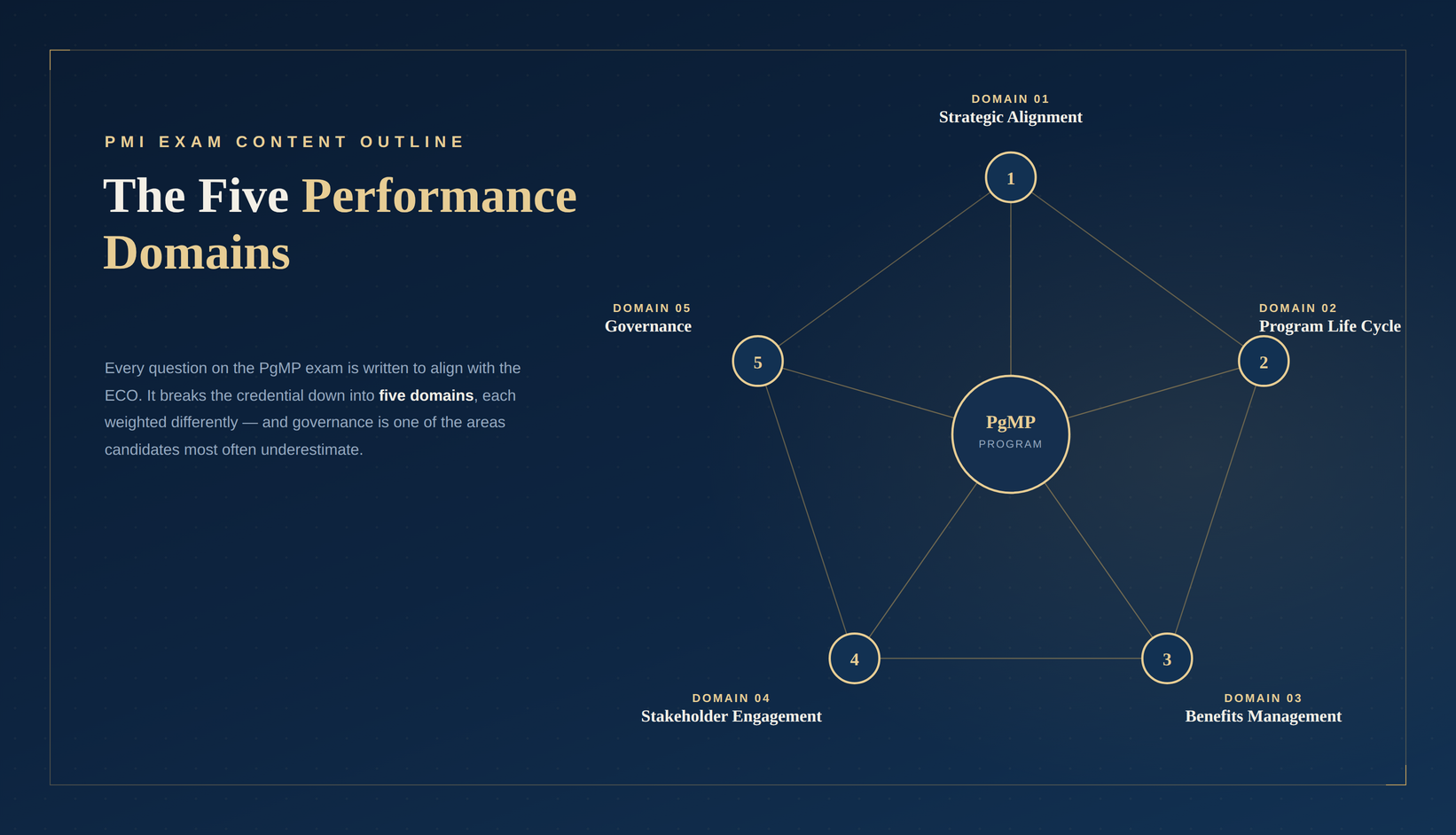
The exam is structured around five performance domains: strategic program management, program life cycle, benefits management, stakeholder engagement and governance.
Understanding the PMI Exam Content Outline (ECO)
The PMI Exam Content Outline breaks each domain down into specific tasks and enablers. Reviewing the ECO early gives candidates a map of exactly what PMI expects them to know, which makes it far easier to prioritize study time.
Create an Effective PgMP Study Plan
Assess Your Current Program Management Knowledge
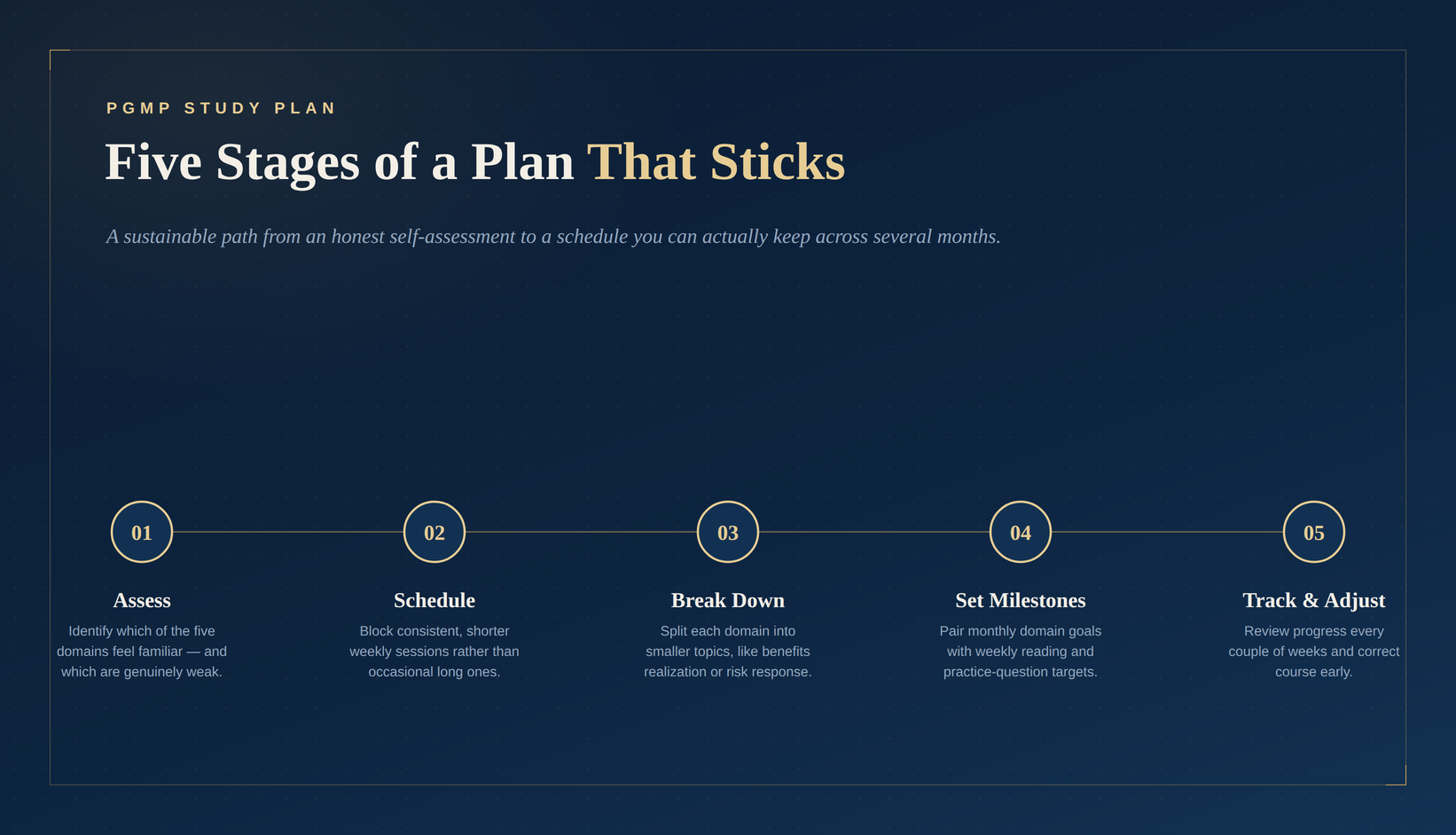
Before building a schedule, it helps to honestly evaluate which domains feel familiar and which feel weak. Many candidates come from strong project backgrounds but have limited exposure to formal benefits management or governance structures, so identifying these gaps early prevents wasted study time later.
Build a Realistic Weekly Study Schedule
A sustainable plan usually spans several months rather than a few intense weeks. Blocking out consistent, shorter study sessions across the week tends to produce better retention than occasional long sessions squeezed in around a demanding job.
Break the Exam Domains into Manageable Topics
Rather than studying the five domains as broad categories, it's more effective to divide each one into smaller topics, such as stakeholder identification, benefits realization planning or program risk response strategies, and tackle them individually.
Set Monthly and Weekly Milestones
Milestones keep preparation on track. A monthly goal might be complete governance and benefits management domains, while weekly goals could focus on specific readings, practice questions or case study reviews.
Track Progress and Adjust Your Plan
Preparation rarely goes exactly as planned. Reviewing progress every couple of weeks and adjusting the schedule where needed keeps candidates from falling behind without realizing it.
Best Resources for PgMP Exam Preparation
PMI Exam Content Outline (ECO)
This remains the single most important reference point, since every exam question is written to align with it.
The Standard for Program Management
PMI's official standard is the foundation for understanding how programs should be structured, governed, and delivered.
PMBOK® Guide
While the PgMP exam focuses on programs rather than individual projects, a working knowledge of the PMBOK® Guide helps candidates understand how project-level work rolls up into program outcomes.
Program Management Case Studies
Real-world case studies help translate theory into applied judgment, which is exactly what the exam tests.
Practice Questions and Mock Exams
Scenario-based practice questions are arguably the most valuable preparation tool, since they train candidates to think the way PMI expects rather than simply recall facts.
Instructor-Led Training
Structured, live PgMP training classes give candidates access to experienced instructors who can clarify complex governance and benefits management concepts, work through realistic program scenarios and keep preparation on a defined timeline. For many candidates balancing full-time roles, this structure is what keeps preparation from stalling, and those who need more individual attention on specific domains can opt for one-on-one training instead.
Study Groups and Professional Communities
Peer discussion often surfaces perspectives and real program examples that self-study alone cannot provide. Candidates who prefer to prepare independently before joining a group can also work through a structured self-study bundle to build a foundation first.
Key Program Management Topics to Master
Program Strategy Alignment
Every program decision should trace back to organizational strategy and the exam frequently tests whether candidates can identify when a program is drifting from its intended strategic purpose.
Benefits Management
Programs exist to deliver measurable benefits, not just outputs. Candidates should be comfortable with benefits identification, planning, realization and sustainment.
Stakeholder Engagement
Programs typically involve a wider and more complex stakeholder group than individual projects, so understanding engagement strategies at an executive level is essential.
Governance and Oversight
Governance structures determine how decisions are made, escalated and reviewed throughout the program life cycle, and this is one of the more heavily weighted areas of the exam. Candidates coming from a PMO background often find this domain easier to relate to, since it mirrors the oversight and reporting discipline used in PMO delivery functions.
Risk and Issue Management
Program-level risk differs from project-level risk in scale and interdependency and candidates need to understand how risks cascade across multiple projects within a program.
Program Lifecycle and Performance Management
Understanding how programs move through definition, delivery and closure, while continuously measuring performance against benefits, ties every other domain together.
Common Mistakes During PgMP Exam Preparation
- Studying without a structured plan
- Ignoring the Panel Review process until the last minute
- Focusing only on project management concepts instead of program-level thinking
- Memorizing definitions instead of understanding program management scenarios
- Taking too few mock exams before the actual test
- Neglecting governance and benefits management topics, which are frequently underweighted by self-study candidates
Avoiding these pitfalls often makes the difference between a first-attempt pass and a frustrating retake.
Exam Day Tips for Success
- Review key program management concepts the night before rather than cramming new material
- Read scenario-based questions carefully, since PMI often embeds subtle details that change the correct answer
- Manage exam time effectively by pacing through sections rather than lingering too long on any single question
- Stay calm and avoid rushing difficult questions
- Review flagged questions before final submission, but avoid second-guessing answers without clear justification
Final Thoughts
Passing the PgMP exam comes down to more than reading through PMI's standards once and hoping the material sticks. It requires a structured preparation strategy, a genuine understanding of strategic program management concepts and consistent practice with scenario-based questions. Candidates who treat memorization as the goal tend to struggle, while those who focus on applied judgment, governance thinking, and benefits realization generally find themselves better prepared on exam day.
Ultimately, the PgMP should be approached as a long-term investment in executive-level leadership capability, not just another certification to add to a resume. With the right combination of official PMI resources, mock exams and practical program experience, professionals can walk into the exam room with genuine confidence rather than guesswork.
Frequently Asked Questions (FAQ)
How long should I prepare for the PgMP exam?
Most candidates spend three to six months preparing, depending on their existing program management experience and how much time they can dedicate each week.
What are the best PgMP study resources?
The PMI Exam Content Outline, The Standard for Program Management, case studies and structured mock exams are generally considered the core resources, often supplemented by instructor-led training.
Is the PgMP exam more difficult than PMP?
Many professionals find the PgMP more demanding because it requires strategic, scenario-based judgment rather than the more procedural knowledge tested on the PMP exam.
How important are mock exams for PgMP preparation?
Mock exams are essential, since they build the scenario-based thinking PMI actually tests and help identify weak domains before the real exam.
Can I pass the PgMP exam on my first attempt?
Yes, many candidates do, particularly when they combine a structured study plan with consistent mock exam practice and a clear understanding of the exam domains.