PMI-ACP Study Plan & Exam Prep Checklist
Introduction
If you're staring at the PMI Agile Certified Practitioner exam content outline wondering where to even start, you're not alone. The PMI-ACP pulls from Scrum, Kanban, Lean and XP simultaneously and most candidates lose weeks just figuring out how to structure their study time before they open a single practice question. This page is built to solve that specific problem: a week-by-week study plan, a breakdown of every exam domain, a resource checklist,and the mock-exam strategy that actually moves the needle. It's not a sales pitch it's the plan itself. If at any point you decide you'd rather have an instructor walk you through the harder domains live, PMI-ACP live classes are there, but everything below works whether you study solo or not.
PMI-ACP Exam Basics
Overview of the PMI-ACP Credential
The PMI-ACP is issued by the Project Management Institute and validates a professional's working knowledge of Agile principles across several methodologies, including Scrum, Kanban, Lean and Extreme Programming (XP), rather than a single framework. Unlike certifications that focus narrowly on one Agile approach, PMI-ACP is designed to test how well a candidate can apply Agile thinking in real project situations, which is part of why many hiring managers treat it as a broader signal of Agile competence. Candidates who are still confirming whether they meet the check your eligibility first should settle that question before building a study timeline, since eligibility affects how much lead time is realistic.
Who Should Pursue the PMI-ACP Certification?
This credential tends to suit professionals already working in or around Agile environments, including:
- Agile project managers
- Scrum Masters
- Product Owners
- Agile Coaches
- Traditional project managers transitioning to Agile
- Software development professionals
- Business analysts working on Agile teams
Benefits of Becoming PMI-ACP Certified
Beyond the credential itself, certified professionals often report stronger credibility in Agile transformation conversations, improved ability to move between frameworks depending on project needs and better positioning for senior delivery roles. Because it isn't tied to one methodology, it also tends to age well as organizations mix and match Agile practices.
Understand the PMI-ACP Exam Before You Start Preparing
PMI-ACP Exam Format
The exam consists of multiple-choice questions delivered in a fixed time window, combining scenario-based questions with more direct knowledge checks. Because many questions describe a situation rather than ask for a definition, memorization alone rarely carries a candidate through.
Exam Domains
PMI organizes the exam content around domains such as Agile principles and mindset, value-driven delivery, stakeholder engagement, team performance, adaptive planning, problem detection and resolution and continuous improvement. Each domain carries a different weight, which should directly influence how study time is allocated.
Types of Questions
Expect a mix of situational judgment questions, terminology-based questions and calculation-style questions tied to Agile metrics like velocity or burn charts. Situational questions are typically the most time-consuming, so practicing them specifically matters more than drilling flashcards. Candidates who have already researched the how the exam content maps to a course syllabus usually have an easier time recognizing how these question types map back to the syllabus.
Understanding the PMI Exam Content Outline (ECO)
The Exam Content Outline is PMI's official breakdown of every domain and task the exam is built from. Treating it as a checklist, rather than a general guideline, helps candidates avoid spending disproportionate time on topics that carry less weight.
Time Management During the Exam
With a fixed number of questions in a fixed time block, most candidates have a little over a minute per question on average. Practicing under timed conditions well before exam day helps prevent the common mistake of running out of time on the final third of the test.
Create an Effective PMI-ACP Study Plan
Assess Your Agile Knowledge
Before building a schedule, it helps to take an honest inventory of which frameworks are already familiar and which are not. Someone with years of Scrum experience but no exposure to Kanban or Lean will need a very different plan than someone starting from scratch.
Create a Weekly Study Schedule
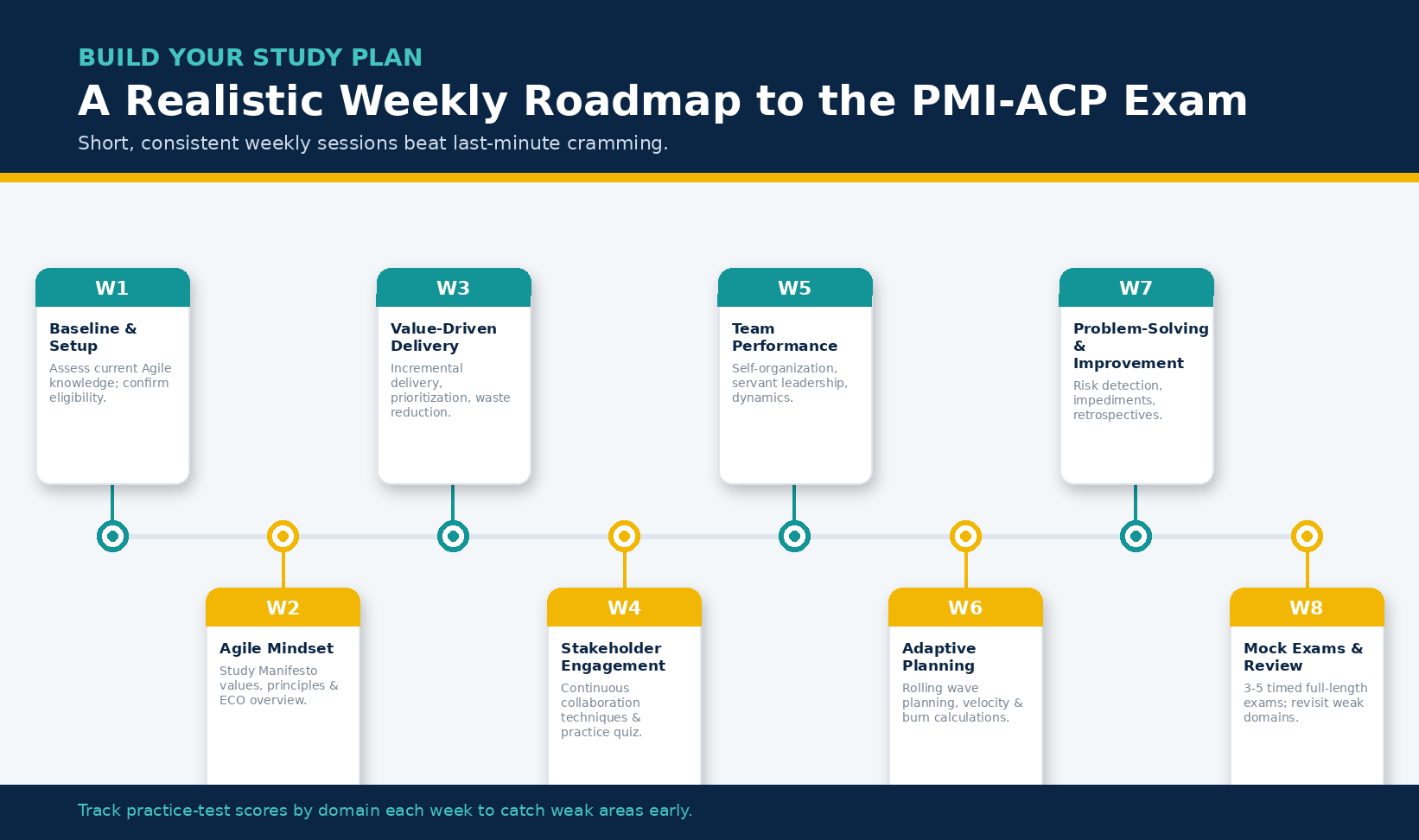
A realistic PMI-ACP study plan usually spans six to ten weeks for working professionals, broken into consistent weekly blocks rather than occasional long sessions. Short, regular sessions tend to retain better than cramming. Professionals with limited time often find it easier to stay consistent inside structured PMI-ACP live classes, where the weekly schedule and accountability are already built in rather than self-managed.
Divide the Exam Domains into Study Sessions
Rather than studying Agile as one broad subject, mapping each week to a specific domain from the ECO keeps progress measurable and prevents any single area from being neglected.
Set Weekly Learning Goals
Concrete, weekly targets, such as completing a domain's readings and a related quiz, keep the plan accountable instead of open-ended.
Monitor Your Progress
Tracking practice test scores by domain, not just an overall percentage, makes it much easier to see which areas genuinely need more attention as the exam date approaches. Professionals who prefer expert feedback throughout this process often benefit from 1:1 mentoring , which allows a mentor to review progress and adjust the plan directly rather than guessing at weak spots alone.
PMI-ACP Study Guide: Free Downloadable Checklist
Key Agile Topics You Must Master
Agile Principles and Mindset
Every domain on the exam ultimately traces back to the Agile Manifesto's values and principles, making this the foundation rather than a standalone topic.
Value-Driven Delivery
This covers prioritizing work by business value, incremental delivery and minimizing waste, all of which show up repeatedly in scenario questions.
Stakeholder Engagement
Candidates should understand how Agile teams maintain continuous stakeholder collaboration rather than relying on periodic status reporting.
Team Performance
Topics here include self-organizing teams, servant leadership and building high-performing team dynamics.
Adaptive Planning
Rolling wave planning, progressive elaboration and iteration-based planning fall under this domain and are commonly tested through calculation-style questions.
Problem Detection and Resolution
This focuses on identifying risks and impediments early and resolving them through Agile-specific techniques rather than traditional risk registers alone.
Continuous Improvement (Kaizen)
Retrospectives and incremental process improvement round out the domain list and often connect back to real-world scenario questions on the exam.
Common Mistakes During PMI-ACP Exam Preparation
- Studying without a structured plan, which leads to uneven domain coverage
- Memorizing Agile terminology instead of understanding how it applies in context
- Ignoring the Agile mindset in favor of purely technical details
- Taking too few mock exams before the actual test date
- Focusing on only one Agile framework, such as Scrum, while neglecting Kanban, Lean or XP
- Neglecting weak knowledge areas identified early in the study plan
Exam Day Tips for Success
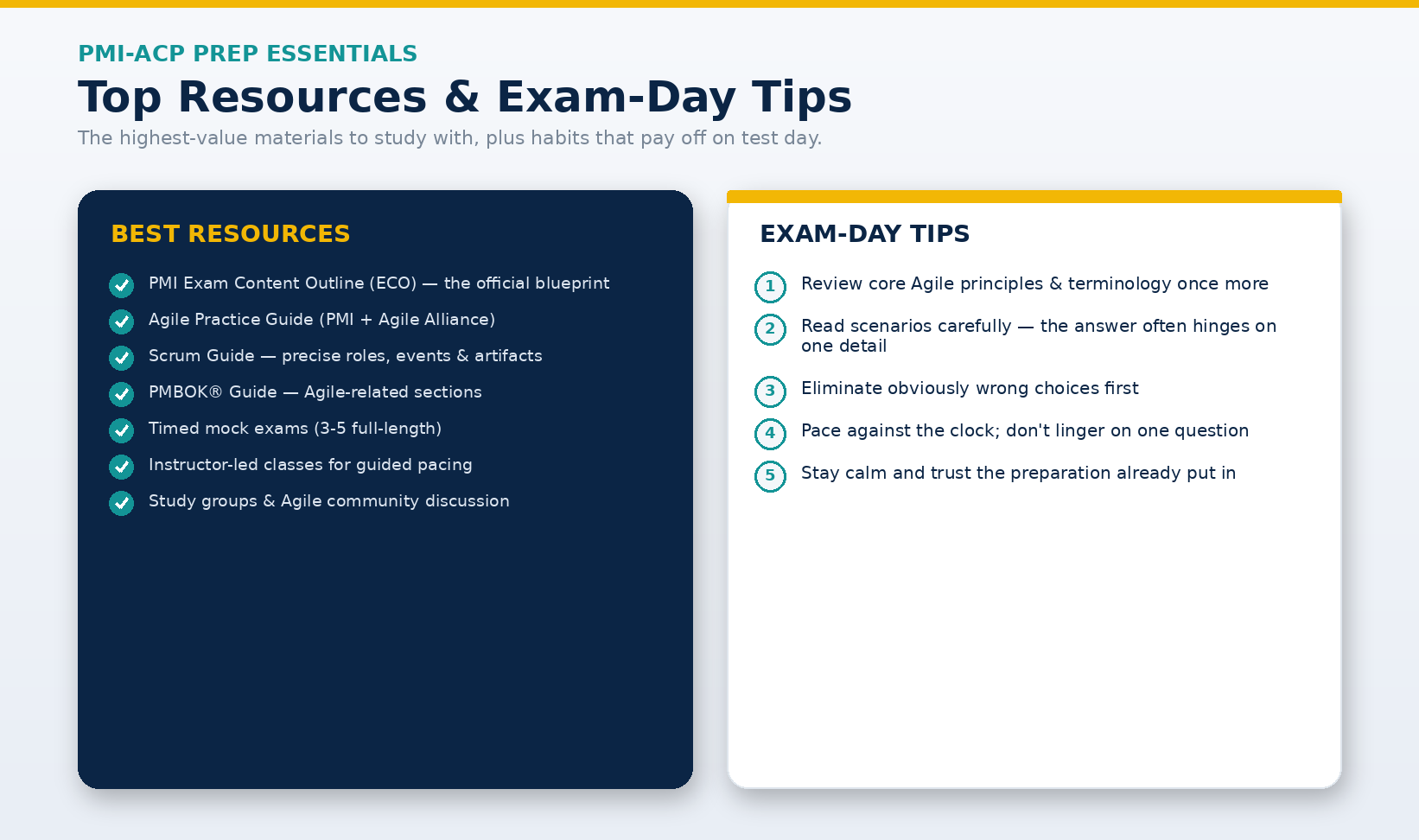
- Review Agile principles and core terminology one final time before the exam
- Read scenario-based questions carefully, since the correct answer often depends on a specific detail in the situation
- Eliminate obviously incorrect answers first to narrow down choices systematically
- Manage exam time by pacing against the clock rather than lingering on any single question
- Stay calm and confident, trusting the preparation already put in.
Final Thoughts
Passing the PMI-ACP exam comes down to consistent, structured preparation rather than last-minute cramming. Candidates who map their study plan to the official Exam Content Outline, practice with scenario-based mock exams and genuinely understand the Agile mindset behind each domain tend to perform far better than those who memorize terminology in isolation. Practical application should always take priority over rote learning, since the exam is built to test judgment, not recall. With the right resources, a realistic weekly schedule and a willingness to revisit weak areas honestly, most professionals can approach exam day with genuine confidence rather than guesswork.
Frequently Asked Questions (FAQ)
How long should I prepare for the PMI-ACP exam?
Most working professionals need six to ten weeks of consistent study, though this varies based on existing Agile experience and how many frameworks are already familiar.
What are the best PMI-ACP study resources?
The PMI Exam Content Outline, the Agile Practice Guide, the Scrum Guide and timed mock exams together cover the majority of what the test requires.
Is the PMI-ACP exam difficult?
It is considered moderately challenging, primarily because it spans multiple Agile frameworks rather than testing one in depth, which requires broader preparation than a single-methodology exam.
How many mock exams should I complete?
A general benchmark is three to five full-length timed mock exams, spaced out so results can inform adjustments to the remaining study plan.
Can I pass the PMI-ACP exam on my first attempt?
Yes, many candidates do, particularly when they follow a structured plan, cover every domain in the Exam Content Outline and consistently practice scenario-based questions rather than relying on memorization.
How hard is the PMI-ACP exam compared to other PMI certifications?
Most candidates rate it moderately difficult harder than a single-framework Agile certificate because it spans Scrum, Kanban, Lean and XP together, but generally considered less demanding than the PMP given the shorter experience requirements.
What's the best free PMI-ACP study material to start with?
The official PMI Exam Content Outline and the Agile Practice Guide are both free starting points before investing in paid mock exams or courses.
How many hours per week should I study for the PMI-ACP?
Most working professionals studying 5–7 hours per week complete adequate preparation in six to ten weeks, per the schedule outlined above.