PMI-PBA Exam Preparation
Introduction
Earning the PMI Professional in Business Analysis (PMI-PBA) certification is one of the most reliable ways for business analysts and project professionals to prove their expertise in eliciting requirements, engaging stakeholders, and delivering measurable business value. But the certification is only as valuable as the preparation behind it. Many candidates underestimate how structured the PMI-PBA exam actually is, and that gap in preparation is often what stands between a first-attempt pass and a frustrating retake.
As organizations lean more heavily on data-driven decision-making and cross-functional collaboration, the demand for certified business analysts continues to climb and many professionals also lean on career advisory support to figure out where a credential like this fits into their broader growth plan. This guide walks through what the PMI-PBA exam actually tests, how to build a realistic study plan, which resources are worth the time and the mistakes that trip up even experienced professionals.
What Is the PMI-PBA Certification?
Overview of PMI-PBA
The PMI-PBA is a globally recognized credential from the Project Management Institute that validates a professional's ability to manage the business analysis process, from needs assessment through solution evaluation. Unlike certifications that focus purely on project execution, PMI-PBA is built around the analytical and stakeholder-facing work that shapes what a project should actually deliver.
Who Should Earn the PMI-PBA Certification?
This credential is a strong fit for:
- Business Analysts looking to formalize their skill set
- Project Managers who regularly handle requirements work, including those who already hold or are pursuing PMP certification
- Product Managers responsible for defining scope and value
- Requirements Engineers in technical or regulated industries
- Consultants advising clients on process and solution design
- PMO Professionals overseeing analysis standards across projects
Benefits of PMI-PBA Certification
Beyond the professional recognition, certified business analysts often report better alignment with stakeholders, fewer scope-related conflicts, and stronger positioning for senior analyst or hybrid PM-BA roles. It also signals to employers that a candidate understands how to translate business needs into deliverable solutions, a skill gap many organizations, including those investing in structured PMO delivery, are actively trying to close.
Understand the PMI-PBA Exam Before You Start Preparing
Exam Format
The PMI-PBA exam is a computer-based, closed-book test made up of scenario-driven questions rather than simple recall items. Most questions ask candidates to apply business analysis judgment to a described project situation, which is why understanding concepts matters far more than memorizing terminology.
Exam Domains
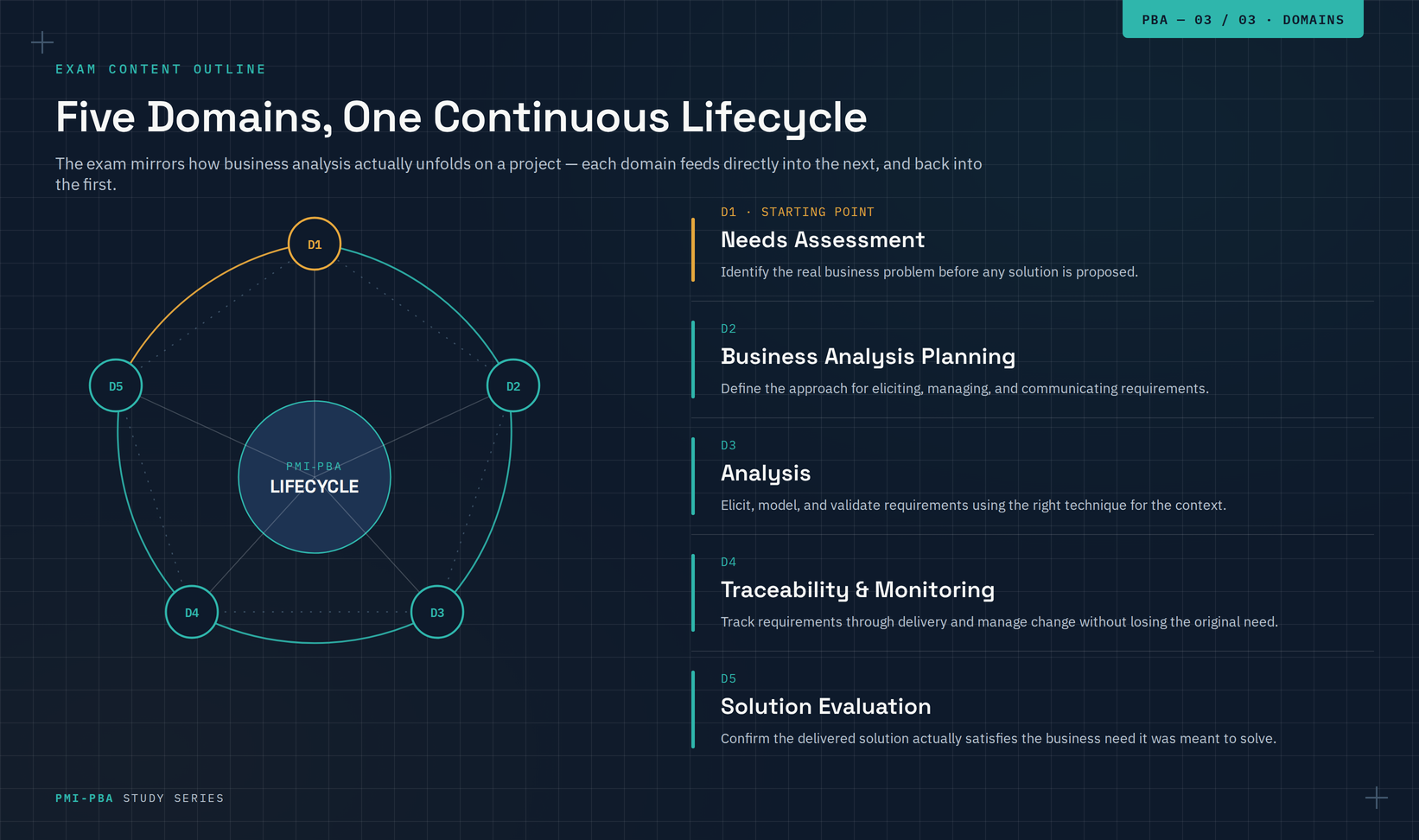
The exam is organized around the core phases of the business analysis lifecycle: needs assessment, planning, analysis, traceability and monitoring and solution evaluation. Each domain carries a different weight and candidates should study accordingly rather than spending equal time everywhere.
Question Types
Expect a mix of single-answer multiple choice and situational questions that test how well a candidate can apply a concept, not just define it.
Exam Duration
Candidates are given a set block of time to complete the full exam, which makes time management during practice sessions just as important as content knowledge.
Understanding the PMI Exam Content Outline (ECO)
The official PMI Exam Content Outline is the single most authoritative source for what the exam will actually cover. Every task statement, enabler and domain weighting listed in the ECO should directly shape a candidate's study plan. Skipping this document is one of the most common reasons candidates feel blindsided on exam day. It's also worth reviewing the PMI-PBA certification requirements beforehand, since eligibility criteria directly affect when a candidate should schedule the exam.
Create a Winning PMI-PBA Study Plan
Assess Your Current Knowledge
Before opening a single textbook, it helps to take a diagnostic practice test. This shows which domains already feel comfortable and which ones need more structured attention, rather than guessing where to start.
Build a Weekly Study Schedule
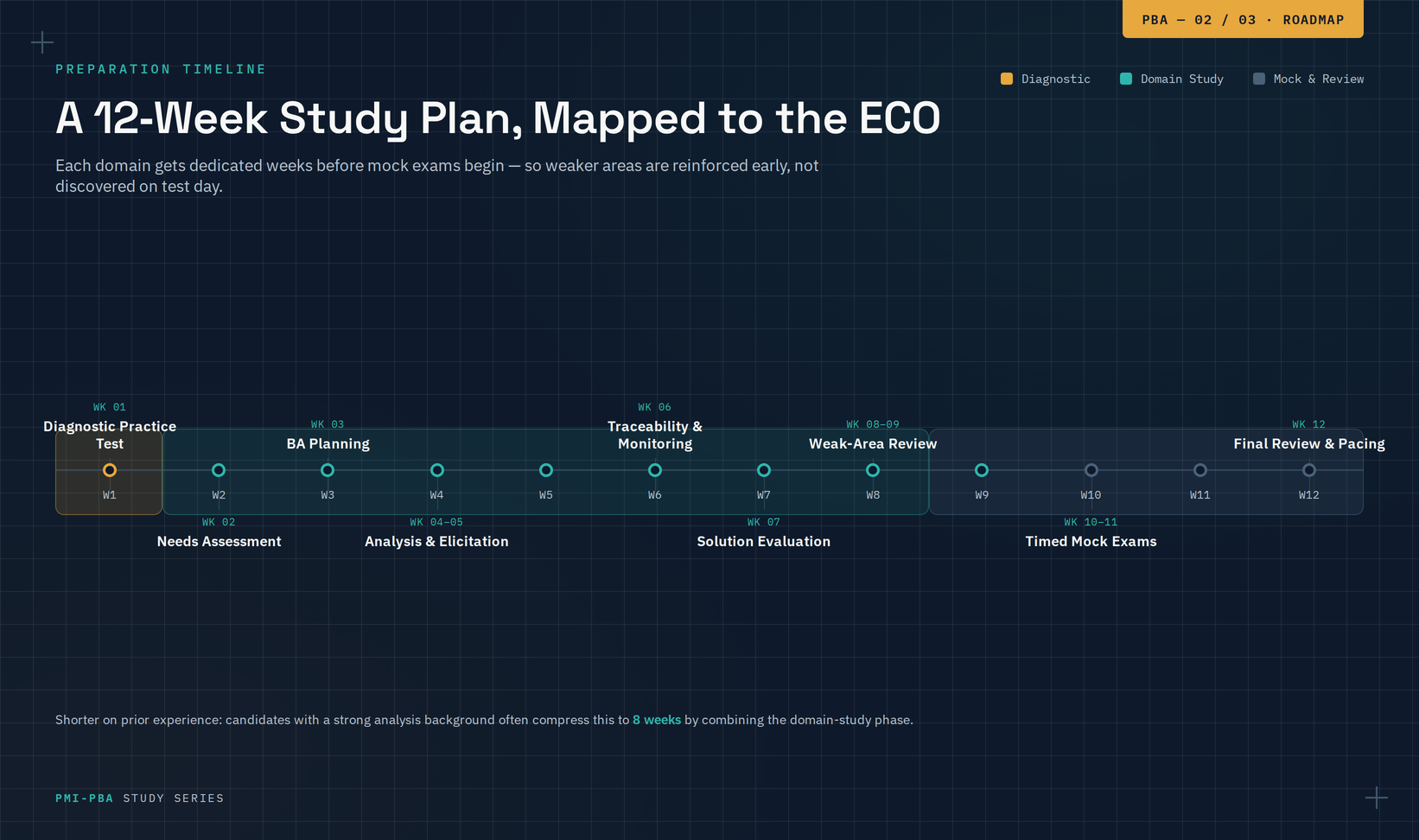
A realistic PMI-PBA study plan usually spans eight to twelve weeks, depending on prior experience. Blocking out consistent weekly study windows, rather than cramming in short bursts, tends to produce far better retention.
Break Down the Exam Domains
Rather than studying topics in isolation, candidates get more value from working through each domain the way it appears in the ECO, connecting needs assessment to planning and planning to solution evaluation, so the concepts build on each other logically.
Set Weekly Milestones
Assigning a specific domain or set of tasks to each week keeps preparation on track and prevents the common trap of over-studying familiar material while neglecting weaker areas.
Track Your Study Progress
Keeping a simple log of practice scores by domain makes it easy to spot patterns. If traceability and monitoring questions consistently score lower, that becomes the next week's focus. For candidates who prefer expert guidance rather than building a plan from scratch, joining a structured PMI-PBA live class can help keep preparation paced and accountable from week one.
Best Resources for PMI-PBA Exam Preparation
PMI Exam Content Outline (ECO)
As mentioned earlier, this is the foundation of every study plan and should be reviewed more than once throughout preparation, not just at the start.
PMBOK® Guide
While the PMI-PBA exam is not built directly around the PMBOK® Guide, it provides useful context on how business analysis work fits into the broader project lifecycle.
PMI Guide to Business Analysis
This is the closest thing to an official reference text for the exam and should be treated as required reading rather than optional background.
Practice Questions
Working through PMI-PBA practice questions regularly, rather than only in the final weeks, helps build the pattern recognition needed for scenario-based items. Candidates who prefer to work at their own pace can also look into a self-study bundle that packages practice material and reference content together.
Mock Exams
Full-length mock exams, taken under timed conditions, are one of the most reliable predictors of readiness. They also help candidates get comfortable with pacing before the real exam.
Instructor-Led Training
Self-study works for some candidates, but many find that guided instruction shortens the learning curve considerably. An instructor-led PMI-PBA training program can walk through each domain with real-world examples, which is often harder to replicate through independent reading alone.
Study Groups and Professional Communities
Discussing scenario questions with peers, whether in a live class or an online community, often surfaces interpretations a solo learner might miss. Candidates who want more individual attention than a group setting allows can also consider one-on-one training, which adapts the pace to their specific gaps.
Key Topics You Must Master
Needs Assessment
Understanding how to identify the business problem before jumping to solutions is foundational to nearly every other exam domain.
Stakeholder Engagement
Candidates should be comfortable identifying stakeholder groups, managing competing priorities and adjusting communication approaches based on stakeholder influence.
Requirements Elicitation
This covers the techniques used to gather requirements, from interviews and workshops to document analysis, and knowing when each technique fits best.
Traceability and Monitoring
This domain tests whether a candidate can track requirements through the project lifecycle and manage changes without losing sight of original business needs.
Solution Evaluation
Confirming that a delivered solution actually meets the intended business need is a frequently underestimated exam area worth extra review time.
Business Analysis Planning
This ties everything together, covering how a business analyst plans the overall approach for a given project or initiative. Organizations preparing multiple team members for this exam often find it more efficient to run this through dedicated corporate training rather than leaving preparation entirely to individual employees.
Common Mistakes During PMI-PBA Exam Preparation
- Studying without a structured plan and hoping general reading will be enough
- Ignoring the Exam Content Outline in favor of unofficial study guides
- Memorizing definitions instead of understanding how concepts apply in context
- Taking too few full-length mock exams before test day
- Skipping weaker knowledge areas because they feel less interesting
- Poor time management during both study sessions and the actual exam
Exam Day Tips for Success
- Confirm the testing environment and required identification well in advance
- Pace time across domains rather than rushing early questions
- Read scenario-based questions slowly, since key details often change the correct answer
- Stay calm during unfamiliar questions rather than letting them affect focus on later items
- Flag uncertain questions and review them if time allows before final submission.
Final Thoughts
Passing the PMI-PBA exam comes down to preparation that is structured, consistent, and grounded in the official Exam Content Outline rather than guesswork. Candidates who build a realistic study schedule, focus on weaker domains and take enough full-length mock exams tend to walk into test day with far more confidence than those who study passively.
There is no substitute for consistent, concept-based practice. Combining self-study with quality resources and reviewing mock exam results honestly, gives every candidate a real path to certification success. With the right approach, the PMI-PBA credential is well within reach for professionals ready to prepare strategically.
Frequently Asked Questions (FAQ)
How long should I prepare for the PMI-PBA exam?
Most candidates spend eight to twelve weeks preparing, depending on how familiar they already are with business analysis concepts and how much time they can commit each week.
What are the best PMI-PBA study resources?
The PMI Exam Content Outline, the PMI Guide to Business Analysis, practice questions and timed mock exams together form the most reliable preparation foundation.
Is the PMI-PBA exam difficult?
The exam is considered moderately challenging, mainly because it tests applied judgment through scenario-based questions rather than simple recall.
How many practice exams should I take?
Completing at least two to three full-length, timed mock exams before test day gives a realistic sense of pacing and readiness across all domains.
Can I pass the PMI-PBA exam on my first attempt?
Yes, many candidates pass on their first attempt when they follow a structured plan built around the Exam Content Outline and combine it with consistent practice testing.