PMP Exam Changes 2026
Introduction
Every few years, the Project Management Institute revisits the PMP exam to make sure it still reflects how project managers actually work. 2026 is one of those years. With the PMBOK® Guide now in its Eighth Edition and a revised Exam Content Outline (ECO) shaping the test, candidates preparing for certification are asking a fair question: what exactly has changed and does it affect them?
This matters because PMI doesn't update the exam just to make things harder. Each revision is meant to keep the credential aligned with real employer expectations, evolving delivery approaches and the tools project managers use every day. For anyone currently studying or planning to book their exam soon, understanding these updates is the difference between studying the right material and wasting weeks on content that's no longer emphasized. This article breaks down what has actually changed, what it means for preparation, and how candidates can adjust their study plan with confidence.
Why Does PMI Update the PMP Exam?
PMI doesn't change the PMP exam on a whim. Updates are driven by ongoing research into how project management is practiced across industries and they typically follow a new edition of the PMBOK® Guide or a refreshed Exam Content Outline.
Keeping Pace with Industry Trends
Project management doesn't look the same as it did a decade ago. Data-driven decision making, remote and distributed teams and AI-assisted planning have all become part of daily practice, and the exam periodically catches up to reflect that.
Aligning with Modern Project Management Practices
The shift from a purely process-heavy approach to one built around principles and value delivery, introduced in earlier PMBOK editions, continues to shape how questions are framed. The goal is to test judgment, not memorization, which is also why PMI's broader PMP certification requirements keep evolving alongside the exam itself.
Reflecting Employer Expectations
Hiring organizations increasingly expect certified professionals to demonstrate leadership, stakeholder management and adaptability, not just technical scheduling knowledge. Exam updates are PMI's way of keeping the credential credible in the eyes of employers.
Supporting Agile, Hybrid and Predictive Approaches
Very few organizations run projects using a single methodology anymore. The exam continues to test across predictive, agile and hybrid environments, since that mirrors what most PMP holders encounter on the job.
PMP Exam Changes 2026: What Candidates Should Know
The most significant update this year centers on the PMBOK® Guide Eighth Edition, which PMI released in phases starting in late 2025, with the print edition following in January 2026. The updated PMP exam tied to this edition launched on July 9, 2026. It's worth being precise here: PMI has officially confirmed this rollout, so this is not speculation, and candidates should treat the date as fact rather than rumor.
Updated Exam Content Outline (ECO)
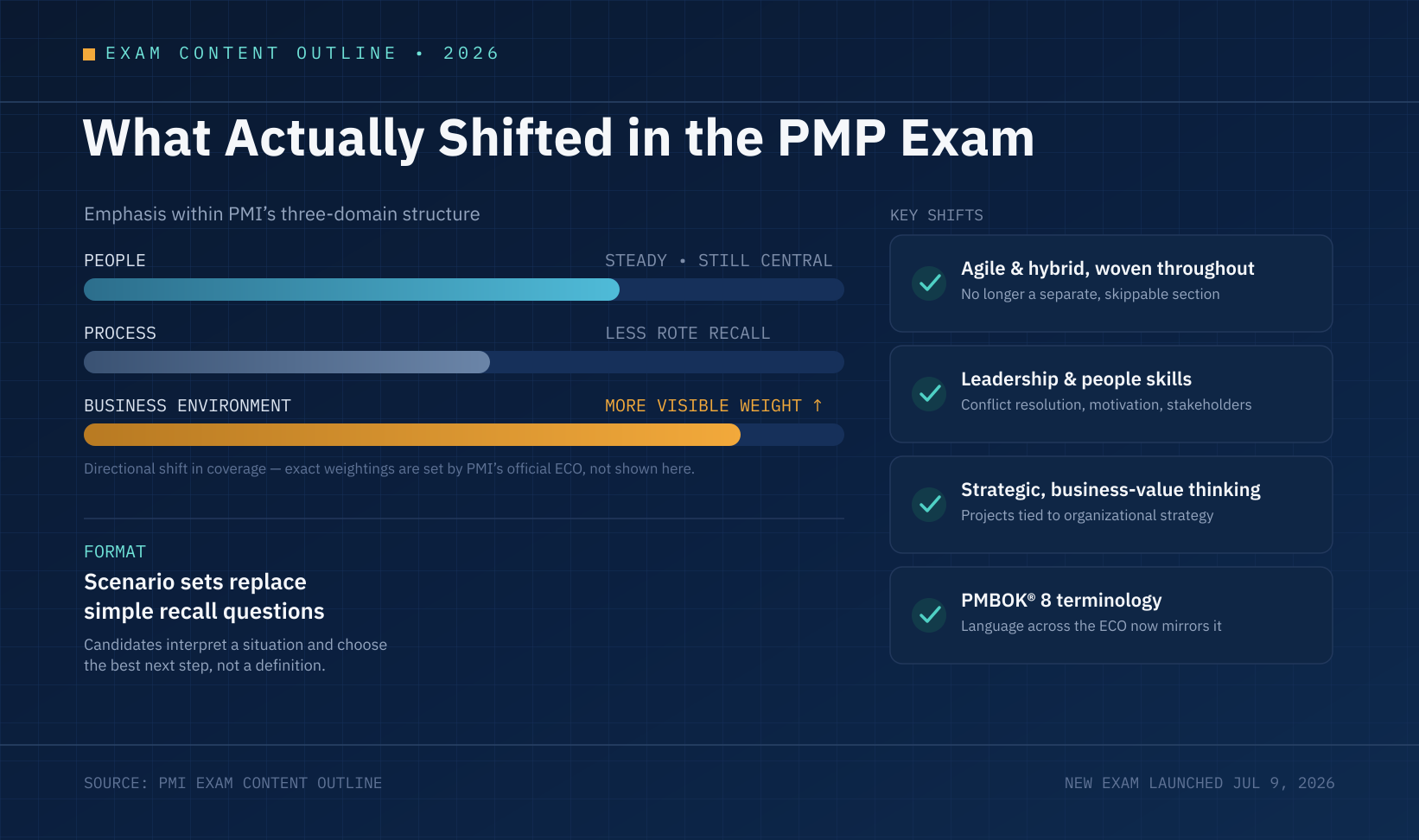
The revised ECO still uses PMI's familiar three-domain structure, People, Process and Business Environment, so the overall framework hasn't been thrown out. What has shifted is the weighting and emphasis within those domains, along with updated terminology that mirrors PMBOK 8 language. Candidates who want a full domain-by-domain breakdown can read this guide to the PMP Examination Content Outline for a closer look at how each domain is structured.
Changes in Knowledge Areas and Domains
Rather than adding entirely new domains, PMI has adjusted how much attention each existing domain receives. Business environment and strategic alignment topics, in particular, carry more visible weight than in the previous version of the exam.
Greater Focus on Agile and Hybrid Project Management
Agile and hybrid delivery questions are no longer treated as a separate add-on to predictive project management. They're woven throughout the exam, which means candidates can't afford to treat Agile as an optional study topic.
Enhanced Emphasis on Leadership and People Skills
Soft skills, conflict resolution, team motivation and stakeholder engagement continue to carry meaningful weight. This reflects PMI's long-running position that a PMP holder is a leader first and a technician second.
Scenario-Based and Situational Questions
One of the more noticeable shifts is format, not just content. PMI has introduced more scenario sets and situational judgment questions that ask candidates to interpret a project situation and choose the best next step, rather than recall a definition.
Business Environment and Strategic Thinking
Understanding how a project connects to organizational strategy, benefits realization, and business value has become harder to skip past. Candidates are expected to think like decision-makers, not just task managers.
It's important to separate what PMI has confirmed from what training providers are still predicting. The domain structure, the July 2026 launch date, and the general shift toward scenario-based testing are confirmed, and readers can see how this ties back to the source standard in the breakdown of what PMBOK 8 actually changed. Exact percentage weightings for every topic are still being clarified by PMI through official channels, so candidates should always verify specifics against PMI's own published ECO rather than relying on unofficial estimates.
How the 2026 Changes Affect PMP Candidates
New Study Priorities
Candidates now need to spend more time on applied judgment questions rather than memorizing formulas and definitions in isolation. Reading a process name and recognizing it is no longer enough.
Changes in Exam Preparation Strategy
A study plan built purely around flashcards or a single textbook is unlikely to hold up. Preparation now needs to combine reading, practice questions and guided discussion of real scenarios, which is exactly the kind of preparation instructor-led PMP live classes are designed around.
Impact on Working Professionals
Professionals juggling full-time jobs alongside exam prep often have the least room for wasted study hours. Since the 2026 update rewards applied understanding over rote learning, working candidates benefit from structured, live instruction that clarifies concepts quickly rather than open-ended self-study. This comparison of PMP live classes vs. self-study is worth reading before deciding which route fits a busy schedule.
Importance of Practical Project Experience
Candidates who are actively managing projects, even informally, tend to adapt faster to scenario-based questions because they've already lived through similar trade-offs. Those without that exposure benefit from case-study-driven training that simulates it and this look at how hard the PMP exam really is explains why hands-on context matters so much for the newer question style.
Best Resources to Prepare for the PMP Exam in 2026
PMI Exam Content Outline (ECO)
This remains the single most reliable source for what the exam actually covers. It should be the starting point for every study plan, not an afterthought. Candidates who want to see how this maps onto real instruction can check a PMP class preview before committing to a full course.
PMBOK® Guide
While the exam isn't based solely on the PMBOK® Guide, the Eighth Edition offers useful context for the principles and language now reflected in exam questions.
Agile Practice Guide
Given how deeply Agile and hybrid concepts are now integrated into the exam, this remains a practical companion resource rather than optional reading.
Practice Questions and Mock Exams
Scenario-heavy exams reward repetition. Timed mock exams help candidates get comfortable with the pacing and question style before test day.
Instructor-Led Training
A structured, live-class format helps candidates work through ambiguous scenario questions with real-time feedback, something static materials can't offer. This is where guided PMP certification training tends to outperform self-paced study alone.
Study Groups and Professional Communities
Peer discussion often reveals blind spots that solo studying misses, particularly around situational judgment questions where more than one answer can seem plausible. This overview of how to get PMP certification covers where study groups fit into the wider certification journey.
Study Plan for the PMP Exam After the 2026 Changes
Review the Latest ECO
Before building a schedule, candidates should read through the current ECO in full so they know exactly what's being tested.
Build a Weekly Study Schedule
Breaking preparation into weekly blocks by domain, rather than cramming, tends to produce steadier retention and less last-minute panic. For a more detailed week-by-week structure, this guide on how to prepare for the PMP exam walks through a practical timeline.
Practice Scenario-Based Questions
Since the format now leans heavily on situational judgment, practice sets should mirror that style rather than relying on simple recall questions.
Take Regular Mock Exams
Full-length timed exams, taken every one to two weeks during the final study phase, help candidates build stamina and identify weak domains early.
Strengthen Weak Knowledge Areas
Mock exam scores should directly shape the following week's study focus, rather than continuing to review material that's already well understood. It's also why live, discussion-based classes tend to close gaps faster than solo review, as explained in how PMP live classes build job-ready skills that mock exams alone can't teach.
Common Mistakes to Avoid
- Studying outdated materials that reflect the previous ECO version
- Ignoring the latest Exam Content Outline in favor of older third-party guides
- Focusing only on memorization instead of applied reasoning
- Skipping Agile and Hybrid concepts, assuming they're a minor section
- Taking too few practice exams before test day
- Not reviewing exam changes before scheduling the test date.
Tips to Stay Updated with Future PMP Changes
Following PMI's official announcements directly is the most reliable way to avoid outdated information, since third-party summaries sometimes lag behind or misinterpret updates. Reviewing the latest Exam Content Outline periodically, even after certification, helps professionals stay current for renewal cycles and CE requirements. Joining PMI chapters or professional communities also surfaces changes early, often before they're widely publicized. Attending webinars or industry events hosted by PMI or accredited training providers is another practical way to catch updates as they're announced, and sessions like this PMP masterclass on the exam changes are a useful example of that kind of update. Finally, updating study resources whenever a new ECO or guide edition is published prevents the common mistake of studying from materials that quietly became outdated.
Final Thoughts
Exam updates can feel unsettling, especially for candidates deep into their preparation, but the 2026 changes are less about difficulty and more about relevance. PMI has aligned the PMP exam with how project management is actually practiced today, favoring applied judgment over memorized definitions. Candidates who rely on PMI's official resources, rather than rumors or outdated third-party guides, will have the clearest picture of what to expect. A structured study plan, current materials, and consistent practice remain the most reliable path to passing. Ultimately, adapting to exam changes is simply part of what it means to grow into a capable, certified project management professional.
Frequently Asked Questions (FAQ)
Has the PMP exam changed in 2026?
Yes. PMI officially rolled out an updated version of the PMP exam on July 9, 2026, aligned with the PMBOK® Guide – Eighth Edition and a revised Exam Content Outline.
Do I need new study materials for the 2026 PMP exam?
Candidates taking the exam after July 2026 should study from the current ECO and updated materials. Those who tested before that date under the prior format did not need to change their materials.
Is the PMP exam harder after the 2026 updates?
It isn't necessarily harder, but it does test differently. The heavier use of scenario-based questions means candidates need stronger applied judgment rather than pure recall.
Will Agile topics carry more weight?
Agile and hybrid concepts are now integrated throughout the exam rather than isolated in a single section, so they can't be treated as optional study material.
How should I adjust my study plan for the 2026 exam?
Focus on the current ECO, prioritize scenario-based practice questions and consider structured instructor-led sessions that walk through real project situations rather than relying solely on textbook review.