Most project managers I talk to don't have a skills problem. They have a direction problem. They are good at the job. They deliver, stakeholders trust them and the last review was positive. Yet somewhere around year five or eight, a quiet question shows up: is this it or is there a next level, and what does it look like?
That question is what good project management career advice should answer. Most of what you'll find online skips it and jumps straight to get another certification. That's a tool not a plan. This article is about the plan.
Why careers stall in the middle
Early in a project career, progress is obvious. You go from coordinator to project manager and the ladder is visible.
After that, the ladder splits. Senior roles look very different from each other:
- Running bigger and more complex projects
- Managing programs made of several related projects
- Owning a portfolio and deciding which work gets funded
- Leading a PMO
- Moving into consulting, advisory, or executive delivery roles
Each path rewards different strengths, and none of them is the next step by default. People stall because they keep doing more of what they are already good at, hoping it will eventually be noticed. It rarely is.
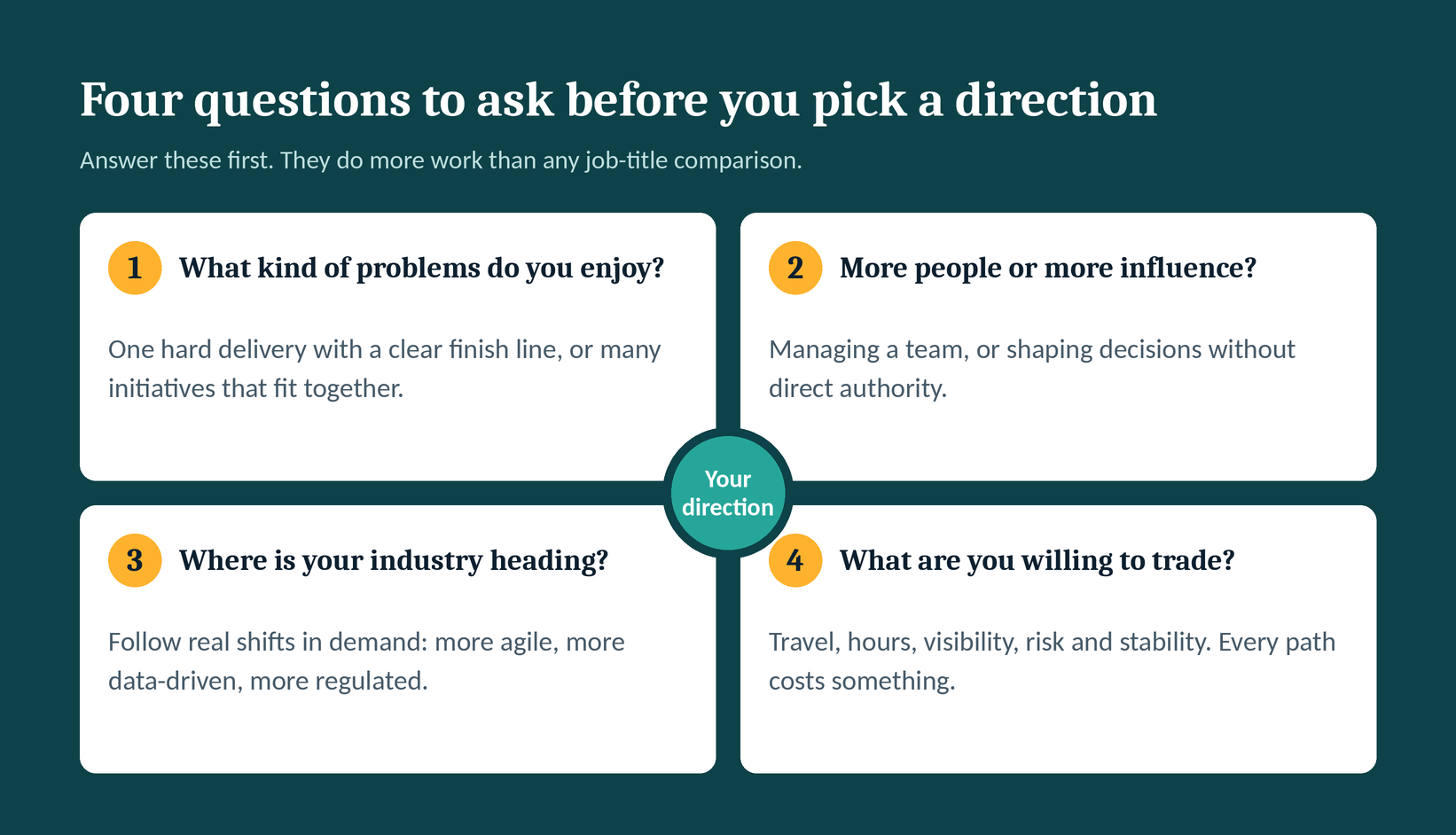
Four questions to ask before you pick a direction
These questions do more work than any job-title comparison.
1. What kind of problems do you enjoy?
Some people like the puzzle of one difficult delivery: tight scope, hard dependencies, a clear finish line. Others prefer the wider view of how many initiatives fit together, compete for people and support a strategy. The first leans toward advanced project leadership. The second leans toward program and portfolio work.
2. Do you want more people or more influence?
A bigger title does not always mean a bigger team. Many senior roles are about influencing decisions without direct authority. If managing people energizes you, plan for it. If it drains you, say so early, because it changes which paths make sense.
3. Where is your industry heading?
Look at your sector honestly. Is work becoming more agile? More data-driven? More regulated? The strongest career moves usually sit where your experience meets a real shift in demand, not where a trend piece says the money is.
4. What are you willing to trade?
Travel, hours, visibility, risk, stability. Every direction costs something. Naming the trade-offs now saves you from choosing a path you'd resent in two years.
The main paths, in plain terms
Senior project manager or delivery lead. You stay close to the work but take on larger, riskier, more political projects. Good if you love delivery itself.
Program manager. You coordinate related projects toward a shared outcome, and benefits matter as much as outputs. It suits people who think in dependencies and long timelines. If this appeals to you, our overview of the PgMP live classes shows how the credential fits this route.
Portfolio manager. You decide which work deserves investment. It's a more strategic and financial role and less hands-on. The PfMP live classes are built for people aiming here.
Agile or hybrid leader. You guide teams and organizations through adaptive delivery. This is a strong fit if your current environment is already shifting that way, and the PMI-ACP live classes support it.
PMO leader. You build the structure, standards, and support that let many projects succeed. It's part delivery, part organizational design.
Advisor or independent consultant. You sell judgment rather than hours. It takes a track record, a clear specialty and comfort with uncertainty.
None of these is better than the others. They are just different jobs.
Where certification fits, and where it doesn't
Certifications are useful when they confirm a direction you've already chosen. They are a poor substitute for choosing.
A PMP, for example is a strong foundation and is widely recognized. If you're mid-career and don't yet hold it, our PMP live classes are where most people start. For the broader picture of how credentials are earned, see our guide on how to get a project management certification.
But adding letters to your name without knowing where you're heading is how people end up with three credentials and the same job. Decide the direction first, then pick the credential that supports it.
Five mistakes that slow people down
Waiting to be noticed. Good work does not advertise itself. Make your results visible in terms leadership cares about: cost avoided, time saved, risks caught early.
Chasing titles over scope. A senior title with the same responsibilities is a label. Look for the role that increases the size and difficulty of decisions you own.
Treating every job as a stepping stone. Depth matters. Staying long enough to see a program through or a system mature, is what builds credibility.
Skipping the conversation with your manager. Many people plan a move without ever saying out loud what they want. Managers can't sponsor what they don't know about.
Going it alone. An outside view helps because you're too close to your own situation. This is the most common reason people book a session with an advisor.
If you've already hit the crossroads
If the fork in the road sounds familiar, we wrote about that moment in the career crossroad: from doing the work to driving the future. It looks at the mindset shift required to move from execution to leadership.
What a useful career advisory session covers
A good session isn't a motivational talk. It should leave you with something concrete:
- A clear read of where you stand today: experience, strengths, gaps
- Two or three realistic paths, each with the trade-offs spelled out
- A view of which credential, if any actually supports your choice
- A 12-month sequence: what to do first, what to postpone, what to ignore
If you're a senior professional preparing for an executive-level move, the executive training programs cover that transition. If you prefer focused, personal guidance, one-on-one training is built for that.
A simple 12-month approach
- Months 1–2: Write down the four questions above and answer them honestly. Talk to two people already in the role you're considering.
- Months 3–4: Close the biggest gap between your current work and that role, usually by asking for a stretch assignment.
- Months 5–8: Start the credential or training that supports your path, if one is needed.
- Months 9–12: Make your results visible. Update your profile, present outcomes, and open the conversation about the next role.
It isn't complicated. It just needs to be deliberate.
Ready to talk it through?
If you want a second opinion on your direction, our career advisory service is designed for exactly this. You can also contact the team with a short note about where you are now and where you'd like to be.