Introduction
Every organization now competes for the same scarce resources: capital, skilled people, technology capacity and time. As strategic priorities shift faster than annual planning cycles can keep up with, the leaders who decide where that money and effort should go carry more weight than ever before. Choosing the right investments, and being willing to stop funding the wrong ones, has become one of the defining responsibilities of senior leadership.
This is precisely where portfolio management earns its place as a discipline, not just a buzzword. It is the connective layer between an organization's strategy and the day-to-day work of projects, programs and operations. For professionals who sit at that intersection, PMI's Portfolio Management Professional (PfMP)® certification is designed to validate the judgment, governance thinking, and prioritization skill that strategic investment decisions demand. The sections below explain what the credential covers, why it matters to investment-level leaders and how it applies directly on the job.
What Is the PfMP® Certification?
Overview of Portfolio Management Professional (PfMP®)
PMI positions the PfMP as its highest-tier credential in the portfolio, program, and project management family. Rather than certifying the ability to deliver one project or coordinate one program, PfMP validates the ability to align an entire portfolio of programs, projects and operations with organizational strategy while balancing competing demands and allocating resources where they create the most value. It is built for practitioners operating at the investment-decision level, not the individual-delivery level.
What Does a Portfolio Manager Do?
In practice, a portfolio manager:
- Aligns investments with organizational strategy
- Evaluates and prioritizes competing initiatives
- Balances risk against expected return across the portfolio
- Manages overall portfolio performance and health
- Allocates limited organizational resources across components
- Monitors progress against strategic objectives over time
PfMP® vs. PMP® and PgMP®
The three credentials sit at different altitudes. PMP® certification focuses on managing the people, processes, and outcomes of a single project. PgMP® focuses on coordinating a program made up of related projects working toward a shared benefit. PfMP® sits above both, focusing on an organization's entire portfolio and asking a different question: not are we doing the work right, but are we doing the right work at all.
Why Strategic Investment Decisions Matter to Organizations
Resources Are Limited
Capital, people, technology and time are finite in every organization, regardless of size or sector. Every dollar or hour committed to one initiative is a dollar or hour unavailable to another.
Not Every Project Deserves Investment
Not every proposed initiative supports the organization's direction and not every initiative that once made sense still does. Leaders need a disciplined way to separate genuinely strategic work from work that simply feels urgent.
Strategic Priorities Change
Markets shift, technology evolves and leadership priorities are revisited. A portfolio that was well balanced a year ago can drift out of alignment quietly if no one is watching for it.
Organizations Need a Balanced Portfolio
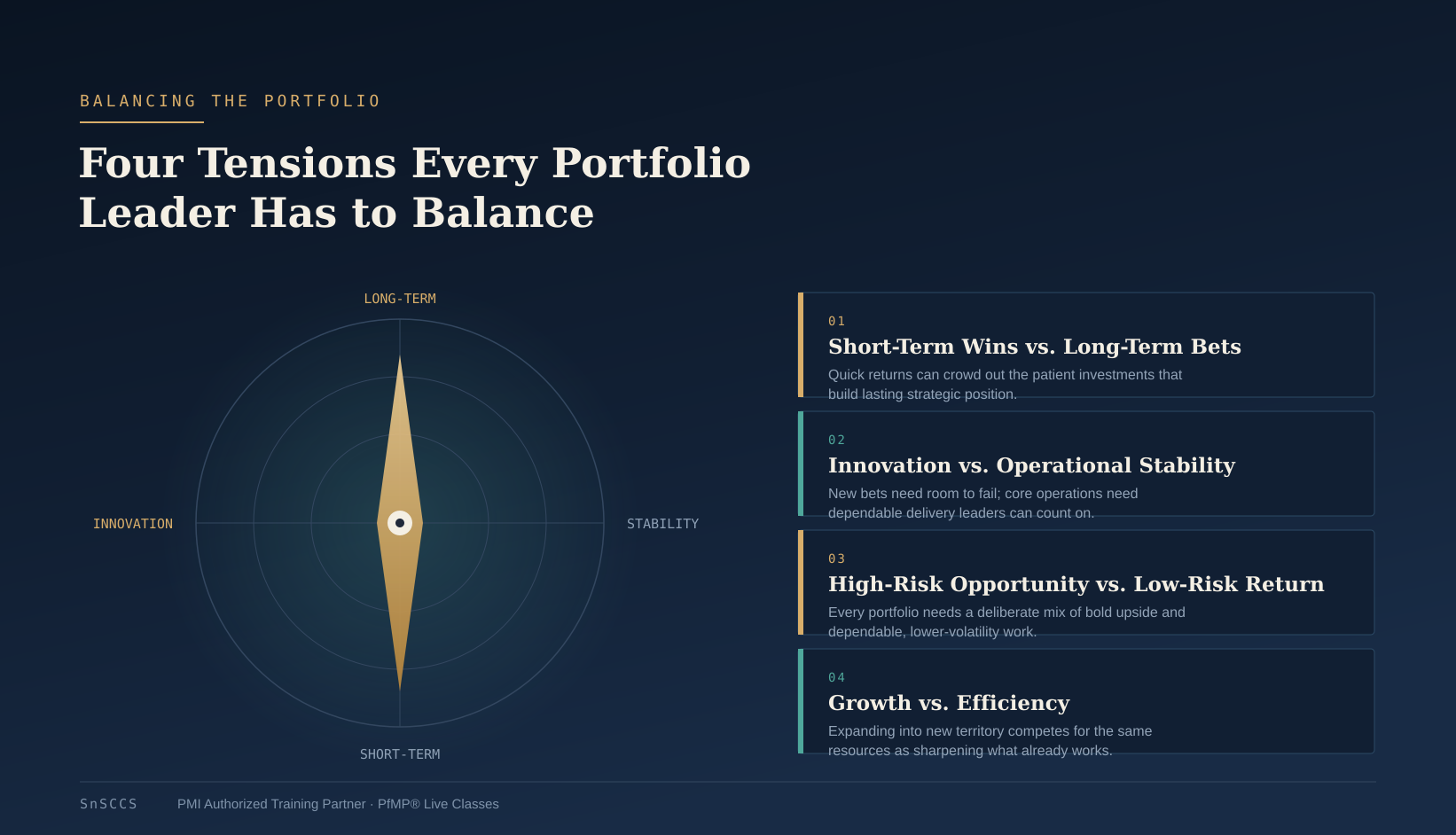
A healthy portfolio blends short-term wins with long-term bets, innovation with operational stability and high-risk opportunities with dependable, lower-risk work.
Poor Investment Decisions Can Create Long-Term Costs
Funding the wrong initiatives does not just waste money in the moment; it consumes people, attention and momentum that could have gone toward work with real strategic return. This is exactly why portfolio-level decision-making matters: it gives leaders a structured way to decide where to invest, what to prioritize, what to continue, and what to stop.
Why PfMP® Is Essential for Strategic Investment Leaders
1. Strengthens Strategic Alignment
PfMP knowledge trains leaders to continually connect investments back to organizational objectives and to recognize when an initiative that once fit the strategy no longer does.
2. Improves Portfolio Prioritization
Rather than relying on instinct or internal politics, portfolio-trained leaders learn to compare competing initiatives against consistent, defensible criteria and prioritize based on value and strategic importance.
3. Supports Better Resource Allocation
Effective allocation means recognizing constraints across the whole portfolio, not just within one initiative and directing limited people, budget and capacity to where they will do the most good.
4. Strengthens Portfolio Risk Management
Individual project risk is only part of the picture. PfMP-level thinking looks at how risks correlate across the portfolio and helps leaders balance overall risk against expected value.
5. Improves Benefits and Value Realization
Portfolio leaders learn to define expected benefits up front, track performance against them, and honestly assess whether an investment is actually producing the outcomes it promised.
6. Supports Executive Decision-Making
Senior leaders rely on clear, evidence-based portfolio insight to make funding and prioritization calls. PfMP knowledge equips professionals to provide that transparency at the executive table.
7. Develops Advanced Portfolio Leadership Capability
Beyond technical skill, the discipline builds strategic thinking, governance instinct, stakeholder management, sound decision-making and organizational awareness the capabilities executives expect from investment-level leaders.
How PfMP® Supports Strategic Investment Decision-Making
Evaluate Investment Opportunities
Portfolio-trained leaders weigh new opportunities against strategic alignment, financial value, risk, organizational capability and expected benefits before committing resources.
Balance the Portfolio
This means consciously balancing high-risk against low-risk investments, short-term against long-term value, innovation against operational priorities and growth against efficiency, rather than letting the balance happen by accident.
Monitor Portfolio Performance
Ongoing monitoring covers financial performance, strategic contribution, benefits realization, risk exposure and resource utilization across every component of the portfolio.
Make Portfolio Adjustments
Portfolio management is never a one-time selection exercise. As organizational conditions change, leaders need to continue, modify, reprioritize or terminate investments and PfMP-level training builds the confidence to make those calls.
The Role of Portfolio Governance in Investment Decisions
Strong governance is what keeps investment decisions consistent rather than reactive. It involves establishing clear decision-making frameworks, defining investment criteria before proposals arrive, maintaining transparency and accountability for how choices are made, managing stakeholder expectations across business units, monitoring ongoing strategic alignment and supporting the broader executive governance structure. Where governance is weak, even good portfolio data tends to get overridden by whoever argues loudest in the room.
Skills Leaders Develop Through PfMP® Knowledge
Portfolio leaders need a wider lens than project delivery alone, because their decisions shape an organization's overall investment direction. The discipline builds strategic thinking, portfolio risk management, financial and investment analysis, benefits management, resource management, executive communication and data-driven decision-making skills that carry directly into boardroom and steering-committee conversations.
Who Should Consider PfMP®?
PfMP is intended for experienced professionals already close to portfolio-level responsibility, including:
- Portfolio managers
- Senior project and program managers
- PMO leaders
- Strategy and transformation leaders
- Investment and business leaders involved in project portfolios
- Executives responsible for strategic initiatives
How to Apply Portfolio Management Thinking in Your Organization
Professionals do not need to wait for certification to start applying the mindset. Defining strategic objectives clearly, establishing portfolio selection criteria, assessing investment value and risk honestly, prioritizing initiatives against those criteria, allocating resources deliberately, monitoring benefits and performance over time and rebalancing the portfolio when conditions change are practical steps any leader can begin today.
Professionals looking to formalize this capability can review the PfMP live classes at SnSCCS, which are built around applying these exact steps to real portfolio decisions rather than exam questions alone.
Final Thoughts
Strategic investment decisions are too consequential to leave to instinct, habit or whoever presents the most convincing slide deck. They require structured portfolio management: clear strategic alignment, disciplined prioritization, honest risk management, deliberate resource allocation and consistent benefits realization. PfMP knowledge gives professionals working at the portfolio and executive level a common language and framework for making those calls with confidence.
Certification is not a substitute for real-world leadership experience it is meant to complement it. What ultimately matters is an organization's ability to direct its limited resources toward the investments that create the greatest strategic value and portfolio-trained leaders are the ones best positioned to make that happen. Please note that certification supports professional readiness and does not itself guarantee employment, promotion or salary outcomes.
Frequently Asked Questions (FAQ)
What is PfMP® certification?
PfMP is PMI's credential for experienced professionals who manage a portfolio of programs, projects, and operations, validating their ability to align that portfolio with organizational strategy while balancing demands and allocating resources.
Why is PfMP® important for strategic investment decisions?
It builds the prioritization, governance and risk-balancing judgment leaders need to decide where limited capital, people and time should go, and where they should be pulled back.
What is the difference between PfMP®, PgMP® and PMP®?
PMP focuses on managing a single project, PgMP focuses on coordinating a program of related projects, and PfMP focuses on managing an organization's entire portfolio against its strategic goals.
Who should pursue PfMP®?
It suits portfolio managers, senior program and project managers, PMO leaders, transformation leaders and executives who influence or own strategic investment decisions. PMI's eligibility paths generally call for several years of professional business experience alongside several years of portfolio management experience.
What skills are important for portfolio managers?
Strategic thinking, prioritization, risk management, financial analysis, benefits tracking, resource allocation, governance and clear executive communication.
How does portfolio management improve investment decisions?
By replacing ad hoc, opinion-driven choices with consistent criteria for evaluating, prioritizing, monitoring and rebalancing investments over time.
How should professionals prepare for PfMP® certification?
By reviewing the current PMI Exam Content Outline, understanding the panel review and application process and working through the domain areas with guided, application-focused training rather than memorization alone.
Samia Waqar is the CEO of SnS Coaching and Consulting Services, a PMI Authorized Training Partner, a PMI Authorized Instructor and an active holder of nine PMI certifications. She combines certification knowledge with extensive real-world experience across project, program, portfolio, risk, agile, business analysis, PMO, AI, sustainability, organizational change and enterprise transformation. Under her guidance, SnSCCS training goes beyond exam preparation, helping professionals understand the discipline, apply it in their current roles, and use their certification to support long-term career growth. Learn more about the PfMP live classes at SnSCCS or get in touch to discuss the right path forward.