How to Choose a PMI (Project Management Institute) Consultant for PMP Certification & PMO Support
Organizations and individual professionals often reach a point where internal knowledge is not enough to solve a project management challenge. A missed deadline, a struggling PMO, an upcoming certification exam or a leadership team that wants stronger project governance all of these can push a company toward outside help. This is usually when a PMI consultant enters the picture.
A PMI consultant can support very different needs. Some focus on certification guidance for credentials such as PMP®, PMI-ACP® or PMI-RMP®. Others work at the organizational level, improving PMO structure, project governance or delivery capability. Because the scope varies so widely, choosing the wrong consultant can waste both time and budget, while the right one can shift how an organization delivers projects for years afterward.
Selecting a PMI consultant should not be based on a single conversation or a polished website. It requires evaluating experience, credentials, methodology, communication style and most importantly evidence of measurable results. The sections below break down exactly what organizations and professionals should look for before making that decision.
This is usually when a PMI (Project Management Institute) consultant enters the picture a specialist in project management certification and governance, not to be confused with post-merger integration consulting.
What Is a PMI Certification Consultant?
Understanding the Role of a PMI Consultant
A PMI consultant is a professional who applies Project Management Institute standards, frameworks and best practices to help organizations and individuals improve how projects are planned, executed and governed. Unlike a generalist business advisor, a PMI-focused consultant brings structured methodology grounded in globally recognized project management practice.
Consultants in this space typically work in one of two directions: helping individuals prepare for PMI certifications or helping organizations strengthen their project management capability from the inside. Some consultants do both, but the depth of expertise in each area can differ significantly.
Areas Where a PMI Consultant May Help
A PMI consultant's scope commonly includes:
- PMP® and other PMI certification guidance
- Project management process design and improvement
- PMO development and governance
- Agile, hybrid, and predictive delivery approaches, including newer frameworks such as CPMAI for AI-driven projects
- Project and program risk management
- Organizational project management maturity
Because certification paths and organizational needs keep evolving CPMAI is a good example of a newer PMI-aligned credential built specifically for AI project delivery, and demand for consultants and trainers who understand it is only growing a consultant's familiarity with current frameworks matters as much as their years in the field.
Consultant vs. Trainer vs. Project Management Coach
These three roles are often confused, but they are not interchangeable. A trainer typically delivers structured course content toward a specific certification. A coach works one-on-one on skill development, mindset or performance over time. A consultant, by contrast, is usually brought in to diagnose a specific problem a stalled PMO, weak governance, inconsistent delivery and recommend or implement a solution.
Some professionals need exam preparation; others need organizational change; some are still deciding which certification path fits their career direction, which is closer to a career advisory conversation than a consulting one. Defining which one applies before searching for a consultant prevents a mismatch that becomes obvious only after the engagement has started.
Why Choosing the Right PMI Consultant Matters
Access to Specialized Expertise
A qualified PMI consultant brings exposure to multiple industries and project types, which is difficult to replicate internally, especially in smaller organizations.
Practical Solutions Instead of Generic Advice
Frameworks are useful, but they need to be adapted. A consultant who understands both the standard and the organization's actual constraints tends to produce recommendations that are usable rather than theoretical.
Better Project Management Processes
The right consultant does not just point out what is wrong; they help build repeatable processes for planning, tracking, and governance that outlast the engagement itself.
Reduced Risk of Costly Mistakes
Poor project governance is expensive. An experienced consultant can catch structural issues unclear ownership, weak risk tracking, inconsistent reporting before they turn into missed deadlines or budget overruns.
Support for Long-Term Capability Building
A strong engagement leaves the organization more capable than before, not dependent on the consultant for every decision the same principle covered in PMO transformation and the roadmap to strategic value. This distinction separates a consultant who understands the organization's specific challenges from one who simply applies generic project management recommendations regardless of context.
8 Key Factors to Consider When Choosing a PMI/PMP Certification Consultant
1. Relevant Project Management Experience
Experience should be evaluated against the actual environment, not just years worked. A consultant who has handled projects of similar size, complexity and industry will understand the practical constraints that a generalist might miss.
2. PMI Certifications and Professional Credentials
Credentials such as PMP®, PgMP®, PfMP®, PMI-RMP®, PMI-ACP® and PMI-PBA® indicate a consultant has been tested against recognized standards. Certification should complement practical experience, not replace it a credential without applied experience is a weaker signal than the two combined.
3. Industry Knowledge
Project management principles are universal, but execution differs by sector. A consultant familiar with the specific dynamics of technology, construction, healthcare, finance, energy or government projects will typically identify risks and opportunities faster than someone applying a one-size-fits-all lens. For sectors now integrating AI into project delivery, this is also where why CPMAI certification matters in 2026 becomes relevant a consultant unfamiliar with AI-adjacent frameworks may miss risks unique to those projects.
4. Track Record and Client Results
Case studies, prior project examples, client testimonials and measurable outcomes tell a more reliable story than a list of services. Ask what changed as a direct result of the engagement.
5. Consulting Methodology
A credible consultant should be able to explain, clearly, how they assess a problem, how recommendations are developed, how improvements get implemented and how success is measured afterward. If this process sounds vague, that is worth noting.
6. Communication Skills
Technical knowledge is only useful if it can be communicated clearly. Look for consultants who explain concepts in plain language, listen actively to stakeholders and can report effectively to executive audiences, not just project teams.
7. Adaptability
Some organizations run predictive projects, others run Agile and many run a hybrid of both. A consultant who insists on one approach regardless of context is less valuable than one who adapts the methodology to the organization.
8. Professionalism and Transparency
Clear scope, defined deliverables, a realistic timeline, transparent pricing, confidentiality commitments and clearly set expectations from the outset are strong indicators of a professional engagement.
How to Evaluate a PMI Consultant's Experience
Review Their Professional Background
Look beyond a summary paragraph request a detailed account of relevant assignments.
Ask About Similar Assignments
Has the consultant worked on projects comparable in scale, industry or complexity?
Request Relevant Case Studies
Specific examples reveal more than general claims about expertise.
Examine Client References and Testimonials
Direct conversations with former clients often surface details a website will not.
Ask About Measurable Results
Years of experience alone are not enough. A strong consultant should be able to explain what problem they solved, what approach they used and what results the client ultimately achieved.
Questions to Ask Before Hiring a PMI Consultant
Before signing an agreement, it helps to get direct answers to:
- What types of organizations have they worked with?
- Have they handled projects similar to this one?
- Which PMI certifications or credentials do they hold?
- What methodology do they use?
- How will they assess current project management maturity?
- What deliverables will be provided?
- How will success be measured?
- How do they handle stakeholder resistance?
- What is the expected timeline?
- What support is available after implementation?
These questions apply whether the engagement is aimed at individual certification support or organization-wide project management consulting services.
PMI Consultant for Certification vs. Organizational Consulting
Choosing a Consultant for PMI Certification Support
This path typically covers exam eligibility guidance, structured study planning, and coaching through practice scenarios useful for professionals preparing for PMP® or other PMI credentials, including newer options like CPMAI live classes for those moving into AI-driven project roles. Professionals who prefer a more personalized pace sometimes lean toward one-on-one training rather than a group cohort.
Choosing a Consultant for Organizational Project Management
This path is broader, covering PMO improvement, project governance, process development, portfolio and program management and risk management at the organizational level closer to what most corporate training engagements are built around.
Candidates should make sure the consultant's experience actually matches the specific service needed certification coaching and organizational transformation require different skill sets, even when the same consultant offers both.
Red Flags to Watch for When Choosing a PMI Consultant
- Guaranteed certification or exam success
- Lack of verifiable experience
- Unclear pricing or deliverables
- Outdated project management knowledge
- One-size-fits-all recommendations
- Poor communication
- No evidence of previous results
- Excessive focus on credentials without practical experience
Any one of these on its own may not be disqualifying, but more than one together is a signal to keep looking.
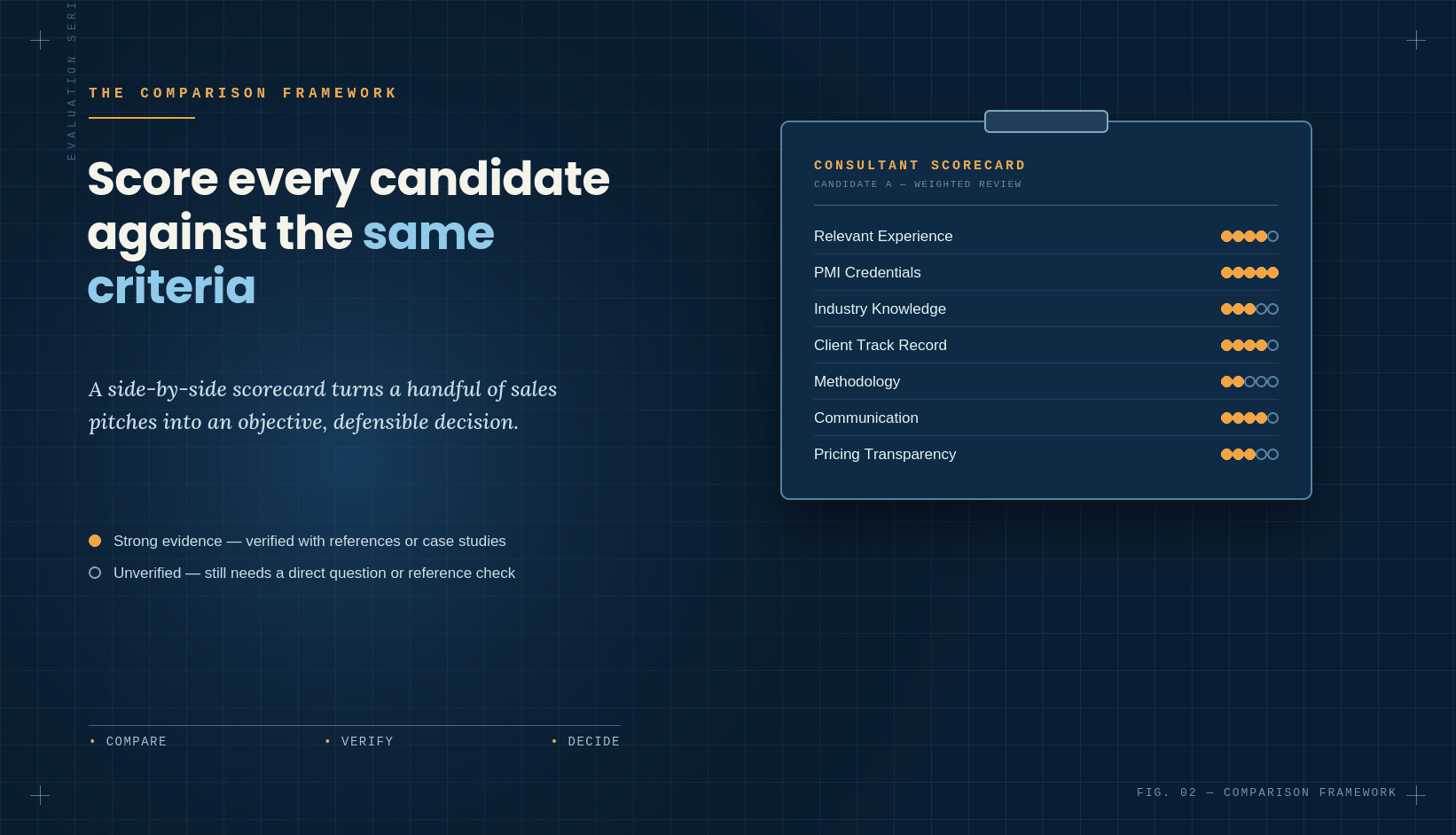
How to Compare Multiple PMI Consultants
A simple side-by-side framework makes the decision easier to evaluate objectively:
| Evaluation Factor | Consultant A | Consultant B | Consultant C |
|---|---|---|---|
| Relevant experience | |||
| PMI credentials | |||
| Industry knowledge | |||
| Methodology | |||
| Client results | |||
| Communication | |||
| Pricing | |||
| Overall fit |
The best consultant is not necessarily the cheapest or the one with the most certifications. The right choice offers the strongest combination of expertise, fit, communication, value and proven results.
Final Thoughts
Choosing a PMI consultant comes down to a handful of consistent factors: practical experience, relevant credentials, industry familiarity, clear methodology, strong communication and evidence of measurable results. Certifications matter, but they work best alongside real, applied experience rather than in place of it.
Organizations and professionals are better served by interviewing more than one consultant before committing, comparing not just cost but fit and track record. The right consultant takes the time to understand specific goals rather than applying a generic playbook. Approached carefully, choosing a PMI consultant is not just a short-term fix it becomes a long-term investment in stronger project management capability.
Frequently Asked Questions (FAQ)
What does a PMI consultant do?
A PMI consultant applies Project Management Institute standards and frameworks to help individuals prepare for certification or to help organizations improve project governance, PMO structure and delivery capability.
What qualifications should a PMI consultant have?
Relevant PMI credentials such as PMP®, PgMP® or PMI-ACP®, combined with verifiable, hands-on project experience in a comparable industry or environment.
Should a PMI consultant have a PMP certification?
It is a strong indicator of tested knowledge, though it should be evaluated alongside practical experience rather than treated as the sole qualification.
How can I verify a consultant's experience?
Through case studies, client references, testimonials and direct conversations that focus on measurable outcomes rather than general claims.
What questions should I ask before hiring a PMI consultant?
Questions about relevant assignments, methodology, deliverables, timeline and how success will be measured are a strong starting point.
How much does a PMI consultant cost?
Pricing varies based on scope, engagement length and whether the work is certification-focused or organization-wide. Transparent, itemized pricing is a good sign regardless of the total.
Is a PMI consultant different from a PMP trainer?
Yes. A trainer typically delivers structured content toward a certification exam, while a consultant diagnoses and addresses broader project management or organizational challenges.
Is a PMI consultant the same as a post-merger integration (PMI) consultant?
No. This guide covers PMI as in the Project Management Institute the body behind PMP® and related project management certifications. Post-merger integration consulting is a separate, unrelated field focused on combining two organizations after an acquisition.