Why PMI CPMAI Certification Matters in 2026 (And Why You Should Get It Now)
Introduction
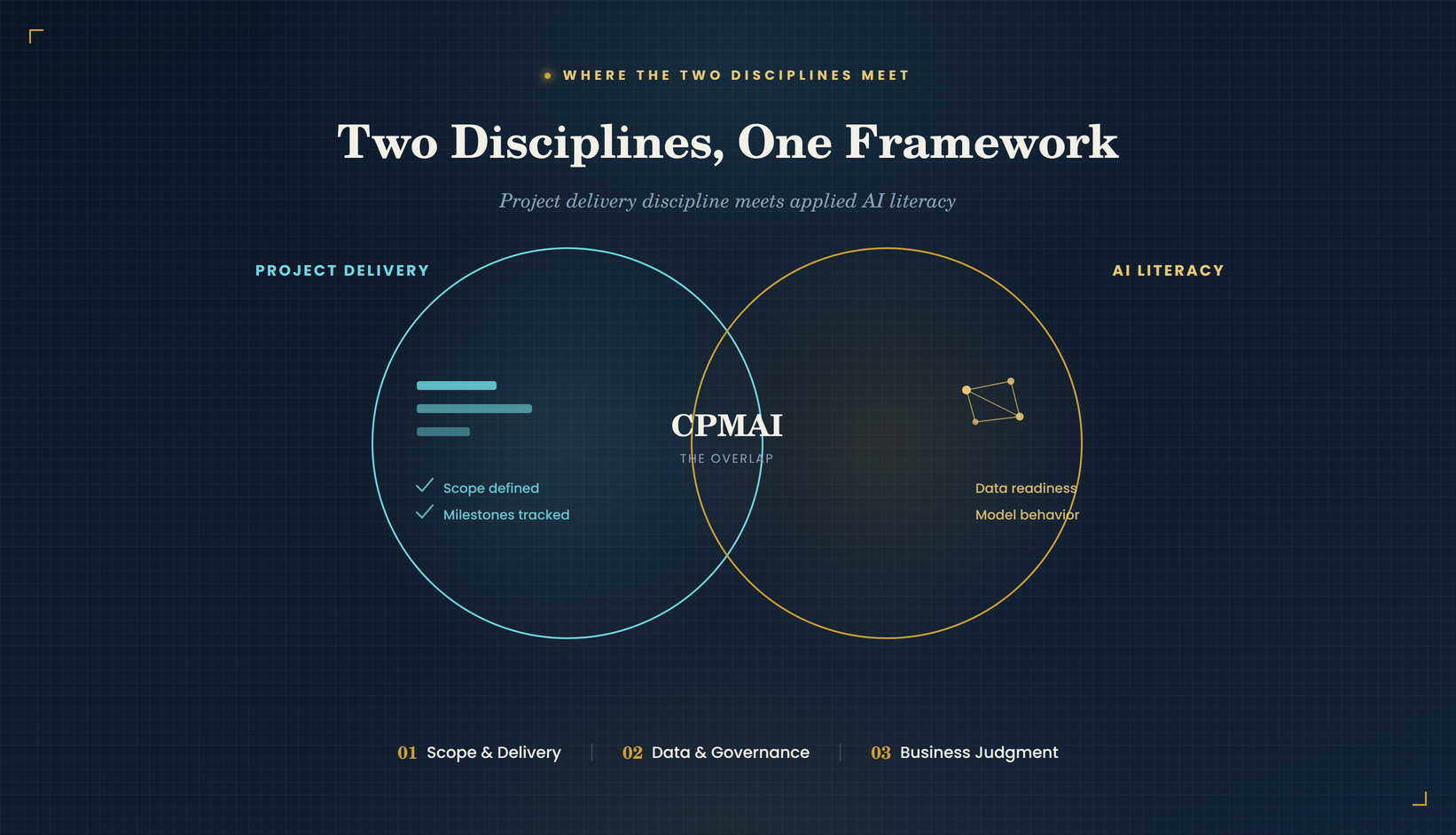
Artificial intelligence is no longer a side conversation in project management. It sits inside the planning tools teams use, the reporting dashboards leadership reviews and the risk models organizations rely on to make decisions. For project professionals, this shift means technical fluency in AI is quickly becoming as expected as budgeting or scheduling once was. This is where the PMI CPMAI certification fits in. Unlike broad, theory-heavy AI courses, CPMAI was built specifically for people who deliver projects and need to apply AI in a structured, practical way. Professionals who combine project management experience with real AI literacy are positioned differently than those who only know one side of the equation. This article looks at what CPMAI actually covers, why 2026 is a meaningful year to pursue it and how it can support a project professional's next career step.
What Is PMI CPMAI Certification?
Overview of PMI CPMAI
CPMAI is a certification offered under PMI that focuses on managing and delivering AI-related initiatives. It was designed to give project, program and business professionals a working framework for AI projects rather than a purely academic introduction to machine learning. Professionals exploring the certification often start by reviewing a structured CPMAI training path to understand how the material is typically taught before committing to a study plan.
What Does CPMAI Stand For?
CPMAI stands for Cognitive Project Management for AI. The name reflects its purpose: applying project management discipline to the specific challenges that AI initiatives bring, such as data dependency, model uncertainty and iterative development.
What Skills Does the Certification Focus On?
The certification centers on a few core areas:
- AI fundamentals
- AI implementation
- Data and analytics
- AI-enabled decision-making
- Responsible AI practices
Who Can Benefit From PMI CPMAI?
The certification is relevant to project managers, program managers, PMO professionals, business analysts, technology professionals and anyone contributing to AI-related initiatives inside their organization.
Why PMI CPMAI Certification Matters in 2026
AI Is Becoming Part of Everyday Business Operations
By 2026, AI tools are embedded in reporting, forecasting and operational workflows across most industries. It is less common now for a project team to have zero exposure to AI-driven processes, which raises the baseline expectation for what professionals should understand.
Organizations Need Professionals Who Understand AI and Project Delivery
Many organizations have data scientists and engineers who understand AI models, but fewer people who can also manage scope, stakeholders and delivery timelines for AI projects. This is a common reason companies invest in corporate training programs built around AI-ready project delivery and it is exactly the gap CPMAI addresses.
AI Skills Can Complement Existing Project Management Expertise
For someone who already holds a project management background, adding AI literacy does not replace their existing skill set. It builds on it, giving them a way to lead initiatives that blend traditional delivery methods with AI components.
Responsible AI and Governance Are Becoming More Important
As AI adoption grows, so does scrutiny around how it is used. Data privacy, bias and accountability are now regular discussion points in project governance, which lines up with PMI's own updated AI standard for project professionals, and CPMAI includes responsible AI practices as part of its core content.
AI Adoption Requires More Than Technical Tools
Selecting the right AI tool is only part of a successful initiative. Change management, stakeholder alignment, and realistic planning are just as important and these are areas where trained project professionals already have an advantage.
Professionals Need to Adapt to Changing Workplace Expectations
Job descriptions across project and program roles increasingly mention AI familiarity, even when the role is not technical in nature. Certification is one way to demonstrate that familiarity in a verifiable format.
Combining project management knowledge with AI literacy allows professionals to participate more effectively in digital transformation efforts and AI-driven initiatives, rather than watching from the sidelines while technical teams lead the conversation.
Key Benefits of PMI CPMAI Certification
Develop Practical AI Knowledge
The certification is built around applied concepts rather than abstract theory, giving professionals a working understanding of how AI projects actually move from idea to delivery.
Improve AI-Related Project Management Skills
CPMAI addresses how traditional project management practices need to adapt when a project involves AI, including handling iterative model development and data-driven uncertainty.
Strengthen Career Competitiveness
Holding a recognized credential focused on AI project delivery can help a professional's profile stand out, particularly in industries where AI initiatives are expanding. Professionals mapping out next steps sometimes work through career advisory guidance to see how a certification like this fits into their broader trajectory.
Support Better Data-Driven Decisions
The certification's focus on data and analytics helps professionals ask better questions about data quality, which directly affects the reliability of AI-driven outcomes.
Understand Responsible AI Implementation
Professionals learn how to factor in ethical and governance considerations early in a project, rather than treating them as an afterthought.
Communicate More Effectively With Technical Teams
A shared vocabulary with data scientists and engineers makes it easier for project leads to translate technical constraints into business terms, and vice versa a gap explored further in why AI projects usually fail for management reasons, not technical ones.
Prepare for AI-Driven Career Opportunities
While certification does not guarantee a promotion or a new role, it does build the kind of applied knowledge that positions professionals for AI-related responsibilities as they emerge within their organizations.
Who Should Consider PMI CPMAI Certification?
Project and Program Managers
Those managing delivery timelines who now find AI components woven into their projects will benefit from a structured approach to handling them.
PMO Professionals
PMO teams overseeing portfolios that increasingly include AI initiatives can use CPMAI concepts to standardize how these projects are evaluated and governed, which connects closely with broader PMO delivery practices.
Business Analysts
Analysts translating business requirements into AI-enabled solutions gain a clearer framework for scoping and validating those requirements.
Digital Transformation Professionals
Anyone leading broader transformation efforts, including those going through executive training, will find the certification useful for understanding where AI fits within a wider change initiative.
Technology and AI Professionals
Technical professionals who want to strengthen their project delivery skills alongside their technical expertise can also benefit from the certification's structured approach.
Professionals Moving Into AI-Enabled Roles
The certification is useful for both experienced professionals adding an AI specialization and individuals earlier in their careers who are building AI-related project skills from the ground up.
PMI CPMAI and the Future of Project Management
AI-Assisted Planning and Forecasting
AI tools are increasingly used to support scheduling and forecasting, though human oversight remains essential for interpreting results correctly.
Automated Data Analysis
Large volumes of project data can now be processed automatically, freeing up time for professionals to focus on interpretation and strategy rather than manual reporting.
AI-Supported Risk Identification
Pattern recognition in AI systems can help flag potential risks earlier, though it still requires a project professional's judgment to assess relevance and priority.
Intelligent Decision Support
AI can surface options and data points faster than manual methods, but final decisions still depend on business context that only an experienced professional can weigh accurately.
Human Judgment and AI Collaboration
The future of project management is less about AI replacing professionals and more about professionals learning to work alongside AI tools effectively.
Growing Importance of AI Governance
As AI becomes more embedded in delivery processes, governance frameworks around its use are likely to expand an idea echoed in why AI literacy is now a strategic leadership imperative, making this an area professionals will need to stay current on.
AI is likely to change how project professionals work day to day, rather than eliminate the need for their expertise altogether.
How PMI CPMAI Can Help Professionals Prepare for AI Adoption
Build an AI Foundation
The certification gives professionals a starting point for understanding AI concepts without needing a data science background first.
Understand AI Project Life Cycles
Learning how AI projects differ from traditional software or business projects helps professionals set more realistic expectations and timelines.
Learn How to Evaluate AI Opportunities
Not every business problem needs an AI solution. CPMAI helps professionals develop the judgment to recognize when AI is genuinely the right approach.
Consider Data Quality and Risk
Since AI outcomes depend heavily on the data feeding them, professionals learn to evaluate data readiness before committing to a project timeline.
Apply Responsible AI Principles
Professionals gain practical ways to build ethical and governance checkpoints into a project plan rather than treating them as separate compliance steps.
Connect AI Capabilities With Business Objectives
The certification emphasizes tying AI initiatives back to measurable business goals, which helps prevent projects from becoming purely technical exercises.
In practice professionals can apply these concepts by reviewing current workplace initiatives, identifying where AI is already involved and using CPMAI frameworks to assess whether governance and data quality checks are in place.
PMI CPMAI Certification vs. General AI Learning
Structured Certification vs. Informal Learning
Free tutorials and short online courses can introduce AI concepts, but they rarely provide the structured, project-focused framework that a formal certification offers. Depending on how someone learns best, that structure can come through a self-study bundle or more personalized one-on-one training.
Project Management Context
Most general AI courses are built for a technical audience. CPMAI specifically addresses how AI concepts apply within a project delivery context.
Practical Application
The certification is designed around applying concepts to real project scenarios, rather than testing theoretical knowledge alone.
Professional Credibility
A recognized credential from PMI carries a level of professional recognition that informal learning generally does not provide.
Continuous Learning
Online courses and tutorials can still play a role after certification, helping professionals stay current as AI tools and practices continue to evolve.
Online AI courses, tutorials and other certifications can complement each other well, while PMI CPMAI provides a structured professional pathway focused specifically on the intersection of AI and project management.
How to Prepare for PMI CPMAI Certification in 2026
Review the Current PMI Certification Requirements
Requirements can be updated periodically, so it is worth confirming the latest eligibility criteria directly before beginning preparation.
Study the Official Examination Content Outline
Reviewing the official outline gives a clear picture of which topics carry the most weight on the exam.
Learn Core AI Concepts
Building a baseline understanding of AI fundamentals makes the more advanced material easier to absorb.
Understand Practical AI Applications
Studying real examples of AI use in project settings helps connect theory to how the concepts show up in practice.
Practice Scenario-Based Questions
Since the exam leans on applied scenarios, practicing with similar question formats helps build familiarity with how concepts are tested. A closer breakdown of this is covered in PMI CPMAI exam preparation.
Create a Consistent Study Schedule
Spacing out preparation over several weeks tends to be more effective than concentrated, last-minute review.
Use Mock Exams to Identify Knowledge Gaps
Practice exams can help highlight weaker areas early enough to adjust a study plan before the actual test date.
Professionals preparing for the exam often find it useful to work through structured CPMAI live classes that walk through the examination content outline and cover current certification requirements in detail.
Final Thoughts
AI literacy is steadily becoming a standard expectation for project professionals rather than an optional add-on. Combining project management experience with practical AI knowledge gives professionals a more complete skill set for the initiatives organizations are prioritizing right now. 2026 is a reasonable time to build this skill set, simply because AI adoption inside businesses continues to grow rather than slow down. Certification alone is not a guarantee of career outcomes, but paired with practical application and ongoing learning, it gives professionals a credible, structured way to demonstrate their readiness. For those weighing whether to start now or wait, the more relevant question may be how comfortable they want to be managing AI-driven work as it becomes a normal part of the job.
Frequently Asked Questions (FAQ)
What is PMI CPMAI certification?
PMI CPMAI, or Cognitive Project Management for AI, is a certification focused on managing and delivering AI-related projects using a structured, practical framework.
Why is PMI CPMAI important in 2026?
As AI becomes more embedded in everyday business operations, professionals who understand both project delivery and AI fundamentals are increasingly valuable to their organizations.
Who should get PMI CPMAI certification?
Project managers, program managers, PMO professionals, business analysts and technology professionals working on or near AI initiatives are all strong candidates.
Is PMI CPMAI useful for project managers?
Yes. It builds on existing project management skills by adding a framework specifically designed for the challenges of AI-related projects.
Do I need an AI background to pursue PMI CPMAI?
No prior AI background is required. The certification is designed to build AI literacy from a project management starting point.
How can I prepare for the PMI CPMAI examination?
Reviewing the official examination content outline, studying core AI concepts, practicing scenario-based questions and following a consistent study schedule are all effective preparation steps.