PgMP® Examination Content Outline
Introduction
Earning the Program Management Professional (PgMP®) credential is one of the most respected achievements a program manager can pursue and the path to that credential starts with a single document: the PgMP® Examination Content Outline. Long before a candidate opens a textbook or enrolls in a course, PMI publishes this outline to define exactly what the exam measures and how heavily each area is weighted. Candidates who skip it often end up studying broadly instead of strategically, which wastes time and creates unnecessary stress closer to exam day.
This guide breaks down what the Examination Content Outline actually covers, why it matters more than most study guides admit, and how experienced program managers can use it to build a focused, results-driven preparation plan. Candidates who have already reviewed what it takes to prepare for the PgMP® exam will find this guide a natural next step, since it goes deeper into the domains that preparation strategy is actually built around. For professionals comparing certification paths, understanding how this outline connects to a structured PgMP® certification training program can make the difference between guessing and preparing with purpose.
What Is the PgMP® Examination Content Outline?
Definition of the Examination Content Outline (ECO)
The Examination Content Outline is PMI's official blueprint for the PgMP® exam. It lists the domains, tasks and enablers that the exam is built around, along with the percentage weight assigned to each domain. In simple terms, it tells candidates exactly what will be tested and in what proportion, rather than leaving preparation to guesswork.
Why PMI Uses the ECO
PMI develops the ECO through a role delineation study involving practicing program managers across industries. This ensures the exam reflects real-world program management responsibilities rather than theoretical concepts alone. Because the outline is grounded in actual job practice, it stays closely tied to what program managers are expected to do on the job, not just what they know in theory.
Difference Between the ECO and the PMBOK® Guide
The PMBOK® Guide and The Standard for Program Management explain concepts, processes and terminology. The ECO, on the other hand, is a testing framework it tells candidates which of those concepts will actually appear on the exam and how much weight each one carries. Treating the ECO as a study companion rather than a replacement for PMI's standards is the smarter approach.
Who Should Use the PgMP® ECO?
The outline is especially valuable for:
- Program Managers preparing for certification
- Senior Project Managers moving into program-level roles
- PMO Leaders overseeing multiple related projects
- Portfolio Managers aligning programs with strategic goals
- Business Transformation Managers driving large-scale change
- Executives responsible for strategic initiative delivery
Understanding the PgMP® Examination Content Outline
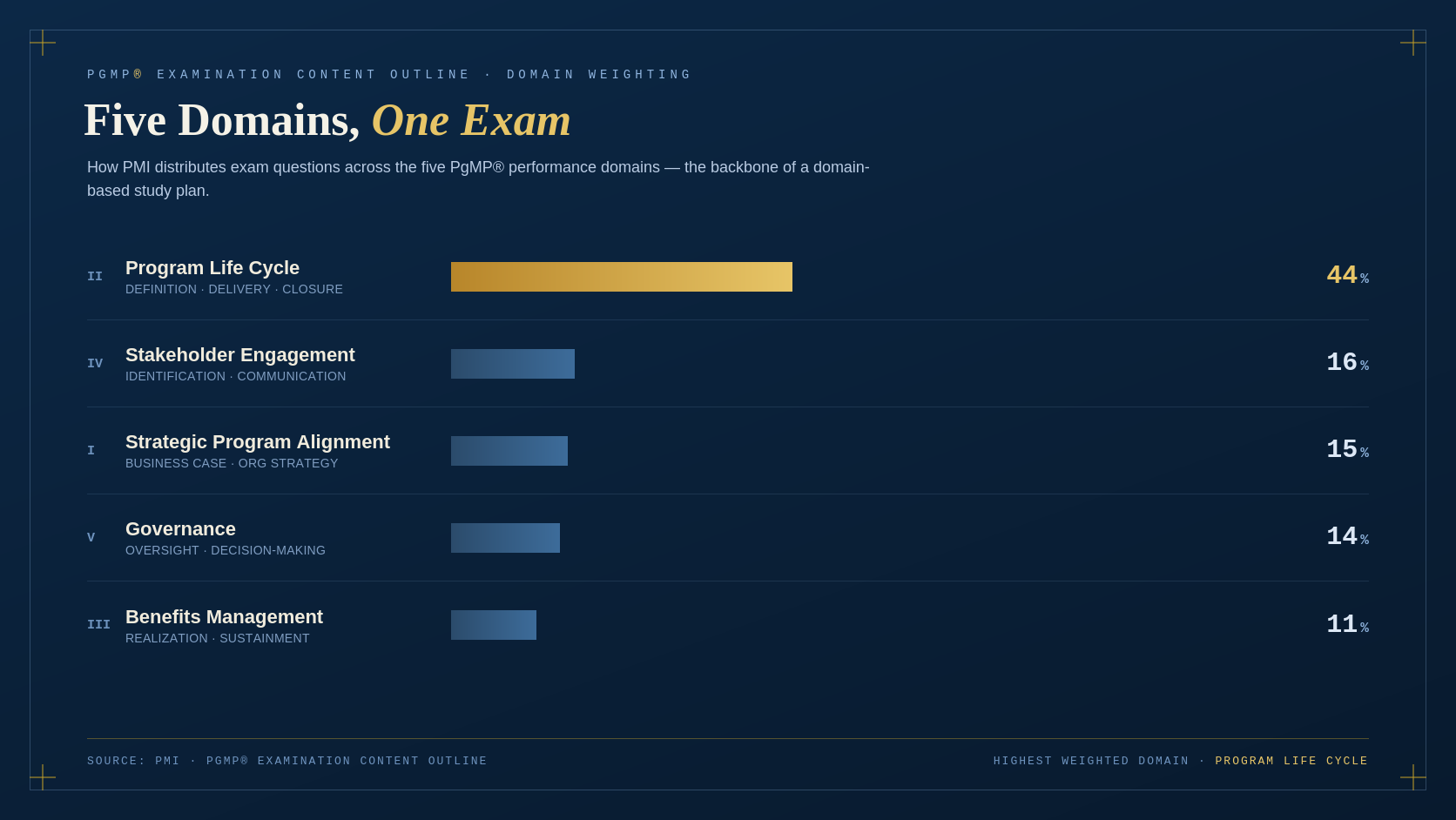
The PgMP® exam is structured around five domains, each representing a core area of program management responsibility.
Domain 1: Strategic Program Management
This domain focuses on aligning programs with organizational strategy. Candidates are tested on evaluating business cases, confirming that a program's objectives support broader strategic priorities and making decisions that keep the program tied to organizational value. Strong performance here reflects the ability to think beyond individual projects and connect delivery to enterprise-level outcomes, a shift many professionals describe as moving from project-driven execution to strategic leadership.
Domain 2: Program Life Cycle
The life cycle domain covers the full arc of a program, from definition through planning, delivery, benefits transition and eventual closure. This is often the most heavily weighted domain because it mirrors the day-to-day realities of managing complex, interdependent workstreams over an extended timeframe.
Domain 3: Benefits Management
Benefits management is what separates program management from project management. This domain tests a candidate's ability to identify expected benefits early, measure business value as the program progresses, track and optimize those benefits over time and ensure outcomes are sustained long after the program has closed.
Domain 4: Stakeholder Management
Programs typically involve a wider and more complex stakeholder landscape than individual projects. This domain covers stakeholder identification, communication planning, engagement strategies, and the ongoing work of managing expectations across sponsors, teams and external partners.
Domain 5: Governance
Governance ties the entire program together. It includes establishing a governance framework, overseeing risk and compliance, managing performance reporting and supporting sound decision-making at every stage. This is closely tied to how a well-run PMO drives governance and strategic value across an organization, since program governance rarely exists in isolation from PMO structures. Candidates who understand governance deeply tend to perform well across the other domains too, since governance decisions influence strategy, delivery, and benefits alike.
How to Use the PgMP® Examination Content Outline for Exam Preparation
Create a Domain-Based Study Plan. Rather than studying topics randomly, structure preparation around the five domains and allocate time based on their exam weight. This is exactly how a guided PgMP® live class is typically structured, moving candidates through each domain in sequence rather than leaving them to sequence it themselves.
Prioritize High-Weight Exam Topics. Program Life Cycle and Benefits Management typically carry significant weight, so they deserve proportionally more study time.
Practice Scenario-Based Questions. The PgMP® exam leans heavily on situational judgment rather than memorization, so practicing scenario-based questions builds the reasoning skills the exam actually tests.
Review Real Program Management Case Studies. Applying concepts to real organizational scenarios helps concepts stick far better than passive reading.
Track Progress and Improve Weak Areas. Regularly revisiting performance across each domain helps candidates identify blind spots before exam day rather than during it.
Candidates who prefer guided support rather than self-directed study often find it easier to stay accountable through a structured PgMP® live training program, where each domain is covered in sequence with instructor guidance and real-world context.
Best Study Resources for the PgMP® Exam
Official PgMP® Examination Content Outline. This remains the single most important reference for structuring a study plan.
The Standard for Program Management. PMI's foundational text explains the concepts and processes referenced throughout the ECO.
PMBOK® Guide. While project-focused, it provides useful grounding for candidates transitioning from project to program management.
Practice Questions and Mock Exams. Timed practice exams build both content knowledge and exam-day pacing, and candidates who prefer a self-paced format often work through a PgMP® self-study bundle that includes structured practice material.
Instructor-Led Training. A well-structured PgMP training course can save significant time by organizing the ECO into a logical, guided sequence rather than leaving candidates to piece it together alone. Organizations preparing multiple program managers at once often explore corporate training options instead, so entire teams study the same domains together.
Study Groups and Professional Communities. Peer discussion often surfaces practical, real-world examples that textbooks don't cover. A free PgMP® masterclass can also be a useful, low-commitment way to hear these discussions before enrolling in a full course.
Common Mistakes Candidates Make
- Ignoring the official Examination Content Outline and studying without a clear structure
- Memorizing concepts without applying them to real program management scenarios
- Overlooking benefits management and governance, which are often underestimated
- Skipping full-length mock exams and underestimating exam pacing
- Relying on outdated study materials that don't reflect current PMI standards
- Neglecting stakeholder management, assuming it overlaps entirely with project-level stakeholder work
Tips to Master the PgMP® Examination Content Outline
Study One Domain at a Time. Trying to cover all five domains simultaneously often leads to shallow understanding across the board.
Apply Concepts to Real Program Management Experience. Candidates who connect ECO tasks to programs they've personally managed tend to retain information more effectively.
Focus on Benefits Realization. This theme runs through nearly every domain, not just the Benefits Management domain itself.
Practice Complex Scenario-Based Questions. The exam rewards judgment and prioritization, not rote recall.
Review Official PMI Standards Regularly. Revisiting source material throughout preparation, rather than only at the start, reinforces retention. For candidates weighing different formats before committing, comparing PgMP® training course options is a practical way to decide what fits their schedule and learning style best.
Real-World Applications of Program Management
Enterprise Digital Transformation. Large technology rollouts require the exact strategic alignment and benefits tracking the ECO tests.
Organizational Change Programs. Culture and structure shifts depend heavily on stakeholder management and governance.
Large Infrastructure Initiatives. Multi-year infrastructure programs rely on disciplined life cycle management across planning, delivery, and closure.
Business Process Transformation. Process overhauls demand constant benefits validation to prove the transformation was worth the investment, which is closely connected to how organizations structure PMO delivery to keep large-scale change accountable.
Strategic Benefits Delivery. Ultimately, every domain in the ECO exists to support one outcome: delivering measurable, sustained business value.
Final Thoughts
The PgMP® Examination Content Outline is more than a reference document it is the foundation every successful certification strategy should be built on. Candidates who study the five domains with intention, rather than treating preparation as a general review of program management theory, consistently walk into the exam with more confidence and clarity.
Pairing the ECO with PMI's official publications, consistent practice, and genuine program management experience gives candidates the strongest possible foundation. Above all, strategic thinking, governance and benefits realization deserve special attention, since they run through nearly every domain of the exam. A structured, domain-by-domain study plan remains the most reliable way to turn ECO knowledge into certification success.
Frequently Asked Questions (FAQ)
What is the PgMP® Examination Content Outline?
It is PMI's official document defining the domains, tasks and weighting used to build the PgMP® certification exam.
How many domains are included in the PgMP® exam?
The exam is organized around five domains: Strategic Program Management, Program Life Cycle, Benefits Management, Stakeholder Management and Governance.
Is the Examination Content Outline enough to prepare for the certification?
The ECO defines what to study, but it should be paired with PMI's official standards, practice exams and applied experience for well-rounded preparation.
Which PMI publications should I study?
The Standard for Program Management is the primary reference, with the PMBOK® Guide offering useful supporting context.
How often does PMI update the PgMP® Examination Content Outline?
PMI periodically revises the ECO based on role delineation studies, so candidates should always confirm they're studying the most current version before beginning preparation.