PMI Authorized Training Partner (ATP) Matters for Your PMP Certification
Introduction
Anyone researching PMP certification training will eventually come across the term PMI Authorized Training Partner, often shortened to ATP. It is not just another marketing label. It is a formal recognition given by the Project Management Institute to training organizations that meet its standards for curriculum, instructor quality and delivery. For someone preparing for the PMP exam, the training provider they choose can shape how confidently they walk into the exam room, how well they understand core project management concepts and how efficiently they use their study time.
Not every PMP training company carries this recognition, and that distinction matters more than most candidates realize when they first start comparing PMP certification courses. A general training provider may offer a similar-looking syllabus, but the depth, structure and PMI alignment behind an ATP course are usually built differently. This article walks through what a PMI Authorized Training Partner actually is, why it matters for PMP certification, how it compares with non-authorized providers and what candidates should look for before enrolling.
What Is a PMI Authorized Training Partner (ATP)?
Definition of a PMI Authorized Training Partner
A PMI Authorized Training Partner is a training organization that has been formally reviewed and approved by the Project Management Institute to deliver certification-aligned courses, including PMP training. This authorization is not automatic. Providers go through an evaluation process that checks whether their course content, instructors and delivery methods meet PMI's expectations.
How the PMI ATP Program Works
Once approved, an ATP is required to keep its course material updated in line with PMI's current exam content outline and to use instructors who meet PMI's qualification criteria. PMI also monitors ATPs on an ongoing basis, rather than granting authorization once and stepping away.
Why PMI Created the ATP Program
The program exists largely because the training market around PMP certification is crowded, and candidates often struggle to tell a serious provider apart from one that simply repackages outdated slides. PMI created the ATP designation to give candidates a way to identify providers that have actually been vetted.
PMI ATP vs. PMI Registered Education Provider (R.E.P.)
Candidates researching older forums or outdated articles sometimes come across the term PMI Registered Education Provider (R.E.P.). This was the earlier designation PMI used before restructuring the program into what is now called the PMI Authorized Training Partner. The underlying idea is the same formal vetting of training quality but the ATP framework introduced stricter, ongoing monitoring rather than a one-time approval. If a provider still markets itself only as an R.E.P., it is worth confirming whether their authorization has actually transitioned to current ATP status.
What Candidates Can Expect From an ATP
In practice this usually translates into a few consistent things: structured learning paths rather than scattered content, material that stays aligned with what PMI actually tests, instructors who understand both the exam and real project environments, a more professional and organized training experience and support built specifically around exam preparation rather than general project management theory.
Why Choosing a PMI Authorized Training Partner Matters for PMP Certification
Access to PMI-Aligned Training
One of the clearest advantages of studying with an ATP is that the content is built around PMI's current certification expectations. Since PMI periodically updates how the PMP exam is structured, training that lags behind those changes can leave candidates studying the wrong emphasis. An ATP is expected to keep its coverage of the PMP examination content outline current, which reduces the risk of preparing from stale material.
Better Understanding of PMP Exam Concepts
The modern PMP exam does not sit inside one methodology. It blends predictive approaches with agile principles and hybrid project management and it weighs people-focused and process-focused questions fairly evenly. A well-built ATP course is designed to walk candidates through all three of these domains rather than favoring one over the others, which matters because many candidates coming from a traditional project background underestimate how much of the exam leans on agile and people-related judgment. Candidates who want to strengthen their grasp of agile fundamentals on their own often look into the PMI-ACP certification requirements alongside their PMP preparation, since the two bodies of knowledge overlap in several areas.
Experienced and Qualified Instructors
Instructor quality is often the difference between a course that simply covers material and one that actually builds understanding. ATP instructors are generally expected to bring real-world project experience into the classroom, which means concepts get explained through practical examples rather than definitions alone. Candidates also get a direct opportunity to ask questions in real time, something self-paced material cannot replicate.
Structured Exam Preparation
A dependable ATP course usually comes with a study schedule, regular practice questions and full-length mock exams, along with some way of tracking progress. This structure matters for working professionals in particular, since it removes the guesswork of figuring out what to study next and helps them stay on pace instead of cramming close to the exam date. Many providers also offer a PMP class preview session, which gives candidates a way to sit in on a live class before committing to a full program.
Greater Confidence Before the Exam
By the time preparation wraps up, structured training tends to leave candidates with a clearer picture of where their knowledge gaps actually are. Reviewing difficult concepts repeatedly and practicing exam-style scenarios builds a kind of familiarity that reading alone rarely produces and that familiarity is often what separates a calm test-day experience from a stressful one. Candidates looking for a broader walkthrough of this process can also read about how to prepare for the PMP exam in more detail.
PMI ATP vs. Non-Authorized PMP Training Providers
Content and Curriculum
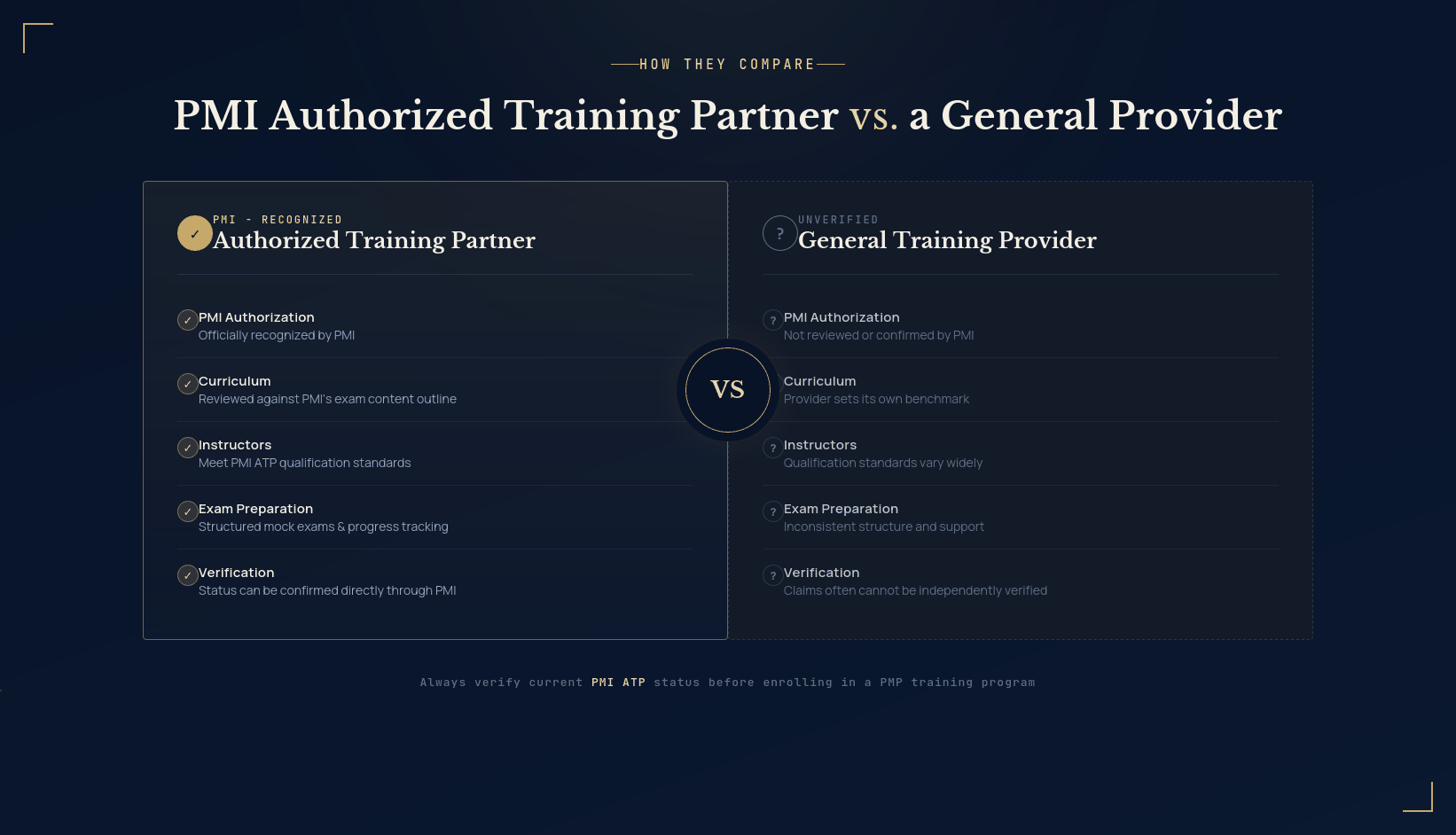
ATP curriculum is reviewed against PMI's standards, while non-authorized providers set their own benchmark, which can vary widely in depth and accuracy.
Instructor Quality
ATPs are expected to meet PMI's instructor qualification requirements. Non-authorized providers may or may not apply similar standards.
Training Structure
Authorized training tends to follow a defined, PMI-aligned structure. Non-authorized courses often follow whatever format the provider prefers.
Learning Resources
ATPs typically provide resources built specifically for PMI's exam content outline, rather than generic project management material.
Exam Preparation Support
Structured mock exams, practice questions, and progress tracking are more consistently built into ATP programs.
Verification and Credibility
Perhaps the simplest difference is that ATP status can be verified directly through PMI, while claims made by a general provider often cannot. This is one reason organizations enrolling teams through corporate training programs tend to check a provider's authorization status before signing off on a group booking. Candidates weighing multiple providers side by side often find it useful to read a broader comparison of what separates credible PMP training from marketing claims, such as our guide on 7 truths about PMP certification training that nobody tells you.
| Factor | PMI Authorized Training Partner | General Training Provider |
|---|---|---|
| PMI authorization | Officially recognized | Varies |
| Training structure | PMI-aligned | Provider-dependent |
| Instructor standards | PMI ATP requirements | Varies |
| Exam preparation | Structured | Varies |
| Learning experience | Standardized framework | Provider-dependent |
What to Look for When Choosing a PMI Authorized Training Partner
Verify Current PMI ATP Status
Authorization status can change, so it is worth confirming a provider is currently listed as an ATP rather than assuming a past claim still holds.
Check Instructor Qualifications
Ask about instructor background, certifications, and how much practical project experience they bring to the classroom.
Review Course Curriculum
A strong curriculum should map clearly to PMI's exam content outline rather than reading like a generic management course.
How to Verify a Provider Through the Official PMI ATP Portal
PMI maintains a searchable directory of currently authorized training partners on its official website. Before enrolling, candidates can search a provider's name directly in this portal to confirm active ATP status, rather than relying on logos or claims listed on a provider's own site. This step takes a few minutes and is the most reliable way to rule out providers using outdated or lapsed authorization. For a broader checklist on evaluating any PMI-aligned consultant or training provider not just ATP status see our guide on choosing a PMI consultant.
Evaluate Live vs. Self-Paced Training
Some candidates learn better through live, instructor-led sessions where they can ask questions as concepts come up, while others prefer the flexibility of self-paced study. Looking at how a provider runs its live PMP classes compared with its self-study bundle is a practical way to judge fit before enrolling. It also helps to see whether a training partner delivers structured, PMI-aligned programs beyond the PMP alone, such as PMI-ACP live classes, since that consistency across certifications is usually a sign of a mature ATP rather than a provider built around a single course.
Check Practice Exams and Learning Materials
Practice exams should reflect the tone and difficulty of the real PMP exam, not just recall-based questions.
Review Student Feedback and Testimonials
Genuine feedback from past candidates often reveals more about teaching quality than a provider's own marketing copy.
Consider Training Schedule and Accessibility
Candidates should think about whether the schedule realistically fits around their work and personal commitments before committing to a course.
Ultimately the smarter approach is to evaluate the actual training experience rather than choosing a provider based only on the lowest price, since a cheaper course that leaves gaps in understanding can end up costing more time and a second exam attempt.
How a PMI ATP Can Support Your PMP Exam Preparation
Understanding the PMP Examination Content Outline
A good ATP program is structured directly around PMI's exam content outline, which helps candidates understand not just what to study, but why each topic matters for the exam.
Building a Personalized Study Plan
Instructors and structured programs can help candidates figure out realistic timelines based on their existing project management background, which is especially useful when building a PMP study plan for working professionals who cannot dedicate full days to preparation.
Practicing Scenario-Based Questions
Since the PMP exam leans heavily on situational judgment, practicing scenario-based questions under guidance helps candidates learn how to reason through them rather than memorize answers.
Learning From Incorrect Answers
Reviewing wrong answers with an instructor, rather than just seeing a score, is often where the real learning happens.
Preparing for Different PMP Question Styles
PMP questions come in several formats, including multiple choice, multiple response, and matching, and structured training exposes candidates to all of them before exam day.
Developing Exam-Day Strategies
Time management, question-flagging strategy and pacing are all things a good ATP program covers, since knowing the content is only part of exam readiness. It also helps to stay current on the PMP certification timeline, since scheduling and eligibility steps can affect how a candidate paces their overall preparation.
Common Mistakes When Choosing PMP Training
Many candidates run into avoidable setbacks simply because of how they choose a provider. Common mistakes include selecting a course based only on the lowest price, skipping verification of ATP status, relying on outdated training material, overlooking instructor experience, not comparing PMP live classes vs. self-study options before enrolling, focusing preparation on memorization instead of understanding, failing to ask whether practice exams and ongoing support are included and assuming that every PMP course delivers the same learning experience when in reality, quality varies significantly between providers.
Is a PMI Authorized Training Partner Right for Every PMP Candidate?
Candidates Who Prefer Instructor-Led Learning
Those who learn best through discussion and real-time feedback tend to benefit the most from live ATP-led sessions.
Professionals With Limited Study Time
A structured schedule can help busy professionals stay consistent instead of falling behind on self-directed study.
Candidates Who Need Structured Guidance
Candidates newer to formal project management frameworks often need the step-by-step structure an ATP provides.
Experienced Project Managers Seeking Exam-Focused Preparation
Even experienced practitioners often benefit from exam-focused training, since real-world experience does not always map directly onto how PMI phrases exam questions. For those also weighing how certification fits into their broader career path a career advisory conversation alongside exam prep can help connect the two.
Candidates Who Prefer Self-Study
Some candidates, particularly those with strong self-discipline and prior exposure to PMI frameworks, may do well with self-paced options instead.
In the end the right learning format depends on a candidate's experience level, available time, preferred learning style and how much structure they personally need to stay on track.
Candidates based in the Middle East evaluating regional options can also see how ATP status applies to providers offering PMP certification training in Saudi Arabia.
Final Thoughts
Choosing where to train for the PMP exam is not a small decision, since the provider a candidate picks can influence how well they understand core concepts and how prepared they feel walking into the exam. PMI-aligned training, qualified instructors, structured preparation and dependable learning resources all play a part in that outcome and a PMI Authorized Training Partner is generally built to offer all of them together. That said, no training provider, authorized or not can guarantee exam success on its own. Candidates should compare providers carefully, ask direct questions, and choose based on the actual training experience rather than price alone. The right training partner will not do the studying for a candidate, but it can make the entire preparation process more organized, focused and effective.
Frequently Asked Questions (FAQ)
What is a PMI Authorized Training Partner?
It is a training organization formally reviewed and approved by PMI to deliver certification-aligned courses, including PMP training, based on PMI's standards for content and instruction.
Why should I choose a PMI ATP for PMP training?
An ATP typically offers PMI-aligned content, qualified instructors, and structured exam preparation, which together can make studying more organized and focused.
Does PMI ATP training guarantee that I will pass the PMP exam?
No. Training quality can significantly support preparation, but exam success still depends on the candidate's own study effort and understanding of the material.
How can I verify whether a provider is a PMI Authorized Training Partner?
ATP status can be confirmed directly through PMI's official resources rather than relying solely on a provider's own claims.
What should I look for in a PMP training provider?
Look at instructor qualifications, curriculum alignment with PMI's exam content outline, quality of practice exams, training format, and feedback from past candidates.
Is PMI ATP training better than self-study?
It depends on the candidate. ATP training offers more structure and guidance, while self-study offers flexibility, so the better option comes down to individual learning style and available time.
Is a PMI Registered Education Provider (R.E.P.) the same as an ATP?
Not exactly. R.E.P. was PMI's earlier version of this program. It has since been replaced by the PMI Authorized Training Partner framework, which includes stricter and ongoing monitoring rather than one-time approval.
Where can I check the official list of PMI Authorized Training Partners?
PMI publishes a searchable ATP directory on its official website, where candidates can confirm a provider's current authorization status directly rather than relying on the provider's own marketing.