PMP Study Plan
Preparing for the PMP exam while holding down a full-time job is one of the biggest challenges project managers face on the path to certification. Between client deadlines, team meetings and personal responsibilities, finding consistent study time can feel nearly impossible. Yet thousands of working professionals pass the PMP exam every year, and what separates them from those who struggle is rarely intelligence or experience it is a structured, realistic PMP study plan.
Busy professionals often run into the same obstacles: inconsistent study hours, information overload from too many resources and burnout from trying to cram everything into weekends. Without a clear roadmap, motivation fades quickly. This guide builds on the fundamentals of how to prepare for the PMP exam and lays out a practical, week-by-week PMP study schedule designed specifically for people who are studying around a full-time job, along with resource recommendations, time management strategies, and common mistakes to avoid along the way.
Why Working Professionals Need a Structured PMP Study Plan
A structured plan does more than organize study sessions it protects working professionals from the chaos that derails most PMP candidates.
Balancing Work, Family and Study
Full-time employees juggle multiple responsibilities every day. A study plan breaks PMP preparation into manageable blocks that fit around work hours and family commitments, rather than demanding unrealistic amounts of free time.
Avoiding Burnout
Cramming large volumes of content in short bursts leads to fatigue and reduced focus. A paced plan spreads learning evenly, allowing the brain to absorb concepts without overwhelming the candidate.
Improving Knowledge Retention
The PMP exam tests applied knowledge, not memorization. Spacing out study sessions over several weeks, rather than rushing through content, strengthens long-term retention and improves performance on scenario-based questions.
Staying Consistent Until Exam Day
Motivation naturally dips during long preparation periods. A written schedule with clear milestones keeps candidates accountable and reduces the temptation to postpone the exam indefinitely.
Before You Start Your PMP Study Journey
Before diving into a study calendar, a few preparatory steps make the entire journey smoother.
Review the PMP Eligibility Requirements
PMI requires either a four-year degree with 36 months of project management experience and 35 hours of training or a high school diploma/associate degree with 60 months of experience and the same training requirement. Confirming eligibility early prevents delays later in the process.
Understand the PMP Exam Content Outline (ECO)
The PMP exam is built around three domains: People, Process and Business Environment. Reviewing the official Exam Content Outline gives candidates a clear picture of what PMI actually tests, which helps prioritize study time on high-weightage topics rather than studying everything equally.
Gather the Right Study Resources
Rather than collecting dozens of scattered materials, working professionals benefit from a focused set of resources: the PMBOK® Guide, the Agile Practice Guide, a reliable mock exam bank, and a structured course. This becomes especially important given how the PMP exam has evolved in 2026, as outdated materials no longer reflect the current exam pattern.
Set a Realistic Exam Date
Booking the exam date early ideally after mapping out a 10–12 week plan creates a natural deadline that keeps preparation on track instead of drifting indefinitely.
Candidates who want a clearer picture of program options before committing to a timeline can review SnSCCS's PMP certification training to compare live and self-paced formats.
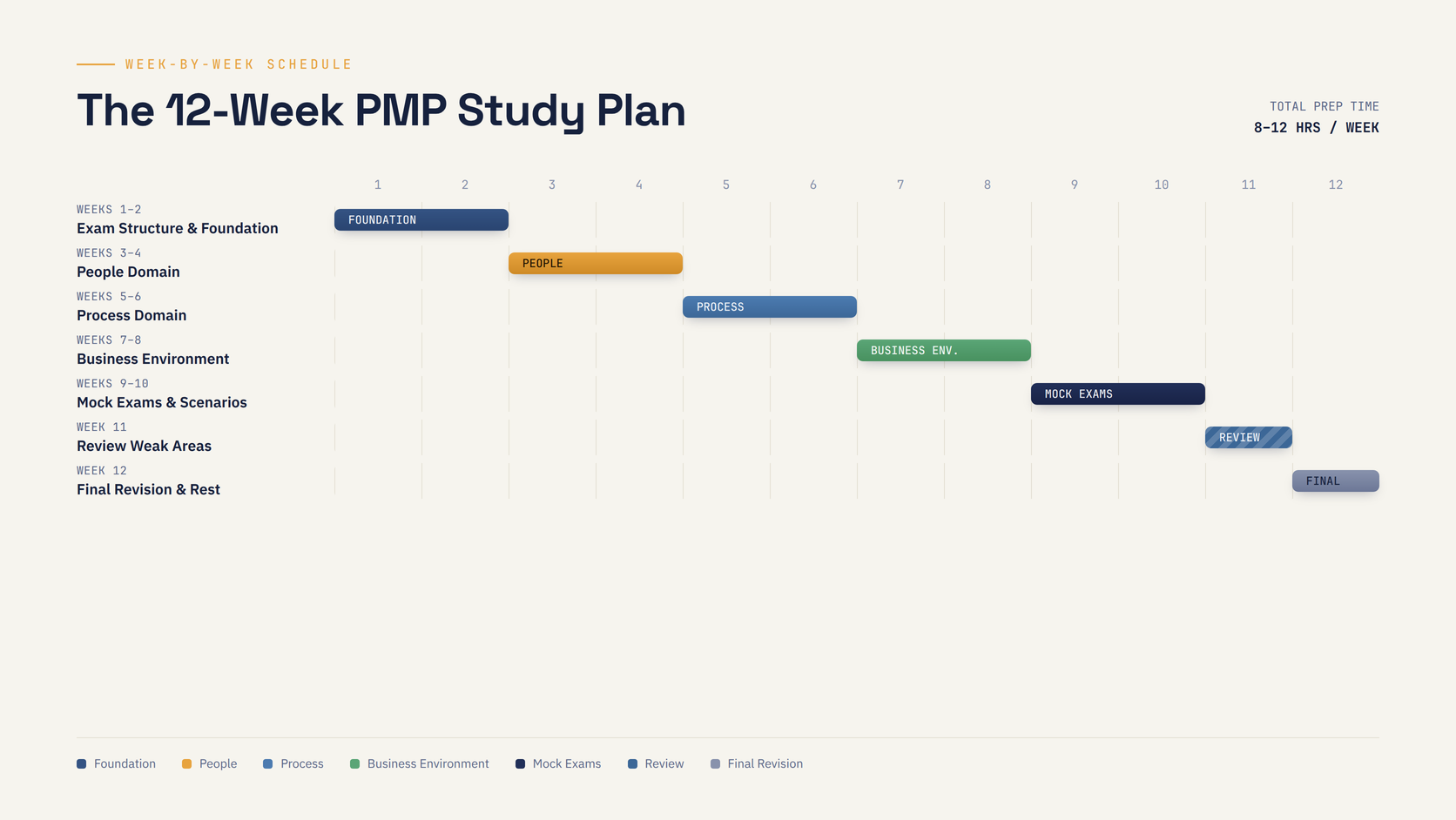
12-Week PMP Study Plan for Working Professionals
A 12-week timeline gives most working professionals enough breathing room to study consistently without burning out. This can be adjusted slightly based on individual pace, but the structure below works well as a baseline.
Weeks 1–2: Learn the Exam Structure and Build a Strong Foundation
The first two weeks should focus on understanding exam format, question types and the three domains. This is also the right time to read through introductory chapters of the PMBOK® Guide and get comfortable with core terminology before diving into deeper content.
Weeks 3–4: Study the People Domain
The People domain makes up the largest share of exam questions, covering team leadership, conflict resolution, stakeholder engagement and emotional intelligence. Working professionals often find this domain easier to relate to real workplace situations, which helps with retention.
Weeks 5–6: Master the Process Domain
This domain covers the technical side of project management scope, schedule, cost, quality, risk and procurement. Because it is the most detail-heavy section, professionals should slow down here and use practice questions to test understanding rather than just reading passively.
Weeks 7–8: Focus on the Business Environment Domain
Though smaller in weightage, this domain ties project outcomes to organizational strategy and compliance. Reviewing this alongside real project examples from the candidate's own work experience makes the content easier to remember.
Weeks 9–10: Practice Scenario-Based Questions and Mock Exams
The PMP exam relies heavily on situational judgment. These two weeks should shift almost entirely toward full-length mock exams and scenario-based practice, which mirrors the actual test experience far better than reading theory alone.
Week 11: Review Weak Areas and Revise Key Concepts
Using mock exam results, candidates should identify weak domains and revisit only those specific topics rather than re-reading the entire syllabus again.
Week 12: Final Revision and Exam Readiness
The final week is for light revision, formula and process-group reviews and rest. Heavy new learning at this stage tends to create confusion rather than confidence.
Faster Options: 4-Week, 6-Week and 8-Week PMP Study Plans
Not every candidate has 12 weeks to spare. If your exam date is closer than that, here's how to adapt the same domain-by-domain structure into a tighter timeline without skipping the fundamentals. For a deeper breakdown of how many hours each background level typically needs, see how hard the PMP exam really is.
6-Week PMP Study Plan
A 6-week plan compresses the same three domains People, Process and Business Environment into roughly double the weekly study load of the 12-week version. Expect 12–15 hours a week instead of 6–8. Weeks 1–2 cover the People and Business Environment domains together, weeks 3–4 focus entirely on Process (the largest domain) and weeks 5–6 shift to full-length mock exams and weak-area review. This pace works best for candidates who already have solid project experience and don't need extra time to absorb unfamiliar terminology.
4-Week PMP Study Plan
Four weeks is realistic only for candidates with strong hands-on project leadership experience and the ability to commit 15–20 hours a week. Week 1 covers all three domains at a fast pace using the PMI Examination Content Outline as a checklist rather than reading every PMBOK® Guide chapter in full. Week 2 goes deep on Process, since it carries the heaviest exam weighting. Week 3 is entirely mock exams and gap analysis. Week 4 is revision only no new content. Candidates without prior PM experience should avoid this timeline; the risk of surface-level understanding is high.
8-Week PMP Study Plan
An 8-week plan is often the most realistic middle ground for working professionals who can commit 8–10 hours a week but don't have 12 weeks before their exam date. It follows the same domain sequence as the 12-week plan, just with two weeks per domain instead of two-and-a-half and one dedicated week for mock exams instead of two.
Is a 2-Week PMP Study Plan Realistic?
Generally, no not for a first attempt. Two weeks is enough only to refresh material a candidate has already studied in depth (for example, before a retake or after completing a live class and needing a final review sprint). For first-time candidates building foundational understanding from scratch, PMI's own data on first-attempt pass rates suggests under-preparation is one of the most common reasons for failing, and 2 weeks rarely allows enough time for scenario-based practice across all three domains.
Choosing the right timeline comes down to two honest questions: how many hours can you realistically commit each week, and how much of this material do you already know from real project experience? Candidates unsure where they stand can sit in on a free class preview to gauge the pace before committing to a self-study timeline.
Best Study Resources for Busy Professionals
Choosing the right resources matters more than the quantity of materials collected.
PMBOK® Guide
The foundational reference for PMP terminology, processes and knowledge areas.
PMI Exam Content Outline (ECO)
The official document outlining exactly what the exam tests, useful for prioritizing study time.
Agile Practice Guide
Since the PMP exam blends predictive, agile and hybrid approaches, this guide is essential for the growing number of agile-related questions.
PMP Mock Exams
Full-length, timed mock exams are the single most effective tool for identifying knowledge gaps and building exam-day stamina.
Flashcards and Mobile Apps
Useful for short study bursts during commutes, lunch breaks or downtime between meetings.
Live Online or Instructor-Led Training
Structured, live sessions provide accountability, expert clarification of difficult concepts and a fixed schedule something many working professionals find hard to maintain on their own. In fact, candidates who train in an instructor-led format often report that live PMP classes build job-ready skills that mock exams alone cannot teach, making structured PMP live classes a strong option for professionals who need consistency and expert guidance built into their preparation.
Time Management Tips for PMP Success
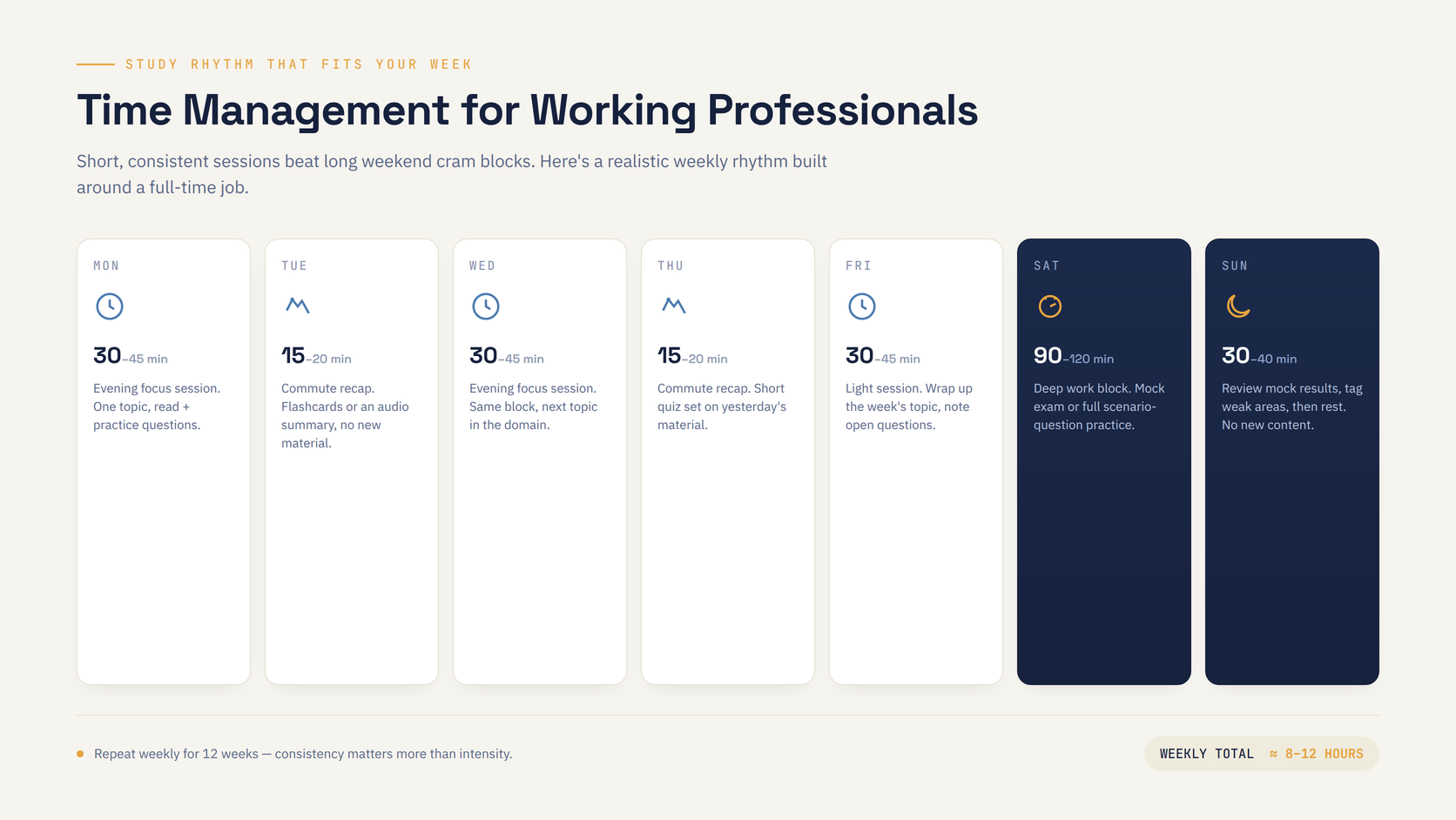
Create a Weekly Study Schedule
Blocking out specific days and times for study, just like a work meeting, makes preparation a non-negotiable part of the week rather than an afterthought.
Use Short Daily Study Sessions
Thirty to forty-five minutes of focused study daily is often more effective than one long weekend session, since shorter sessions are easier to sustain over 12 weeks.
Study During Commutes or Breaks
Audio summaries, flashcards and short practice questions make idle time commuting, waiting or lunch breaks productive without adding extra hours to the day.
Set Weekly Learning Goals
Breaking the syllabus into weekly targets, as outlined in the 12-week plan above, makes progress measurable and prevents last-minute cramming.
Minimize Distractions
A dedicated, distraction-free study space even for short sessions significantly improves focus and information retention.
Common Mistakes Working Professionals Should Avoid
- Studying without a plan and hoping consistency will happen naturally
- Skipping practice exams until the final week
- Waiting until weekends to study, which leads to long gaps in learning
- Ignoring Agile and Hybrid topics, which now carry significant exam weight
- Using outdated study materials that do not reflect the current exam version
- Trying to memorize processes instead of understanding how and why they apply
Staying Motivated Throughout Your PMP Preparation
Celebrate Small Milestones
Finishing a domain or completing a mock exam deserves recognition small wins keep long-term motivation alive.
Join Study Groups
Connecting with other PMP candidates, whether online or through a training cohort, provides accountability and different perspectives on difficult topics.
Track Your Progress
A simple tracker showing completed topics, mock exam scores and remaining weeks makes progress visible and keeps momentum going.
Maintain a Healthy Work–Study Balance
Preparing for the PMP exam is a marathon, not a sprint. Protecting sleep, downtime and family time ultimately leads to better focus during study sessions.
Final Thoughts
Passing the PMP exam while working full-time comes down to consistency, not the number of hours squeezed into a single weekend. A realistic 12-week study plan, built around focused daily sessions and regular mock exams, gives working professionals a clear path from start to exam day. Choosing the right resources, tracking progress, and avoiding common mistakes like last-minute cramming can make the difference between a stressful attempt and a confident pass. With a disciplined routine and steady effort, any working professional can prepare for the PMP exam without putting their career or personal life on hold.
Frequently Asked Questions (FAQ)
Can I pass the PMP exam while working full-time?
Yes. Most PMP candidates are working professionals. Success depends less on available free time and more on following a consistent, structured study plan over 10–12 weeks.
How many hours should I study each week?
Most candidates study between 8 and 12 hours per week, spread across short daily sessions rather than long weekend blocks, depending on prior project management experience.
Is a 12-week PMP study plan enough?
For most working professionals, 12 weeks provides enough time to cover all three domains thoroughly, complete multiple mock exams and revise weak areas without burning out.
What are the best study resources for busy professionals?
A combination of the PMBOK® Guide, the Agile Practice Guide, mock exams and either a self-paced course or live instructor-led training tends to work best for time-constrained candidates.
How many mock exams should I complete before the PMP exam?
Most successful candidates complete at least 4 to 6 full-length mock exams, using the results to identify and revise weak domains before exam day.
Is a 4-week PMP study plan enough?
Only for candidates with strong existing project leadership experience who can commit 15–20 hours per week. Without that background, a 4-week timeline usually leads to surface-level understanding rather than exam-ready judgment.
What's a realistic 6-week PMP study plan?
A 6-week plan works by compressing the same three-domain structure into roughly double the weekly hours of a standard 12-week schedule about 12–15 hours a week, with the final two weeks reserved for mock exams and revision.
Can I prepare for the PMP exam in 2 weeks?
Two weeks is realistic mainly as a final review sprint for candidates who've already studied the material in depth, not as a starting point for first-time preparation from scratch.