PMI Authorized Training Partner in Dubai
Dubai runs on delivery. Towers, metro extensions, data centres, logistics hubs and government programmes all need people who can plan, budget and finish projects and a recognised PMI credential is one of the clearest ways to show that ability. That is why many professionals start by searching for a PMI Authorized Training Partner in Dubai before they commit to any course.
The market is crowded though. Some institutes are formally authorised by the Project Management Institute (PMI). Others are capable independent trainers. A few simply use PMI’s name in their marketing. The difference affects what materials you study, who teaches you and how confident you can be about your PMP certification path. This guide explains what ATP status means, how to check it and what else to compare before paying a fee.
What Is a PMI Authorized Training Partner?
The Authorized Training Partner (ATP) programme is PMI’s quality framework for training organisations. PMI the body that owns the PMP, CAPM and other credentials, reviews a provider and, if approved, allows it to teach using PMI-developed course content delivered by PMI-authorised instructors. Providers are listed in a public directory on PMI’s own website.
Two points are worth separating. First, ATP status describes the training organisation and its course materials, not your exam result. Second authorisation is not permanent, so a provider that was listed last year may not be listed today. For a wider look at the topic outside Dubai, see why ATP status matters for PMP candidates.
Why PMI Authorization Matters When Choosing a Provider
- Official content: the course follows PMI-developed material rather than a trainer’s personal summary of it.
- Prepared instructors: teachers meet PMI’s programme requirements for the course they deliver.
- Structure: lessons follow a defined pathway, which helps working professionals who cannot afford to study in a scattered way.
- Learning resources: many ATP courses include official learning kits, though the exact inclusions differ by course.
- Accountability: the provider answers to a programme with standards, which is a useful signal when comparing similar-looking institutes.
ATP status is a quality indicator, not a complete verdict. Teaching style, student support and fit with your schedule still decide whether a course works for you.
Is an ATP Course Required for the PMP?
No. This is one of the most misunderstood points in Dubai’s training market. PMI asks PMP applicants to show 35 hours of project management education or to hold a CAPM. Those hours can come from any course that meets PMI’s requirements and an ATP course is one reliable way to get them. Eligibility also depends on education and years of project leadership experience, which the guide on requirements for project management professional certification sets out in full.
So the sensible question is not “do I need an ATP?” but “which route gives me official content, a clear completion certificate for the 35 hours and teaching I will actually follow?”
Which PMI Certifications Can You Prepare For?
Course availability varies by partner, but PMI certification training in Dubai commonly covers the following:
- PMP: for experienced project leaders. Related: PMP live classes.
- CAPM: for people building foundational project knowledge.
- PMI-ACP: for agile practitioners. Related: PMI-ACP live training.
- PMI-CP: for construction professionals, a relevant option in Dubai’s building sector.
- PMI-RMP: for risk specialists. Related: PMI-RMP live classes.
- PMI-PMOCP: for professionals working in project management offices. Related: PMOCP training.
- CPMAI: for those managing AI-related initiatives. Related: CPMAI live classes.
Never assume a partner teaches every credential. Confirm the exact course before enrolling.
How to Verify a PMI Authorized Training Partner in Dubai
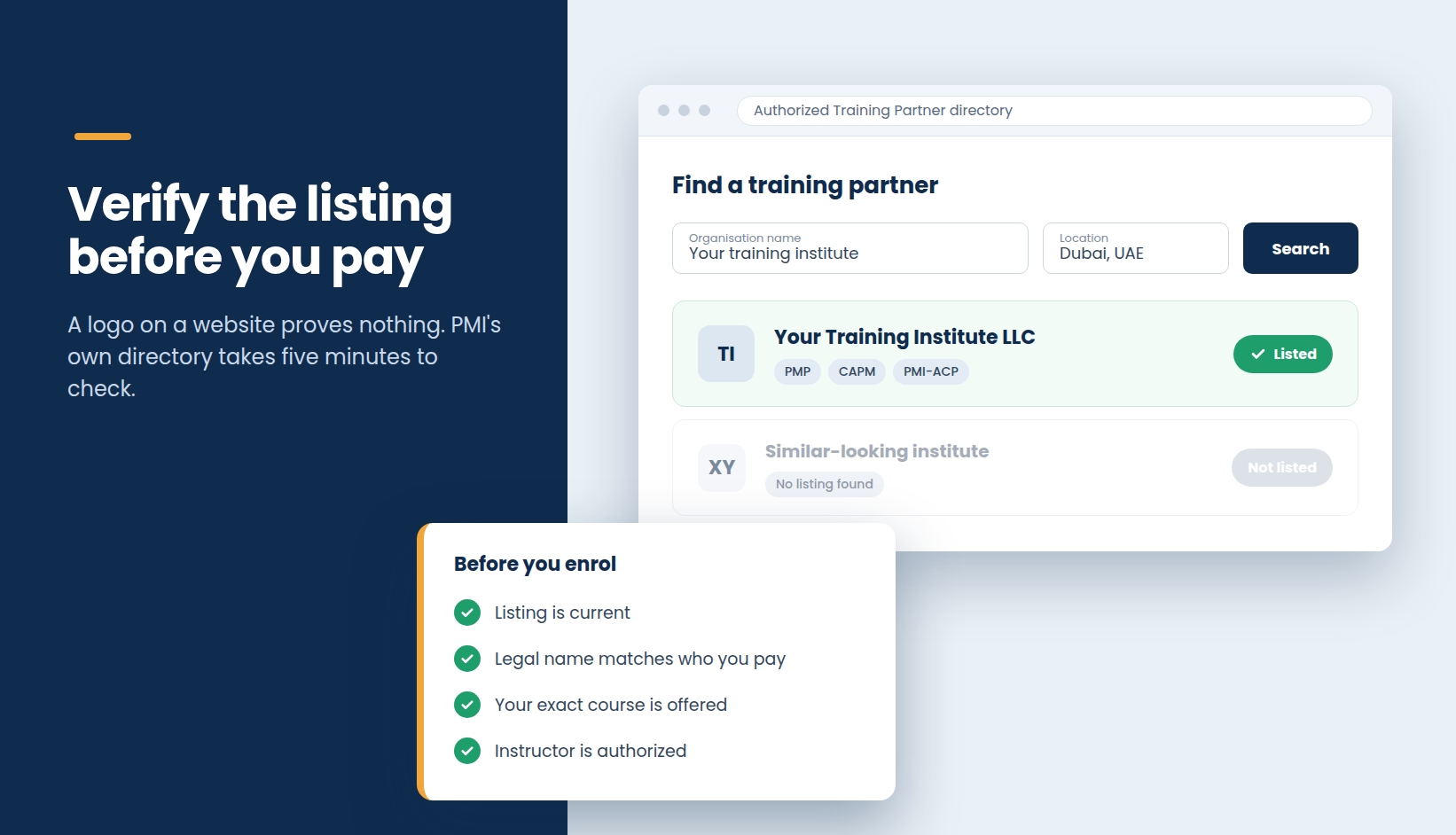
A logo on a website proves nothing by itself. A five-minute check on PMI’s official site is more reliable.
- Open PMI’s Authorized Training Partner directory.
- Search by organisation name and by location.
- Confirm the listing is current and that the legal name matches the company you will pay.
- Check that the specific certification course you want is offered by that partner.
- Ask who will teach your batch and how they are authorised.
- Ask whether the course uses official PMI-developed materials.
- Request the schedule, total hours, delivery format and what is included.
For institutes operating a physical training centre in Dubai, it is also reasonable to ask about approval from the Knowledge and Human Development Authority (KHDA), the emirate’s education regulator. That is a separate check from PMI authorisation and some providers hold both.
What Makes a Good PMI Training Course?
Whether a buyer is looking at a PMP training institute in Dubai or a specialist programme, the same questions apply:
- Does it cover the full exam syllabus? For the PMP, compare the topics against the PMP examination content outline.
- Is the instructor experienced and properly prepared for this credential?
- Are official PMI learning resources included?
- Are there practice questions and full mock exams and are they scenario based?
- Can you ask questions live, or is it largely pre-recorded?
- Is there revision support and help with the exam application?
- Will you receive a completion document that states the contact hours?
Compare what each course actually includes, not what the promotional banner says. The article on how to choose a PMP training provider offers a longer checklist.
Timing matters too. PMI updated the PMP exam content in mid-2026, so ask whether materials reflect the current outline. A summary of what changed is in PMP exam changes in 2026.
Classroom vs Live Online Training in Dubai
| Factor | Classroom | Live online |
|---|---|---|
| Interaction | Face to face, easy group discussion | Live Q&A through video |
| Travel | Commute across Dubai traffic | None |
| Schedule | Fixed centre timetable | Often evening or weekend batches in Gulf time |
| Best for | Learners who focus better in person | Busy professionals and shift workers |
Both can work when taught by an authorised programme. Live online sessions suit people commuting between Dubai and Abu Dhabi or working site hours, while classroom batches suit those who want peer discussion. Learners who want a personalised pace can look at one-on-one PMP coaching and the comparison of PMP live classes vs self-study helps weigh live teaching against recorded options. Language can also matter: some Dubai providers offer Arabic-medium batches, so ask early. For a realistic weekly plan, see the PMP study plan for working professionals.
How Much Does ATP Training Cost?
Fees differ because the products differ. Certification type, number of live hours, instructor access, mock exams, language and group size all change the price. Publicly listed PMP preparation fees in Dubai ranged from roughly AED 1,000 to AED 3,000 or more in October 2026, with live and one-to-one formats usually costing more than group or self-paced options. Treat that as a rough guide and confirm the current figure with the provider.
Keep three things separate:
- Training fee: paid to the provider for the course.
- PMI exam fee: paid to PMI when you apply for the exam, never through the training provider.
- Extras: additional mock exams, printed books or resit support may carry separate charges.
Ask for a written fee breakdown before paying, and weigh the whole package rather than the lowest number. Companies sponsoring several employees can also explore corporate project management training, where group pricing and tailored content are common.
Seven Mistakes to Avoid
- Enrolling without checking PMI’s directory.
- Treating a general training institute as an authorised partner.
- Choosing only on price.
- Ignoring the instructor’s background.
- Assuming every partner teaches every credential.
- Skipping questions about materials and support.
- Not reading the payment, rescheduling and refund terms.
A little checking before enrolment usually saves weeks of frustration later.
Frequently Asked Questions
Is ATP training mandatory for the PMP exam?
No. PMI requires 35 hours of project management education or a CAPM and an ATP course is one way to meet it.
Can I study online from Dubai and still count the 35 hours?
Instructor-led online courses are widely used for this. Confirm that your completion certificate states the contact hours before you pay.
Is the training fee the same as the PMI exam fee?
No. The training fee goes to the provider, while the exam fee is paid to PMI during your application.
How do I know an ATP listing is current?
Check PMI’s official directory directly and match the organisation’s legal name. Do not rely on a logo alone.
Does ATP training guarantee I will pass?
No. Good training improves preparation, but results depend on your experience, practice and exam-day performance.
Final Thoughts
For anyone weighing a PMI Authorized Training Partner in Dubai, the process is simple: verify the listing on PMI’s directory, confirm the exact course and instructor, compare what each fee includes and choose a delivery format that fits real working hours. Authorisation and official materials give a strong foundation, but they support preparation rather than replace it. A candidate who checks first and studies consistently is in the best position to earn the credential.