PMI-CPMAI Examination Content Outline
Introduction
Every PMI credential is built around one governing document and for the newest addition to PMI's portfolio, that document is the PMI-CPMAI Examination Content Outline (ECO). Released alongside the PMI Certified Professional in Managing AI (PMI-CPMAI)™ certification, the ECO tells candidates exactly what the exam will test, how heavily each area is weighted, and what competent looks like in the eyes of PMI. Skimming a course syllabus is not the same as reading the outline that the exam itself is built from and candidates who treat the two as interchangeable often study the wrong things in the wrong proportions. This guide walks through what the PMI-CPMAI ECO covers, why it matters more than any single prep book and how to turn it into a working study plan.
What Is the PMI-CPMAI Examination Content Outline?
Definition of the Examination Content Outline (ECO)
The ECO is PMI's official specification document for a certification exam. For PMI-CPMAI, it lists five domains, the tasks within each domain, and illustrative enablers that show what kind of work each task actually involves. It also states how many exam questions come from each domain, so nothing about the exam's structure is left to guesswork.
Why PMI Uses an Examination Content Outline
PMI doesn't build exams from opinion; it builds them from evidence. The PMI-CPMAI ECO was developed using a DACUM (Developing a Curriculum) job-task analysis, where a panel of AI project and product management practitioners facilitated by The Ohio State University identified 68 tasks that reflect real work in the field. Those tasks were then rated for importance, frequency and difficulty before being organized into the five domains seen in the final outline. That process is what gives the exam its validity.
Difference Between the ECO and Study Materials
A prep course or third-party study guide interprets the ECO; it doesn't replace it. Course authors decide how to teach a topic, but only the ECO decides whether that topic is fair game on exam day. When a study resource and the ECO disagree on emphasis, the ECO wins.
Who Should Use the PMI-CPMAI ECO?
The outline is most useful for:
- AI and ML project managers
- Product managers overseeing AI-driven features
- Program and portfolio leaders sponsoring AI initiatives
- Data and analytics leads working alongside project teams
- PMO leaders standing up AI governance practices
- Project managers transitioning from traditional delivery into AI-driven work
Readers who are still weighing whether the credential fits their career path may also want SNS's earlier breakdown of the PMI-CPMAI AI project management certification before working through the outline itself.
Understanding the PMI-CPMAI Examination Content Outline
The ECO organizes the exam into five domains, each carrying a different weight on the actual test.
Domain I: Support Responsible and Trustworthy AI Efforts (15%)
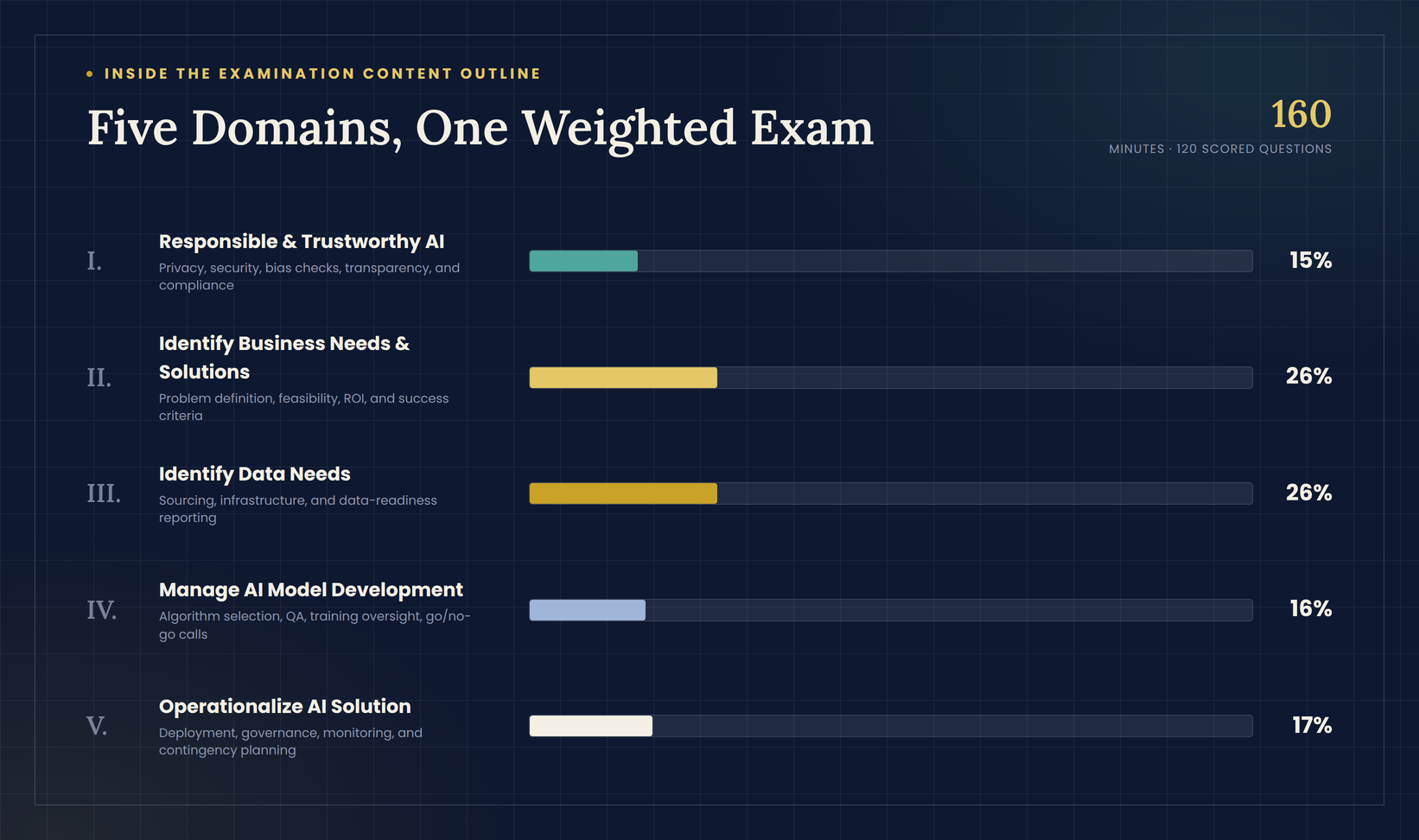
This domain covers the governance side of AI delivery: privacy and security planning, model and algorithm transparency, bias checks across data and outputs, regulatory and policy compliance and accountability documentation. It's a reminder that PMI-CPMAI isn't only about shipping a working model it's about shipping one that can be trusted and audited, a discipline SNS has also covered under AI literacy for leaders.
Domain II: Identify Business Needs and Solutions (26%)
The largest domain, tied with Domain III, focuses on the front end of an AI initiative: defining the problem, evaluating feasibility, running risk assessments, scoping the project, calculating ROI, managing adoption risk and setting success criteria. This is where a project manager decides whether AI is even the right tool for the problem at hand the same front-end discipline SNS unpacked in why AI projects really fail.
Domain III: Identify Data Needs (26%)
Also weighted at 26%, this domain covers everything that happens before a single model gets trained: defining what data is required, locating subject matter experts and data sources, coordinating infrastructure, gathering and evaluating data, and communicating data readiness to leadership. Data problems are the most common reason AI projects stall, which is likely why this domain carries so much weight.
Domain IV: Manage AI Model Development and Evaluation (16%)
This domain shifts into oversight of the technical build: guiding algorithm selection, managing quality assurance and configuration, overseeing training, managing data transformation, and making go/no-go calls on data and model readiness. Candidates aren't expected to code models they're expected to manage the people and decisions around building one.
Domain V: Operationalize AI Solution (17%)
The final domain covers what happens after a model is built: deployment planning and execution, model governance, performance monitoring, lessons-learned reporting, transition planning and contingency planning for AI system failures.
How to Use the PMI-CPMAI Examination Content Outline for Exam Preparation
Build a Domain-Weighted Study Plan
Since Domains II and III each carry 26% of the exam, they deserve roughly twice the study time given to Domain I. A plan that spends equal hours on every domain is misallocating effort before it even starts.
Study the Tasks, Not Just the Domain Titles
Each domain title is a heading; the real exam content lives in the tasks and enablers underneath it. Working through those line by line gives a far more accurate picture of what will actually be tested.
Practice Scenario-Based Reasoning
PMI-CPMAI questions tend to present a situation and ask for the best next step, not a definition. Practicing with scenario-style questions builds the judgment the exam is actually measuring.
Pair the ECO With PMI's Reference Materials
PMI lists specific supporting resources including its AI in Project Management guide and the Leading and Managing AI Projects Digital Guide that align directly with ECO content.
Reassess Progress Against the Domain Weights
Periodically checking readiness domain by domain, rather than topic by topic, keeps preparation aligned with how the exam is actually scored. Candidates building out a week-by-week timeline can pair this with SNS's dedicated PMI-CPMAI exam preparation guide for pacing and study sequencing.
Best Study Resources for the PMI-CPMAI Exam
The Official PMI-CPMAI Examination Content Outline
This remains the single most authoritative resource, since every exam question is mapped back to it.
The PMI-CPMAI Exam Prep Course
Completion of this course is mandatory before a candidate can even schedule the exam, making it the foundation of any prep plan rather than an optional add-on.
PMI's AI in Project Management Learning Materials
PMI's own published guides and blog resources on AI governance, ethics and data practices reinforce Domain I and Domain III concepts specifically.
Structured, Instructor-Led Training
Live, instructor-guided sessions help candidates work through the ECO's tasks in a structured order instead of self-navigating a dense document alone the format behind SNS's PMI-CPMAI live classes.
Practice Questions Aligned to the ECO Domains
Practice sets that clearly map each question back to a domain make it far easier to see where preparation is strong and where it isn't.
Common Mistakes Candidates Make
- Studying general AI theory instead of the CPMAI methodology PMI actually tests
- Treating all five domains as equally weighted
- Under-preparing for Domain II and Domain III, despite them carrying over half the exam
- Skipping the mandatory Exam Prep Course requirement in planning a study timeline
- Ignoring the governance and accountability content in Domain I
- Practicing only with recall-style questions instead of scenario-based ones
- Relying on outdated materials that predate the current ECO version
Tips to Master the PMI-CPMAI Examination Content Outline
Work Through One Domain at a Time
Isolating each domain before moving to the next keeps the study process from becoming overwhelming.
Connect Every Task to a Real Project Decision
Tasks like evaluate initial AI feasibility or verify model ready for operationalization are easier to remember when tied to an actual project scenario, past or hypothetical.
Use the Enablers as a Checklist
The enablers under each task are effectively a checklist of what doing the task well looks like useful for both study and later, real project work.
Track Domain-Level Readiness
Simple self-scoring by domain, rather than a single overall percentage, shows exactly where more time is needed.
Take a Full-Length Practice Exam Before Scheduling
A full 120-question run under timed conditions is the closest simulation of the real 160-minute exam experience.
Real-World Applications of the CPMAI Methodology
Structured AI Feasibility Assessment
Organizations use the same Domain II logic problem definition, feasibility, risk and ROI before committing budget to an AI initiative.
Data Readiness Reviews
Domain III's data-need identification process mirrors what data and analytics teams already do before any model training begins.
Responsible AI Governance Frameworks
Domain I maps closely to how enterprises are now building internal AI governance policies around privacy, bias and compliance.
Model Monitoring and Drift Management
Domain V's operationalization tasks reflect the ongoing monitoring work required once an AI system is live in production.
Cross-Functional AI Project Leadership
Across all five domains, the CPMAI methodology reinforces a project manager's role as the connector between business stakeholders, data teams, and technical builders a shift SNS has tied more broadly to the project economy and future of work.
Final Thoughts
The PMI-CPMAI Examination Content Outline isn't paperwork to skim before diving into a prep book it's the actual blueprint the exam is built from. Candidates who study its five domains in proportion to their real weighting, work through the tasks and enablers rather than just the headings and pair that with the required Exam Prep Course put themselves in a far stronger position than those relying on generic AI study material. Preparation that respects the outline's own weighting, rather than a generic study checklist, is consistently what separates a first-attempt pass from a retake.
Frequently Asked Questions (FAQ)
What is the PMI-CPMAI Examination Content Outline?
It's PMI's official document defining the five domains, tasks and question weightings that make up the PMI-CPMAI certification exam.
What topics are covered in the PMI-CPMAI exam?
Responsible and trustworthy AI, business needs identification, data needs identification, AI model development and evaluation and AI solution operationalization.
Is the Examination Content Outline enough to prepare for the exam?
It defines what to study, but candidates still need the mandatory Exam Prep Course, structured practice and scenario-based review to be exam-ready.
What are the best study resources for PMI-CPMAI?
The official ECO, the required Exam Prep Course, PMI's published AI project management guides and domain-mapped practice questions.
How should a PMI-CPMAI study plan be structured?
Around the domain weightings heaviest focus on Identify Business Needs and Solutions and Identify Data Needs, since together they make up more than half the exam.