PMI-RMP Exam Preparation
Introduction
Risk has become one of the most talked-about skills in project management and the PMI-RMP certification is the credential built specifically around it. As organizations run larger, more distributed and more technically complex projects, professionals who can identify, quantify and respond to risk are being asked to step into roles that go beyond traditional project execution.
Passing the exam, however is rarely about how much a candidate already knows. It comes down to how well that knowledge is organized before test day. Many candidates who understand risk concepts well still struggle because they never built a structured plan, misjudged the exam's scenario-based style, or ran out of time on their weaker domains. This guide walks through what the PMI-RMP exam actually tests, how to build a realistic study plan around it, which resources are worth the time, and the mistakes that most often derail first-attempt candidates.
What Is the PMI-RMP Certification?
Overview of PMI-RMP
The PMI Risk Management Professional (PMI-RMP) is a certification from the Project Management Institute that validates a professional's ability to identify project risks, assess their probability and impact, and build response strategies that protect project outcomes. Unlike broader certifications covering the full project life cycle, PMI-RMP is narrowly focused on one discipline: risk, across predictive, agile and hybrid environments.
Who Should Pursue PMI-RMP?
The certification tends to suit professionals who already sit close to project decision-making: project managers who own risk registers on complex initiatives, dedicated risk managers, PMO professionals responsible for portfolio-level risk visibility, program managers overseeing interdependent workstreams, project engineers in high-stakes technical environments, and team leads who need to defend risk-based decisions to senior stakeholders. Many candidates already hold PMP certification and pursue PMI-RMP as a way to specialize further, while PMO teams often pursue it collectively through corporate training programs built around a specific project portfolio.
Career Benefits
Holding the credential signals professional credibility that employers look for when staffing high-risk or high-budget projects. The preparation process itself sharpens practical risk skills that carry into daily project work and it often opens the door to advancement in industries like construction, IT, energy and government contracting, where risk exposure is constant. A deeper look at how PMI-RMP certification benefits employers and teams is worth reviewing before committing to a study plan and professionals unsure how the credential fits their next move can also work through career advisory support to map it against their goals.
Understand the PMI-RMP Exam Before Preparing
Exam Structure
The PMI-RMP exam is computer-based, delivered in a fixed two-and-a-half-hour window. Current test-takers report a format of around 115 questions, a portion of which are unscored pretest items PMI uses to evaluate future exam content. Since pretest questions aren't identifiable during the exam, every question should be treated as if it counts.
Exam Domains
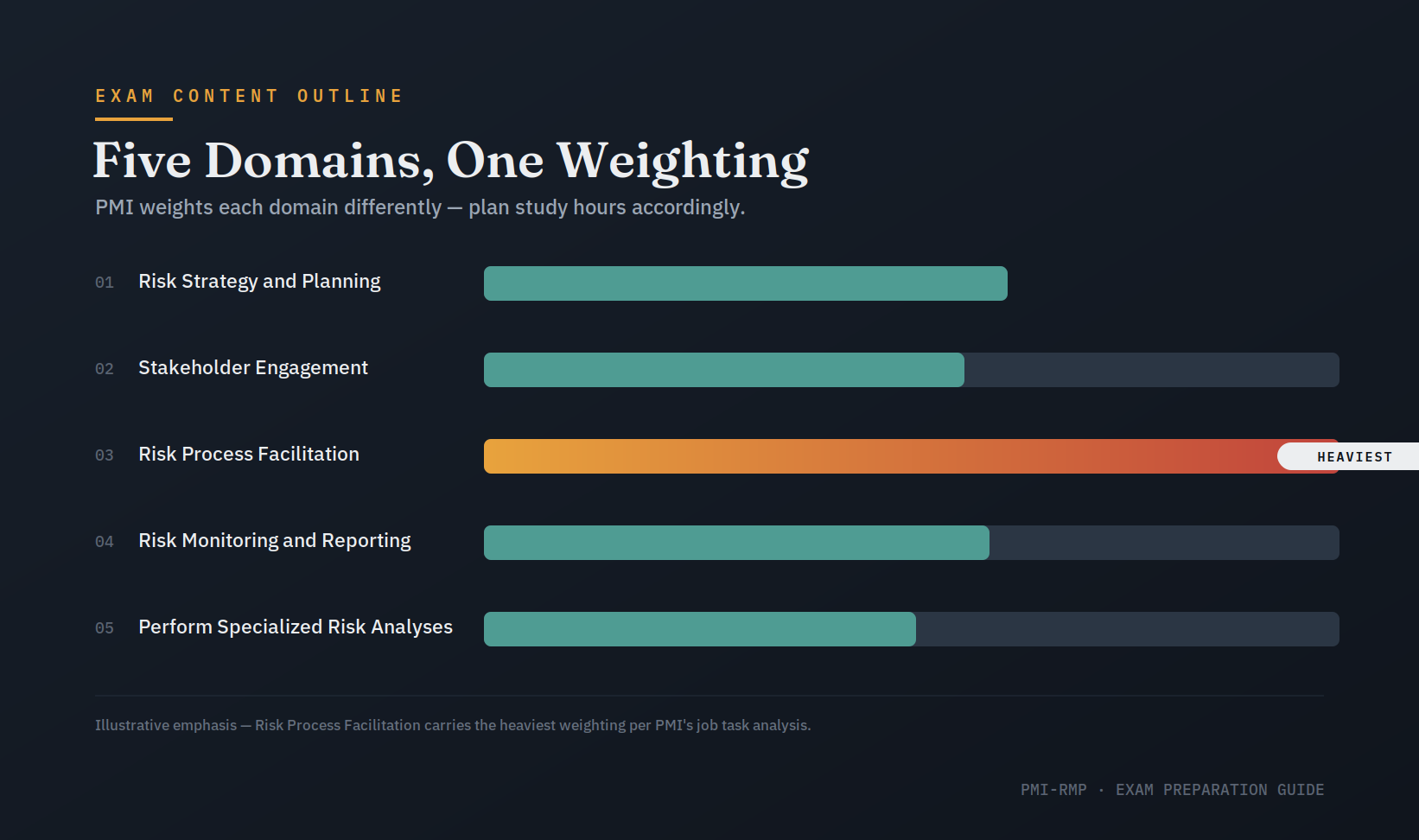
PMI structures the exam around five domains, each weighted differently based on real-world job task analysis: Risk Strategy and Planning, Stakeholder Engagement, Risk Process Facilitation, Risk Monitoring and Reporting and Perform Specialized Risk Analyses. Risk Process Facilitation typically carries the heaviest weighting, so study hours shouldn't be split evenly across all five.
Question Types and Time Management
Expect more than plain multiple-choice: single-answer, multi-select, matching and scenario-based items that place candidates inside realistic project situations. Several choices may look technically correct; the goal is picking the one that best reflects PMI's standardized risk approach. With roughly 115 questions in 150 minutes, candidates have a little over a minute per question on average and scenario items take longer to read than that pace suggests.
Build a PMI-RMP Study Plan
Assess Your Current Knowledge
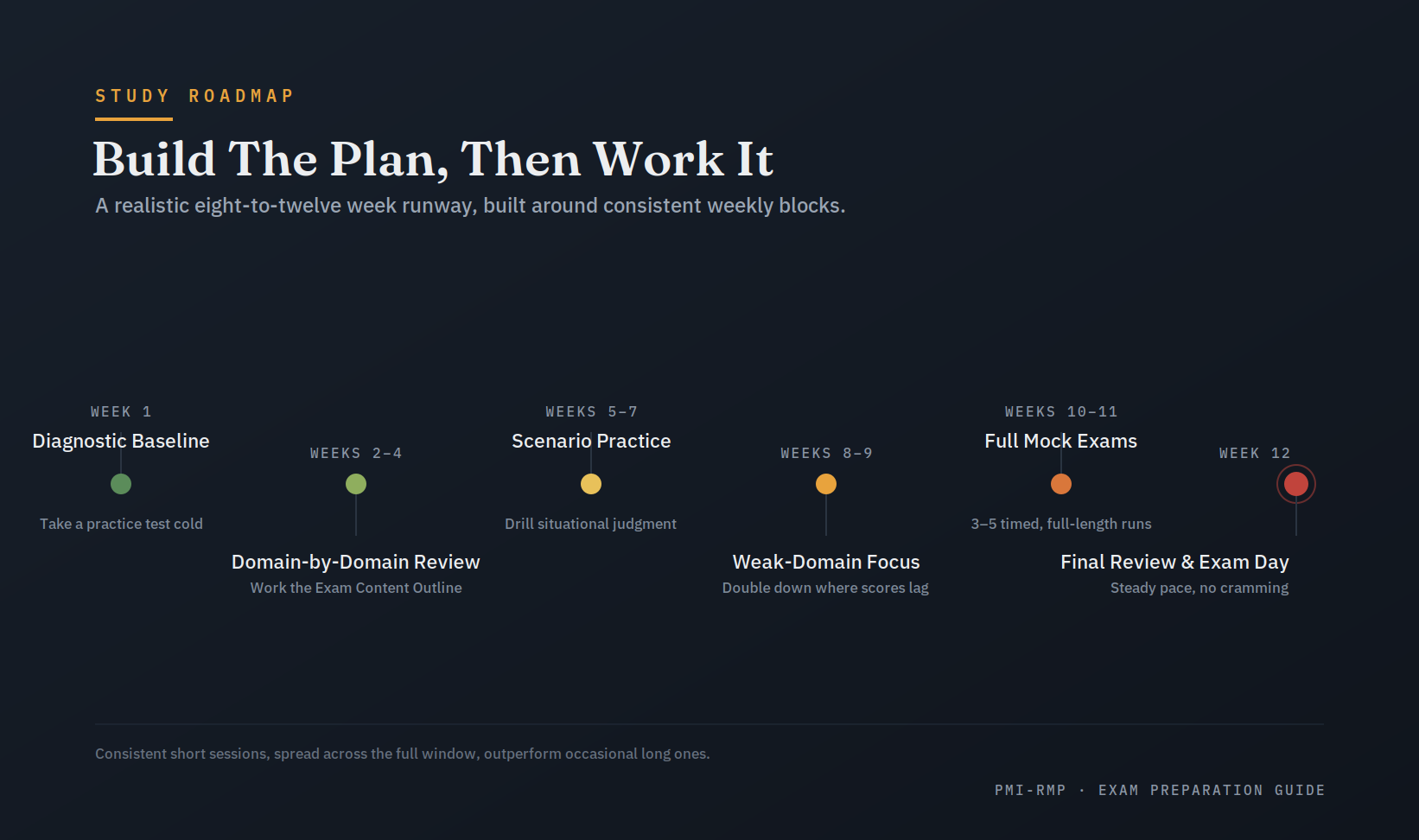
A study plan only works from an honest baseline. A diagnostic practice test before opening any prep material identifies which domains already feel comfortable and which need more attention.
Set a Weekly Study Schedule
Most successful candidates spread preparation across eight to twelve weeks, with consistent short sessions rather than occasional long ones, blocking specific hours for specific domains.
Break the Content into Manageable Topics
Rather than studying risk management as one broad subject, breaking the five domains down into their individual tasks, as listed in PMI's official Exam Content Outline, keeps sessions focused and progress measurable.
Track Progress and Balance Theory with Practice
A simple tracker logging practice scores by domain makes gaps obvious, so candidates stop reviewing material they already know while avoiding what actually needs work. Alternating concept review with scenario-based practice builds the applied judgment the exam tests, since PMI-RMP questions rarely reward memorization alone.
Best Study Resources for PMI-RMP Exam Preparation
The PMBOK® Guide remains a foundational reference for how risk fits into the broader project framework, particularly its sections on risk identification, analysis and response planning. PMI's official Exam Content Outline is arguably the single most important document in the process and should anchor the study plan rather than sit as an afterthought. Beyond that, working through scenario-based practice questions regularly, and later full-length timed mock exams, builds both familiarity with PMI's phrasing and the stamina to sit through 150 minutes of scenario-heavy testing.
Self-study works for some candidates and a self-paced study bundle can suit those who prefer to move at their own speed. Many others benefit from structured, instructor-led PMI-RMP live classes that walk through each domain with real project examples and keep preparation on a fixed schedule, which reduces the guesswork of deciding what to study next. Candidates weighing that decision can also sit in on a free PMI-RMP masterclass before committing to a full program. Peer discussion through a study group, meanwhile, often surfaces blind spots that solo study misses.
Proven Strategies to Pass the PMI-RMP Exam
Passing on the first attempt usually comes down to a handful of consistent habits: understanding the reasoning behind risk concepts instead of memorizing definitions, practicing scenario-based questions regularly so the exam's style feels familiar, reviewing every incorrect practice answer to understand why the right answer was right, putting extra hours into whichever domain scores lowest rather than the one that feels most comfortable, building a rough per-question pace for exam day and revising consistently across the full preparation window instead of cramming in the final days.
Common Mistakes to Avoid During Preparation
Several patterns show up repeatedly among candidates who don't pass on the first attempt: studying without a structured plan, ignoring the official Exam Content Outline in favor of generic material, taking too few full-length mock exams, relying on memorization instead of applied understanding, waiting until the final week to review weaker domains and treating risk terminology as optional rather than foundational to scenario questions.
Exam Day Tips for Success
Confirm identification and testing requirements well in advance and arrive early for an in-person exam or test the online proctoring setup the day before if testing remotely. Read each question fully before evaluating the answer choices, since key details often sit in the last sentence. Keep a steady pace, avoid over-investing in any single question, and stay calm through unfamiliar scenarios, since some ambiguity is built into the exam by design.
Final Thoughts
Passing the PMI-RMP exam on the first attempt depends far more on structured preparation than on natural aptitude for risk management. Candidates who assess their starting point honestly, build a realistic schedule around PMI's official Exam Content Outline and practice consistently with scenario-based questions put themselves in a strong position heading into test day. Success comes down to understanding how risk decisions are made, not memorizing definitions and that discipline is what separates a first-attempt pass from a second try.
Frequently Asked Questions
How long should I prepare for the PMI-RMP exam?
Most candidates spend eight to twelve weeks preparing, depending on existing familiarity with risk concepts and available weekly time.
Is the PMI-RMP exam difficult?
It's considered challenging mainly because of its scenario-based question style, not because the underlying concepts are unusually complex. Candidates who practice applying concepts to realistic situations tend to find it more manageable than those relying on memorization.
Which study resources are most helpful?
A combination of the Exam Content Outline, the PMBOK® Guide, scenario-based practice questions, and structured live training tends to cover both the knowledge and the exam-style judgment the test requires.
How many mock exams should I take?
At least three to five full-length, timed mock exams, spaced out so there's time to review and correct weak areas between attempts.
Can I pass the PMI-RMP exam on my first attempt?
Yes, for candidates who follow a structured study plan, work through the Exam Content Outline, and practice enough scenario-based questions to feel comfortable with the format before test day.