How Long Does It Take to Get PMP Certified?
Introduction
The PMP certification remains one of the most respected credentials in project management, recognised by employers across industries for proving that a professional can lead projects with structure, discipline and measurable results. Yet one question comes up again and again among candidates preparing to apply: how long does it actually take to get PMP certified?
The honest answer is that it depends. Some professionals complete the entire journey in a matter of weeks, while others spread it across several months around a full-time job. The certification timeline is shaped by eligibility status, application processing, study habits and how quickly an exam slot can be booked.
This guide walks through the complete 2026 PMP certification timeline stage by stage, the factors that speed it up or slow it down and realistic sample schedules so candidates can plan with confidence rather than guesswork.
Understanding the PMP Certification Journey
What Is the PMP Certification?
The Project Management Professional (PMP) certification is a globally recognised credential issued by the Project Management Institute (PMI). It validates a candidate's ability to manage people, processes, and business outcomes across predictive, agile and hybrid project environments, and it is widely regarded as one of the most valuable project management certifications available today.
Why Professionals Pursue PMP Certification
Beyond the credential itself, PMP certification signals credibility to hiring managers and clients. It often opens doors to senior project roles, stronger salary negotiations and a shared vocabulary with PMI-certified peers worldwide, which is part of why demand for structured PMP exam preparation continues to grow year after year.
Who Should Apply for PMP Certification?
The certification suits project coordinators, team leads and experienced professionals who already carry some project responsibility, whether formally titled or not. It is equally relevant for those managing projects informally within operations, IT, construction or corporate functions who want their experience formally recognised.
How Long Does It Take to Get PMP Certified? Full 2026 Timeline
On average, most candidates complete the full PMP certification process in two to six months, though the timeline can compress to a few weeks for well-prepared applicants or stretch longer for those juggling demanding schedules. Here is how the process breaks down stage by stage.
Step 1: Meet the PMP Eligibility Requirements
Before anything else, candidates need either a four-year degree with 36 months of project leadership experience and 35 hours of project management education or a secondary diploma with 60 months of experience and the same 35 hours of training. A closer look at the full eligibility requirements helps candidates confirm where they stand before applying. Gathering documentation for this stage typically takes one to three weeks, depending on how organised a candidate's project history already is.
Step 2: Submit Your PMI Application
Once eligibility is confirmed, the online PMI application itself takes roughly 60 to 90 minutes to complete, though candidates often spend a few extra days refining their experience descriptions to align with PMI's language and expectations.
Step 3: Application Review and Approval
PMI reviews most applications within five to ten business days. A small percentage are selected for audit, which can extend approval by an additional two to four weeks, so it helps to keep experience records handy from the start.
Step 4: Schedule Your PMP Exam
After approval, candidates receive an eligibility ID valid for one year and can book an exam slot immediately. Depending on testing centre or online proctoring availability, this step can take anywhere from a few days to two weeks.
Step 5: Prepare for the Exam
This is usually the longest stretch of the entire process, ranging from six weeks to four months depending on prior experience, study consistency, and whether a candidate is following a structured PMP exam preparation timeline or studying independently.
Step 6: Take the PMP Certification Exam
The exam itself is completed in a single sitting of around four hours, covering people, process and business environment domains based on PMI's current exam blueprint.
Step 7: Receive Your Certification and Maintain It
Results are available immediately after the exam, and the official certificate typically arrives within a few weeks. Certification remains valid for three years, after which continuing education credits are required to renew it.
Actual timelines vary from one candidate to the next, but this seven-step structure gives a realistic framework for planning.
Factors That Can Affect Your PMP Certification Timeline
Previous Project Management Experience
Candidates who already lead projects tend to grasp PMBOK® Guide concepts faster than those learning project terminology for the first time, which shortens the preparation phase considerably.
Weekly Study Hours
Someone dedicating 10 to 15 hours a week will naturally finish preparation faster than someone managing five hours around other commitments. Consistency matters more than any single long study session.
Learning Method (Self-Study vs. Instructor-Led Training)
Self-study offers flexibility but requires strong self-discipline and can stretch the timeline if momentum is lost, a trade-off worth weighing when comparing live classes against self-study. Structured, instructor-led PMP training tends to compress preparation time by keeping candidates accountable to a fixed schedule and clarifying difficult topics faster than solo study allows.
Work and Personal Commitments
Full-time employment, family responsibilities and travel all affect how much consistent time a candidate can realistically commit each week, which is often the single biggest variable in the entire timeline.
Exam Availability
Testing centre slots and online proctoring availability can vary by location and season, occasionally adding a week or two between completing preparation and sitting the actual exam.
Sample PMP Certification Timelines
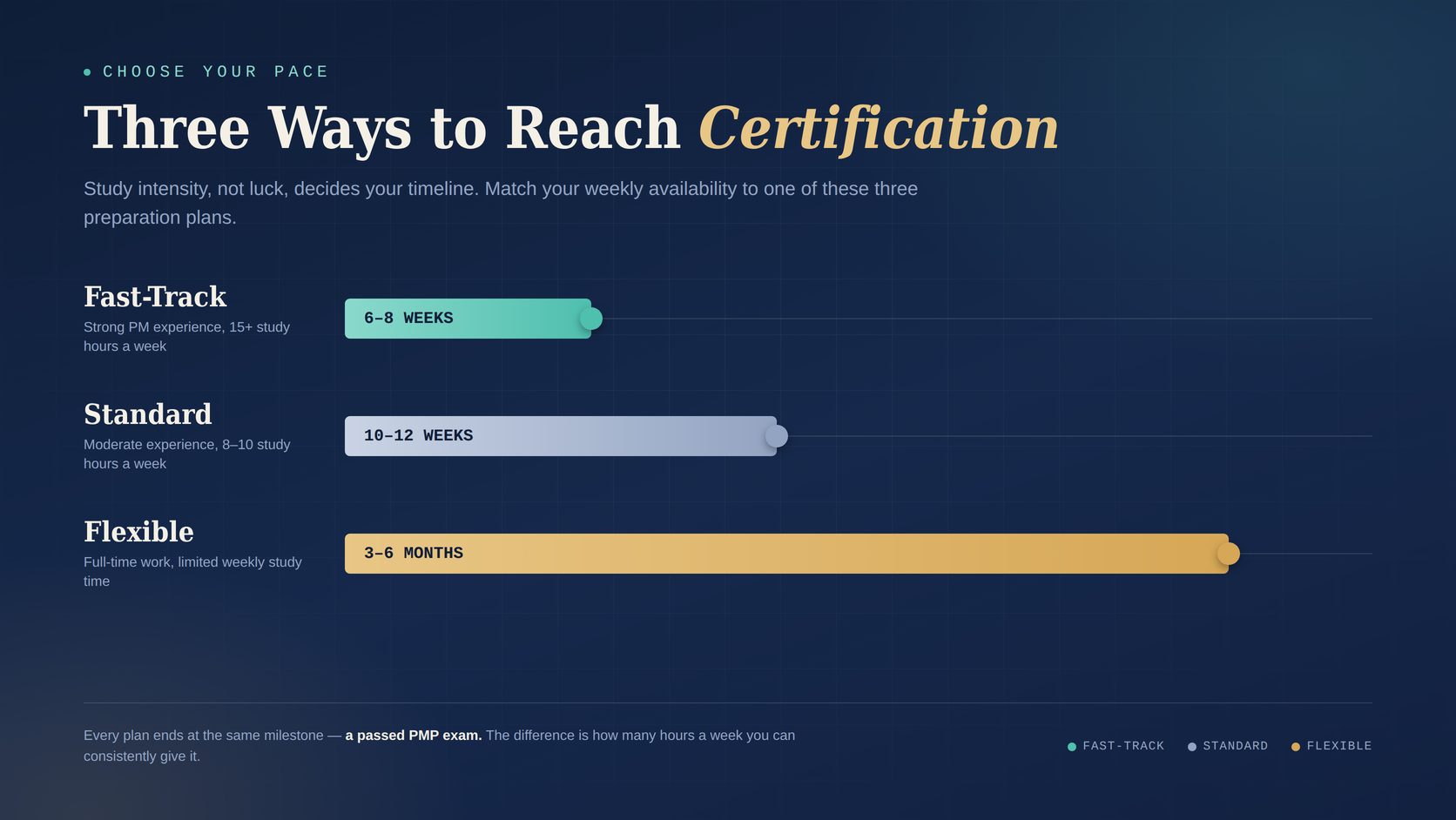
| Plan | Duration | Best Suited For |
|---|---|---|
| Fast-Track Plan | 6–8 weeks | Candidates with strong PM experience and 15+ study hours/week |
| Standard Plan | 10–12 weeks | Working professionals with moderate experience and 8–10 study hours/week |
| Flexible Plan | 3–6 months | Professionals balancing full-time work with limited weekly study time |
Fast-Track Plan (6–8 Weeks)
Suited to candidates with solid hands-on project experience who can commit significant weekly hours, often supported by intensive live classes that compress the PMBOK® Guide and PMP Exam Content Outline (ECO) into a tight schedule.
Standard Plan (10–12 Weeks)
The most common route for working professionals, balancing weekday study with weekend practice tests and steady progress through each knowledge area.
Flexible Plan for Working Professionals (3–6 Months)
Designed for candidates with unpredictable schedules, spreading preparation across several months with lighter weekly study loads and more frequent revision cycles.
Tips to Complete Your PMP Certification Faster
Verify Eligibility Early
Confirming eligibility before committing to a study plan avoids delays later in the process.
Create a Structured Study Plan
A week-by-week study plan mapped against the PMP Exam Content Outline keeps preparation focused rather than scattered, especially for candidates balancing full-time work.
Use Official PMI Resources
Relying on PMI-aligned materials, the current PMBOK® Guide and the official PMP Examination Content Outline reduces the risk of studying outdated content.
Take Regular Mock Exams
Frequent PMP mock exams build exam stamina and highlight weak knowledge areas well before exam day.
Schedule the Exam in Advance
Booking a firm exam date early creates accountability and prevents open-ended preparation from dragging on indefinitely.
Stay Consistent with Daily Study
Shorter, consistent daily sessions generally outperform infrequent long study marathons for retention and exam readiness.
Common Mistakes That Delay PMP Certification
- Waiting too long to submit the PMI application after meeting eligibility
- Choosing an unrealistic exam date without enough preparation time
- Using outdated or unofficial study materials
- Skipping practice exams until the final week
- Studying inconsistently instead of following a fixed schedule
- Ignoring weak knowledge areas instead of addressing them early
Professionals working through structured PMP live classes such as the cohort-based training run by SNSCCS often avoid several of these pitfalls simply because the schedule, materials and mock exams are already built into the course structure.
Final Thoughts
Getting PMP certified is rarely a single fixed timeline; it is a process shaped by eligibility, application review, exam scheduling and preparation habits. On average, candidates can expect anywhere from six weeks to six months depending on their starting point and weekly commitment. What matters most is building a realistic plan, using credible study resources, and staying consistent rather than rushing. Candidates who approach PMP certification with a clear schedule and steady preparation are far more likely to pass on their first attempt and move forward in their project management careers with confidence.
Frequently Asked Questions (FAQ)
How long does it usually take to get PMP certified?
Most candidates complete the process in two to six months, depending on experience level and weekly study time.
Can I become PMP certified in two months?
Yes, this is achievable for candidates with solid project experience who can dedicate 10 or more hours a week to focused preparation.
How long does PMI take to approve a PMP application?
Most applications are reviewed within five to ten business days, though audited applications may take longer.
How much time should working professionals dedicate to studying?
Eight to ten hours a week is a realistic target for most working professionals following a standard preparation timeline.
What is the fastest way to complete the PMP certification process?
Combining verified eligibility, a fixed exam date, and structured instructor-led preparation is generally the fastest path to certification