Introduction — The PMO Is Changing
The project management office is no longer the back-office function it used to be. For years PMOs were built around status reports, templates and compliance checklists. That model is fading. Organizations now expect their PMOs to influence strategy, strengthen governance, guide transformation programs and prove that project work actually contributes to business performance. Many organizations still treat the PMO purely as a reporting and governance function, even though its real value lies well beyond that.
This shift has changed what PMO professionals need to know. It is not enough to understand individual projects; a PMO leader must understand how projects, programs and portfolios connect to enterprise strategy. This is exactly the gap that PMI-PMOCP™ certification was designed to close. Offered by the Project Management Institute, the credential focuses specifically on the people who design, run, and improve PMOs not on general project execution.
As PMOs take on broader responsibility for governance, prioritization, and value delivery, the professionals leading them need a mix of business judgment, leadership skill, and structured PMO knowledge. The argument at the center of this article is simple: the PMO of the future needs professionals who can connect delivery work to business value and PMI-PMOCP™ is one of the clearest paths to building that capability.
What Is PMI-PMOCP™ Certification?
Overview of PMI-PMOCP™
PMI-PMOCP™ or the PMI PMO Certified Professional credential, is a certification created for professionals who work in or with a PMO. According to PMI, the credential validates the ability to lead and shape PMOs, respond to the realities of a specific organizational context, and drive measurable strategic value rather than simply reporting on project status. This makes it directly relevant to PMO managers, directors, and anyone responsible for how a PMO operates.
What Does a Modern PMO Professional Need to Understand?
A capable PMO professional today needs a working grasp of PMO principles, governance structures, stakeholder engagement, strategic alignment, value delivery, performance management and continuous improvement. These skills overlap constantly in day-to-day PMO decisions rather than functioning as separate checklists.
Why Specialized PMO Knowledge Matters
General project management experience is valuable, but it does not automatically prepare someone to design a PMO's operating model, resolve governance gaps or measure the value a PMO creates across an entire portfolio. Running a PMO is a different discipline from running a project, which is why specialized, PMO-specific knowledge the kind covered through structured PMI-PMOCP™ certification training carries real weight for professionals moving into these roles.
Why the Traditional PMO Model Is No Longer Enough
From Administrative Support to Strategic Partner
The traditional PMO model centered on reporting, project documentation, and compliance monitoring. The emerging model looks different: strategic decision support, portfolio visibility, organizational transformation and value measurement. This is often described as the shift from a PMO support function to a strategic partner and it is reshaping how leadership teams view the function entirely.
Changing Business Expectations
Executives now expect faster decision-making, greater transparency into where investment is going, better resource utilization and measurable business outcomes rather than activity counts. A PMO that only tracks tasks cannot answer these questions.
Increasing Project Complexity
As organizations run more digital initiatives, transformation programs and interdependent portfolios, complexity has increased sharply often faster than existing leadership models can handle. PMOs have to adapt their governance and prioritization approaches to keep pace or they risk becoming a bottleneck instead of an enabler.
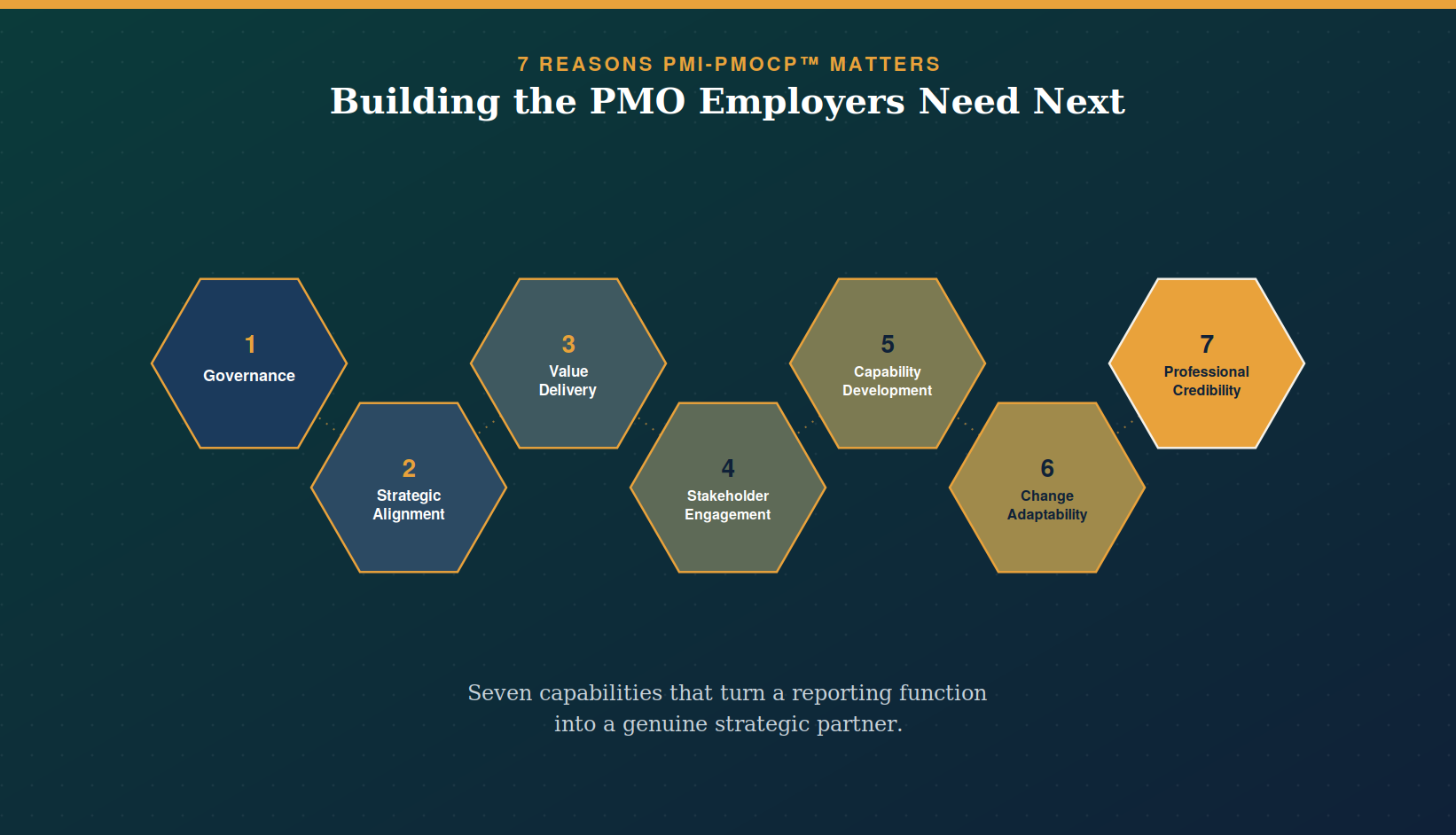
7 Reasons PMI-PMOCP™ Matters for the Future of the PMO
1. Strengthens PMO Governance
PMI-PMOCP™ helps professionals establish clear governance processes, support consistent decision-making, improve accountability and align governance structures with what the organization actually needs not a generic template. This connects closely to the broader discipline of PMO governance and delivery, where structure and consistency directly affect execution quality.
2. Connects the PMO With Organizational Strategy
A PMO that operates in isolation from strategy adds limited value. The certification reinforces how to link projects and programs to strategic priorities, helping leaders understand whether current investments genuinely support business objectives and close the gap between strategy and delivery.
3. Focuses the PMO on Value Delivery
Rather than measuring activity how many projects are open, how many reports were filed a value-oriented PMO measures outcomes and benefits. This mirrors the broader move toward a strategic, value-driven PMO transformation that many organizations are now pursuing.
4. Improves Stakeholder Engagement
PMO leaders sit between executives, project teams and business units. Strengthening this communication layer translating executive priorities downward and project realities upward builds the kind of organizational alignment a fragmented PMO struggles to achieve.
5. Supports PMO Capability Development
The certification encourages professionals to identify capability gaps, improve PMO maturity, standardize practices that fit the organization and build a habit of continuous improvement rather than a one-time setup.
6. Helps PMOs Adapt to Organizational Change
Agile and hybrid delivery models, digital transformation, new technologies and shifting business priorities all put pressure on PMOs to adapt. A PMO built on rigid, outdated processes cannot keep up with this pace of change.
7. Strengthens Professional Credibility
For individuals, the credential demonstrates specialized PMO knowledge, supports career growth into more senior roles and differentiates candidates in a market where general project management experience is common but PMO-specific expertise is not.
The Future PMO: From Project Support to Business Value
The Strategic PMO
Future PMOs are expected to contribute directly to strategic planning, investment decisions, portfolio visibility, risk management and benefits realization areas that used to sit entirely with executive leadership.
The Value-Oriented PMO
The underlying question is changing. Instead of asking how many projects are we managing, value-oriented PMOs ask what value are these projects actually creating. That single shift changes how a PMO reports, prioritizes and justifies its own existence, and it depends heavily on the kind of systems thinking that program, portfolio, and PMO leaders now need.
The Enterprise Perspective
To operate at this level, PMO professionals need to understand the organization as a whole its strategy, its constraints, its competing priorities rather than focusing narrowly on individual projects in isolation.
How Technology Is Transforming PMOs
AI and Automation
Automation is increasingly used to generate reporting, identify patterns across portfolios and support forecasting, reducing time spent on manual data compilation.
Real-Time Dashboards
Dashboards now give leaders live visibility into portfolio performance, resource utilization, risk indicators and overall project health, replacing static monthly reports.
Integrated Project and Portfolio Data
Connecting project data across systems improves decision-making and increases transparency across the enterprise, rather than leaving information trapped in separate tools.
Why Technology Does Not Replace PMO Leadership
Technology can surface information, but it cannot interpret it, communicate it to stakeholders or make a judgment call about what to prioritize. That responsibility still sits with the PMO professional, which is one reason structured PMO expertise remains relevant even as tools become more advanced.
PMI-PMOCP™ and PMO Maturity
Building a mature PMO involves assessing current capabilities, identifying gaps, designing improvement initiatives, establishing appropriate processes, measuring performance and creating a culture of continuous improvement. A mature PMO is not defined by how many processes it runs; it is defined by how well those processes fit the organization's size, strategy and project environment rather than adding unnecessary layers of governance.
Who Can Benefit From PMI-PMOCP™?
The credential is relevant to PMO managers, PMO directors and leaders, project managers who work closely with a PMO, program and portfolio professionals, project management consultants and professionals supporting broader organizational transformation. In short it applies to anyone who helps establish, run, improve or support a PMO function not only those with PMO in their job title.
How Professionals Can Prepare for the Future of PMO Leadership
Preparing for this shift involves developing strategic thinking, strengthening governance knowledge, learning to measure value rather than activity, improving stakeholder communication, building digital and data skills and understanding agile and hybrid delivery environments. These capabilities align closely with what a structured PMI-PMOCP™ training program is designed to build, alongside a genuine commitment to continuous professional development.
Final Thoughts — Building the PMO of Tomorrow
The PMO of the future is not an administrative back office; it is a strategic function expected to influence governance, value delivery, technology adoption and organizational transformation. PMI-PMOCP™ gives professionals a structured way to build the specialized knowledge this shift demands. Certification alone does not make an effective PMO leader practical experience and ongoing development still matter but it provides a credible foundation. As organizations continue to rely on projects to execute strategy, they will need PMO professionals capable of turning day-to-day project activity into measurable business value.
Frequently Asked Questions
What is PMI-PMOCP™ certification?
It is a PMI credential designed for professionals who lead, design, or work within a PMO, focused on governance, value delivery and strategic alignment rather than general project execution.
Why is PMI-PMOCP™ important for the future of the PMO?
Because PMOs are shifting from administrative reporting toward strategic influence, and the credential builds the governance, prioritization and value-measurement skills that shift requires.
What does a modern PMO do?
A modern PMO supports strategic planning, portfolio visibility, risk management and benefits realization not just project tracking and status reporting.
How can a PMO become more strategic?
By linking project and program work directly to organizational strategy, measuring outcomes instead of activity and taking an enterprise-wide view of priorities and risk.
What skills does a PMO professional need?
Governance knowledge, strategic thinking, stakeholder communication, value measurement and comfort with digital tools and agile or hybrid delivery models.
How does PMI-PMOCP™ support PMO maturity?
It reinforces how to assess capability gaps, design improvement initiatives and build a continuous improvement culture within a PMO.
Is PMI-PMOCP™ useful for project managers?
Yes, particularly for those who work closely with a PMO or want to move into PMO leadership, program management or portfolio-level roles.
How is technology changing the role of the PMO?
AI, automation, and real-time dashboards are taking over routine reporting, but PMO professionals are still needed to interpret data and guide decisions.