Introduction — Why Project Leaders Need to Be Future-Ready
Picture a program manager sitting across from a client who has just asked a question no exam ever prepared them for: How does this project reduce our environmental footprint and can you prove it in our next disclosure report? It's a fair question and an increasingly common one. Boards, regulators and customers are asking project teams to account for impact, not just output and most professionals were never trained to answer that kind of question with confidence.
This is the gap the CSPP™ certification PMI's Certified Sustainable Project Professional credential was built to close. Project leadership no longer looks the way it did a decade ago. Digital transformation, hybrid teams, sustainability regulation and constant business disruption have changed what organizations expect from the people running their most important initiatives. Technical planning skills schedules, budgets, scope documents are still necessary, but on their own they no longer prepare someone for the questions boards and clients are now asking. Being future-ready today means something broader than knowing a methodology. It means adapting quickly, thinking strategically, understanding how technology and sustainability shape outcomes, and communicating with confidence at every level of an organization. Leaders who keep building these capabilities are the ones best positioned to guide teams through uncertainty rather than simply react to it.
What Is CSPP™ Certification?
Understanding CSPP™
CSPP™ stands for Certified Sustainable Project Professional, a credential developed by PMI to help project professionals apply sustainability principles directly to project delivery from planning and procurement to governance and reporting. PMI describes the certification as a way to equip professionals to uncover hidden value, mitigate risk, build resilience, and deliver measurable, future-ready business outcomes a framing that goes well beyond a checklist of green initiatives. It sits alongside other specialized PMI credentials as a way to demonstrate a specific, in-demand capability rather than a general knowledge base. For anyone already holding a project management certification, adding CSPP™ signals the ability to connect day-to-day delivery decisions with wider organizational priorities such as risk reduction, resilience and long-term value creation.
In practice, CSPP™ centers on a handful of themes that run through nearly every module:
- Integrating sustainability into everyday project decisions rather than treating it as a separate, bolt-on activity
- Building resilience, reducing risk and creating long-term, measurable value rather than one-off wins
- The growing connection between project delivery and sustainability expectations from regulators, clients, and boards
- Preparing professionals to lead responsible, future-ready initiatives rather than simply compliant ones
- How this knowledge complements rather than replaces project, program, portfolio and strategic leadership capability
Why Future-Focused Project Leadership Matters
Organizations increasingly need leaders who combine strategic thinking with hands-on delivery skills people who understand governance, manage stakeholders across departments and translate business value into measurable outcomes rather than just a completed task list.
Certification vs. Practical Experience
A certification provides structure. It organizes knowledge that would otherwise be picked up slowly through years of trial and error. But no credential replaces real project experience. The professionals who benefit most from CSPP™ are usually the ones who pair it with active project work, using the framework to sharpen decisions they're already making on the job.
Why the Certification Matters Right Now
Sustainability has moved from a side conversation to a board-level priority, but PMI's own research into sustainability delivery found a consistent pattern: the gap organizations face isn't a lack of ambition, it's a lack of practical execution knowledge and that gap widens the closer a project gets to actual delivery. That's not a motivation problem it's a capability problem, and it's exactly the capability CSPP™ was designed to build. As more organizations face reporting frameworks tied to environmental and social performance, project leaders who can translate sustainability commitments into project-level decisions, controls and measurable outcomes are becoming genuinely difficult to find which is exactly what makes the certification valuable right now rather than in some distant future.
What Professionals Will Learn
CSPP™ study covers the practical mechanics of embedding sustainability into a project, not just the theory behind it. That typically includes applying recognized sustainability frameworks to identify and measure impact across a project's lifecycle, building documentation that holds up against enterprise reporting and disclosure requirements, and using scenario planning to turn potential disruption into a manageable, adaptive response rather than a crisis. It also means learning how to connect project-level decisions procurement choices, resource use, delivery timelines to the kind of impact metrics boards and clients now expect to see reported. None of this is theoretical for long; it maps directly onto decisions project leaders are already making, just with a sharper lens for evaluating trade-offs.
Why the Project Leadership Landscape Is Changing
Several forces are reshaping what it means to lead a project well.
Project complexity keeps increasing. Global teams, overlapping stakeholders, interdependent workstreams and requirements that shift mid-cycle are now the norm rather than the exception.
Technology is changing how projects get delivered. AI, automation and data analytics are being built into scheduling tools, risk dashboards, and reporting systems, while digital collaboration platforms have made distributed delivery standard practice.
Business priorities move faster than project plans do. Market uncertainty, shifting customer expectations, new regulatory requirements including sustainability and ESG disclosure rules and economic pressure all force leaders to revisit assumptions mid-project.
Leaders are managing change, not just tasks. The shift is away from tracking activities and toward guiding people, decisions and transformation efforts that determine whether a project actually delivers business value.
7 Reasons CSPP™ Can Help Project Leaders Prepare for the Future
1. It strengthens leadership capability. Working through sustainability-focused scenarios sharpens decision-making, helps leaders manage diverse teams and reinforces accountability across functions.
2. It supports strategic thinking. CSPP™ pushes professionals to connect individual projects to broader organizational goals and prioritize initiatives based on the value they create rather than just their urgency. Professionals building this muscle further often pair certification study with structured executive training focused specifically on strategic decision-making at a leadership level.
3. It encourages adaptability. Sustainability priorities and regulatory expectations shift regularly, so the certification builds habits around responding to changing requirements rather than sticking rigidly to an original plan.
4. It improves stakeholder management. Leaders learn to communicate sustainability and resilience considerations to executives, manage competing expectations, and build alignment among stakeholders who don't share the same priorities.
5. It develops a broader business perspective. CSPP™ encourages professionals to think about cost, ROI and long-term business performance rather than treating "project complete" as the finish line echoing PMI's own research on the gap between sustainability ambition and delivery, which found organizations struggle less with intent and more with the practical knowledge needed to execute.
6. It supports digital-age project leadership. Understanding how AI-driven forecasting, risk analysis, and performance dashboards fit into delivery helps leaders work effectively with increasingly data-driven, distributed teams.
7. It supports professional credibility. A recognized, sustainability-focused credential demonstrates ongoing commitment to growth and can support career progression into program, portfolio, or PMO-level roles.
What Makes a Project Leader "Future-Ready"?
A future-ready project leader understands how individual initiatives connect to organizational strategy, not just how to execute them. They stay adaptable as business conditions shift and they build enough digital awareness to understand how emerging technologies affect delivery without needing to become a technical specialist themselves. People leadership matters just as much: coaching, clear communication, collaboration, and the ability to manage conflict constructively. Perhaps most importantly, future-ready leaders shift their internal measure of success. Instead of asking did we complete the project, they ask did the project create the value it was meant to create. That single shift in mindset changes how priorities, trade-offs, and risks get evaluated throughout delivery.
How Technology Is Changing the Role of Project Leaders
Artificial intelligence is now used for automation, forecasting, risk analysis and decision support across many project environments. Project analytics tools generate performance dashboards and predictive insights that let teams make decisions based on data rather than instinct alone. Collaboration technologies have made it normal for teams spread across time zones to deliver complex work together. Yet none of this removes the need for human leadership. Technology can improve the speed and quality of information, but project leaders remain responsible for judgment calls, stakeholder alignment, ethical considerations and the kind of communication no dashboard can replace.
CSPP™ and the Shift From Project Management to Project Leadership
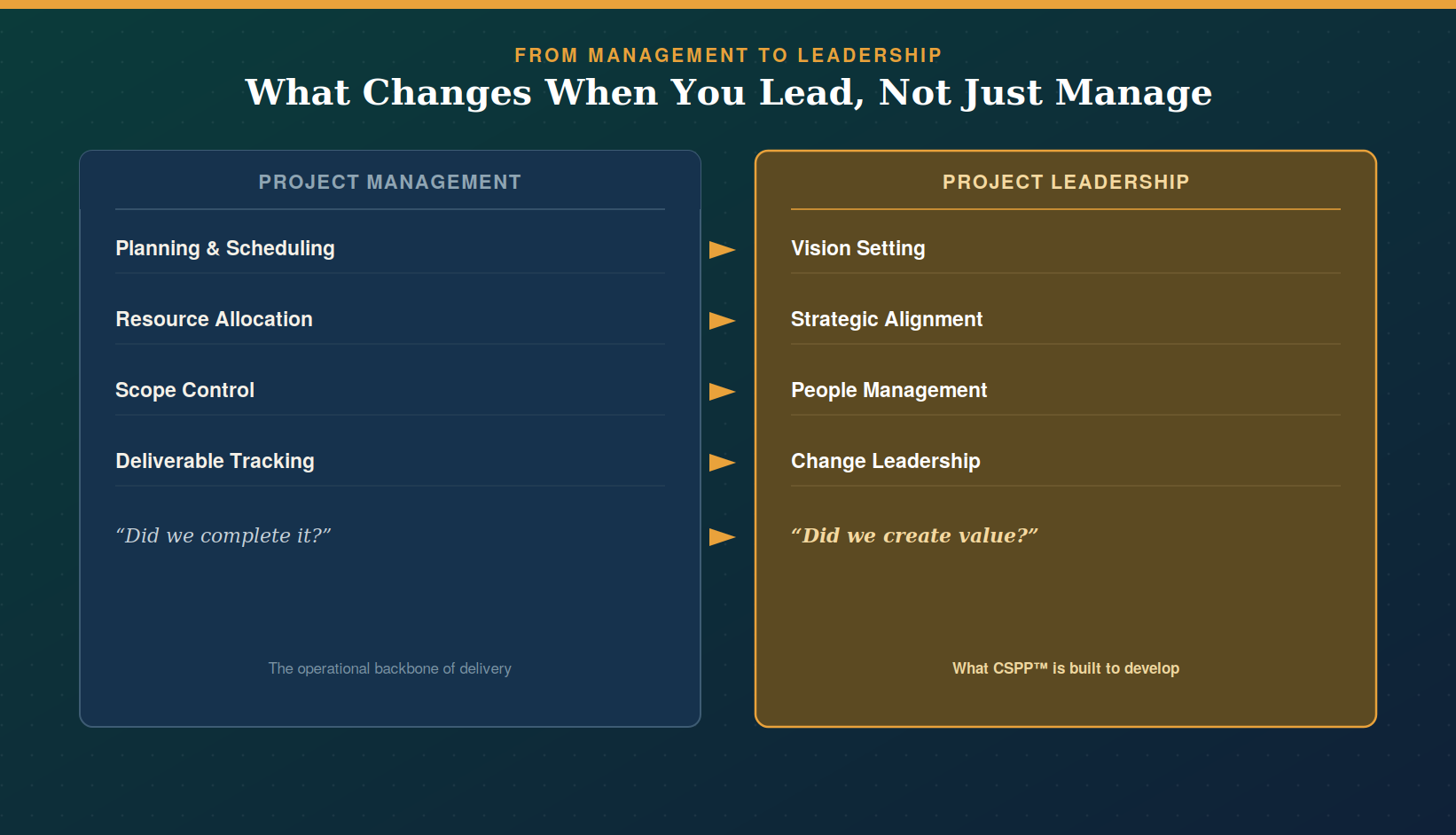
Traditional project management leans heavily on planning, scheduling, resource allocation, scope control, and deliverable tracking the operational backbone of any initiative. Project leadership expands well beyond that into vision setting, strategic alignment, people management, change leadership, business value and influence across the organization. This distinction matters more now than ever, because organizations need professionals capable of doing both: managing execution with discipline while also leading people toward outcomes that matter to the business as a whole. Many of the organizational shifts described in how PMOs are moving from a support function to a strategic partner reflect exactly this transition.
How the Knowledge Applies on the Job
The value of CSPP™ shows up less in the certificate itself and more in how a project leader starts framing everyday decisions. A procurement choice stops being purely about cost and starts factoring in supply chain resilience. A risk register starts including disruption scenarios tied to regulation or resource availability, not just schedule and budget risk. Status reports to executives begin speaking the same language as enterprise sustainability reporting, which makes it far easier for a project leader to hold their own in conversations that used to happen without them. None of this requires a separate workflow it's the same project, viewed through a wider lens.
Who Can Benefit From CSPP™?
Project managers looking to build leadership capability beyond core execution skills will find the sustainability lens adds a new dimension to how they evaluate trade-offs.
Program and portfolio professionals managing initiatives with organization-wide impact can use CSPP™ to connect delivery decisions to enterprise reporting and long-term value a theme also explored in why PfMP is a strategic investment for leaders.
PMO professionals responsible for governance often find the certification useful for embedding sustainability into standard frameworks.
Project coordinators and emerging leaders preparing for greater responsibility can use CSPP™ as a stepping stone toward broader roles.
Experienced project leaders looking for structured, credible development alongside their existing track record are a natural fit.
How CSPP™ Supports Career Growth and Promotion Readiness
Promotion decisions rarely come down to who can run a schedule the best. They come down to who a leadership team trusts to represent the organization's priorities in front of a client, a regulator or a board and sustainability has quietly become one of those priorities. A project manager who can speak fluently about resilience, risk, and measurable impact has a real advantage when a program or portfolio role opens up, because that conversation is already happening at the level above them. CSPP™ won't substitute for a track record of delivery, but paired with one, it gives a hiring manager or promotion committee a concrete reason to see a candidate as ready for broader responsibility rather than simply due for one.
How to Become a More Future-Ready Project Leader
Building continuous learning habits is the foundation staying current with both project management practice and broader business trends. Developing digital literacy around AI, analytics, and automation helps leaders keep pace with how delivery tools are evolving. Strengthening communication across technical teams, executives, and external stakeholders remains one of the highest-value skills a project leader can build. Developing strategic thinking means understanding how individual projects tie back to business objectives, not just completing tasks on a plan. Learning from real projects both successes and failures builds judgment that no course alone can teach. Many professionals also work with a career advisory service to map out which certifications and experiences will move them toward the leadership roles they're targeting using structured guidance to pursue relevant credentials such as CSPP™ alongside hands-on project work.
Why Candidates Should Train Through a PMI Authorized Training Partner
Not all exam prep is created equal, and this matters more for a newer, less widely understood credential like CSPP™. A PMI Authorized Training Partner (ATP) delivers training that has been reviewed against PMI's own standards for content accuracy, exam alignment, and instructional quality which reduces the risk of studying material that's outdated or misaligned with what the exam actually tests. For a certification built around evolving sustainability frameworks and reporting standards, that quality control isn't a minor detail; it directly affects whether the training actually prepares a candidate for both the exam and the job. The reasons this matters are laid out in more detail in why a PMI Authorized Training Partner matters for certification training, and the same logic applies just as directly to CSPP™ as it does to PMP®.
Why SnSCCS Provides a Distinctive Learning Experience
SnSCCS approaches certification training as preparation for the job, not just the exam. Rather than working through slides in isolation, candidates train alongside instructors who connect sustainability frameworks to real project scenarios, so the concepts hold up once they're back at their desk facing an actual stakeholder question. Professionals can choose the format that fits how they learn and work structured live classes, a self-study bundle for those who prefer to pace themselves, or one-on-one training for a more personalized path. For leaders and teams looking to build this capability at an organizational level, SnSCCS's executive training programs are built specifically to connect certification-level knowledge with the strategic decision-making expected at senior levels, while corporate training options extend the same approach across an entire team or department.
Frequently Asked Questions (FAQ)
What is CSPP™ certification?
CSPP™ or Certified Sustainable Project Professional, is a PMI credential that helps project professionals apply sustainability principles to real project delivery, including planning, governance, procurement and reporting.
Why is CSPP™ considered a future-ready certification?
It addresses skills organizations increasingly expect from project leaders: connecting delivery to business value, managing resilience and risk and responding to regulatory and stakeholder expectations around sustainability.
Who should consider CSPP™?
Project managers, program and portfolio professionals, PMO staff, emerging leaders and experienced project professionals looking to broaden their leadership capability.
What skills do future-ready project leaders need?
Strategic thinking, adaptability, digital awareness, stakeholder management and a value-oriented approach to measuring project success.
How is project leadership different from project management?
Project management focuses on planning, scheduling, and delivering scope. Project leadership expands into vision, strategy, people, change and organizational influence.
Why are digital skills important for project leaders?
AI, automation and analytics are now built into how projects are planned, tracked, and reported, so leaders need enough digital fluency to interpret and act on that information.
How can project professionals prepare for future leadership roles?
By combining continuous learning, real project experience, stronger communication skills and relevant certifications that demonstrate applied capability rather than theory alone.
Final Thoughts — Preparing for the Next Generation of Project Leadership
The project profession keeps evolving and traditional project management techniques on their own are no longer enough to prepare someone for a leadership role. What matters now is a combination of leadership, adaptability, strategic thinking, digital awareness, stakeholder management and a genuine focus on delivering value rather than just completing tasks. CSPP™ fits naturally into a broader professional development strategy for anyone building toward that kind of role, but it works best as a complement to experience, not a replacement for it. The project leaders who will stand out in the years ahead are the ones who can navigate uncertainty, lead people through change use technology intelligently, and consistently connect project delivery back to real business value.
Ready to Build Future-Ready Leadership Capability?
Certifications like CSPP™ carry the most weight when they're backed by training that connects the material to real decisions leaders face on the job. If you're a project professional looking to strengthen strategic and sustainability-focused leadership skills or an organization looking to build that capability across a team explore SnSCCS's executive training programs or get in touch to talk through the right path for where you are in your career.