PgMP® Certification Requirements
Program managers who lead multiple related projects toward a single strategic outcome eventually reach a point where a project-level credential no longer reflects the scope of their work. That is usually the moment the PgMP® (Program Management Professional) certification enters the conversation. Before anyone applies, though, PMI expects candidates to meet a specific set of PgMP certification requirements covering education, project management experience and program management experience.
Unlike entry-level credentials, PgMP eligibility is not a simple checklist. It involves layered experience thresholds, documentation that PMI reviews closely and an application process that can include an audit. Understanding these requirements before starting the application saves time, prevents rejected submissions and helps candidates plan their study path with confidence. This guide breaks down who the certification is for, what PMI expects in terms of experience, how the application and evaluation process works and what the exam itself covers.
What Is the PgMP® Certification?
Overview of the PgMP® Certification
The PgMP® credential, awarded by the Project Management Institute, recognizes professionals who manage complex programs made up of multiple interrelated projects. Rather than measuring the ability to deliver one project on time and on budget, PgMP evaluates whether a candidate can align a group of projects with an organization's strategic goals, manage benefits realization and govern program-level risk and stakeholder relationships.
Who Is PgMP® Designed For?
The certification suits professionals already operating above the single-project level, including:
- Program managers overseeing multiple, interdependent projects
- Senior project managers preparing to step into program leadership
- PMO professionals responsible for governance across several initiatives, often working alongside broader PMO delivery functions
- Program directors accountable for strategic delivery outcomes
- Professionals coordinating cross-functional teams on large, multi-year initiatives
How PgMP® Differs From PMP®
A PMP® certification validates the ability to plan, execute, and close an individual project. PgMP® sits a level above that. Where project management focuses on scope, schedule and budget for one deliverable, program management focuses on coordinating several related projects so that, together they produce a strategic benefit the organization actually needs. Many candidates pursue PMP live classes first to build a project management foundation, then move toward PgMP once they take on program-level responsibility.
PgMP® Certification Requirements at a Glance
Educational Requirements
PMI recognizes two educational starting points for PgMP eligibility:
- A four-year degree (bachelor's degree or global equivalent)
- A secondary diploma or global equivalent (high school diploma, associate degree, etc.)
The education level a candidate holds directly affects how much program management experience PMI requires.
Program Management Experience
Candidates with a four-year degree generally need around four years (48 months) of program management experience. Candidates whose highest qualification is a secondary diploma typically need closer to seven years (84 months) of program management experience. Because PMI periodically reviews and adjusts these thresholds, the exact figures should always be confirmed against PMI's current published criteria before an application is submitted.
Project Management Experience
In addition to program management experience, PMI requires a set amount of project management experience commonly around four years (48 months), regardless of education level. This project-level background demonstrates that a candidate understands execution fundamentals before being evaluated on strategic program oversight. A PMP® credential, when held, can support this portion of the eligibility profile.
Current PMI Eligibility Rules
PgMP eligibility requirements are not static. PMI has adjusted experience thresholds, the audit process and application documentation expectations over time and all qualifying experience typically needs to fall within a defined look-back period, often the past 15 years. Any candidate mapping out their eligibility should verify the current criteria directly through PMI's official certification handbook rather than relying solely on secondhand summaries, including this one.
PgMP® Experience Requirements Explained
What Counts as Program Management Experience?
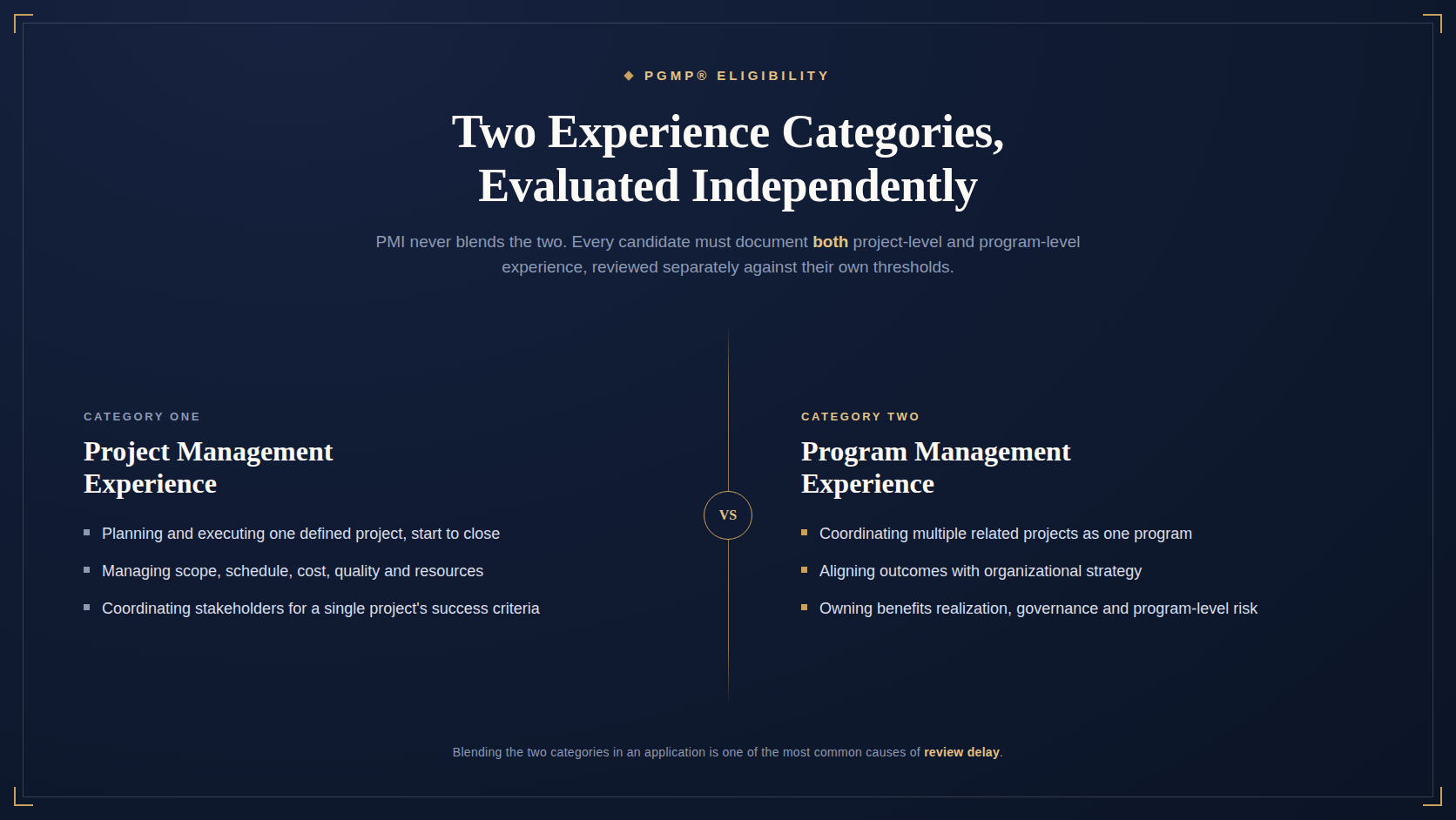
PMI does not count general management or supervisory work as program management experience. To qualify the role should involve genuine program-level responsibilities, such as:
- Managing a set of related projects as a coordinated program rather than isolated deliverables
- Aligning program activities and outcomes with broader organizational strategy
- Overseeing benefits management, including tracking whether the program delivers intended value
- Coordinating stakeholders across multiple projects, departments or business units
- Managing program-level risk, governance structures, and decision-making frameworks
What Counts as Project Management Experience?
Project management experience is more familiar to most applicants and generally includes:
- Planning and executing a defined project from initiation through closure
- Managing scope, schedule, cost, quality and resource allocation for that project
- Coordinating stakeholders specific to a single project's success criteria
The distinction matters because PMI's application review specifically separates these two experience types, and blending them together in an application often leads to delays or a request for clarification.
How to Document Your Experience
PMI expects each program or project entry to include:
- A clear description of the program or project and its objectives
- The candidate's specific role and responsibilities
- Accurate start and end dates for the work performed
- How the work connected to organizational objectives
- The outcomes or benefits the program or project delivered
Vague descriptions rarely hold up during review. Entries that read like a job description, rather than a specific account of program leadership are one of the most common reasons applications stall.
Common Experience Documentation Mistakes
Frequent issues include overlapping dates across roles, describing project-level work as program management, missing detail on benefits or strategic alignment, and listing responsibilities without explaining actual outcomes. Careful, honest documentation matters more than length.
PgMP® Application and Evaluation Process
Once eligibility is confirmed, the application itself follows a structured path:
Creating a PMI Account
Candidates first register with PMI and set up an account through which the entire application, exam scheduling and certification maintenance will be managed.
Submitting the Application
The application form captures education history, contact and employer information and detailed program and project experience entries.
Documenting Professional Experience
Each entry needs to reflect the program management and project management experience criteria discussed above with enough specificity for a reviewer to assess it independently.
Application Review
PMI reviews submitted applications for completeness and, in many cases, applies random or targeted audits before granting approval.
Potential Audit Process
An audit may require supporting documentation, such as verification from supervisors or organizational contacts confirming the experience described. Keeping records organized in advance makes this step far less stressful.
Approval and Exam Scheduling
Once the application clears review (and audit, if applicable) candidates receive eligibility to schedule the exam within PMI's designated eligibility window.
Accuracy and consistency matter throughout this process. Mismatched dates, inflated titles or generic descriptions raise red flags with reviewers and can delay approval by weeks or months. Candidates who want a second set of eyes on how their program and project experience is framed often work through this stage alongside structured PgMP training courses rather than navigating the eligibility paperwork alone.
PgMP® Examination Requirements
Understanding the Examination Content Outline
PMI publishes an examination content outline that defines exactly what the PgMP exam measures. Reviewing this outline in detail including the full breakdown available in SnSCCS's PgMP examination content outline guide gives candidates a clear map of what to study rather than guessing at scope.
Program Management Domains
The exam is built around core program management domains, including:
- Strategic program management
- Program life cycle
- Benefits management
- Stakeholder management
- Program governance
Scenario-Based Exam Preparation
Because the exam tests applied judgment rather than memorized definitions, most questions present a scenario and ask the candidate to select the most appropriate program management response. Preparation should lean heavily on scenario-based practice rather than flashcard-style review.
Understanding Program Management Principles
Strong performance depends on genuinely understanding how program governance, benefits realization, and stakeholder alignment interact not just recognizing terminology from a textbook.
Preparing With Practice Questions and Mock Exams
Structured mock exams help candidates get comfortable with the pacing and scenario style of the real test, and they highlight weak domains early enough to correct before exam day. SnSCCS covers this in more depth in its dedicated guide to PgMP exam preparation, which walks through domain-by-domain study strategy.
PgMP® Certification Process Step by Step
- Confirm eligibility against PMI's current education and experience criteria.
- Prepare the application, gathering program and project experience details in advance.
- Submit the application through PMI's official platform.
- Complete any required evaluation or audit, providing supporting documentation if requested.
- Schedule the examination once eligibility is confirmed.
- Prepare and take the exam, using the official content outline as a study framework.
- Maintain the certification by earning continuing certification requirement (PDU) credits within PMI's renewal cycle.
Common Mistakes When Applying for PgMP®
Several avoidable errors slow candidates down or lead to application rejection:
- Applying before confirming eligibility against current PMI requirements
- Confusing project-level experience with genuine program management experience
- Submitting incomplete or vague experience descriptions
- Using inconsistent employment dates across entries
- Ignoring PMI's most recent application and documentation requirements
- Starting exam preparation before fully understanding the eligibility process
- Relying on outdated blog posts or forum threads instead of PMI's official criteria
How to Prepare for PgMP® Certification Successfully
Review the Current PMI Requirements
Start by confirming today's education and experience thresholds directly through PMI, since figures and policies can shift between certification cycles.
Assess Your Professional Experience
Map existing program and project roles against PMI's definitions before drafting the application, so gaps or documentation issues surface early.
Study the Examination Content Outline
Use PMI's official outline, along with structured resources, to build a study plan around the actual domains being tested.
Use Official PMI Resources
Lean on PMI's own handbooks and reference materials as the primary source of truth, supplementing with third-party prep only where it adds value.
Practice Scenario-Based Questions
Regular exposure to scenario-based questions builds the judgment the exam is actually designed to measure.
Create a Structured Study Schedule
A realistic, phased schedule eligibility first content review second, practice exams third tends to produce far better outcomes than compressed, last-minute preparation. Candidates who prefer guided, live instruction often find that structured PgMP live classes keep this schedule on track more reliably than self-paced study alone, while professionals who need a schedule built around existing work commitments sometimes opt for one-on-one training instead. Organizations sponsoring a cohort of program managers through this process can also explore SnSCCS's corporate training options for group-based PgMP preparation.
Final Thoughts
Meeting PgMP certification requirements takes more than counting years on a resume. PMI expects candidates to clearly document genuine program management experience, separate it accurately from project-level work, and present an application that holds up under review or audit. Getting the eligibility phase right is just as important as preparing for the exam itself, since a stalled or rejected application can add months to the timeline.
Professionals who take a strategic approach verifying current PMI criteria, documenting experience carefully, and building a realistic study plan around the official content outline tend to move through the process with far fewer setbacks. For those already meeting the eligibility bar, the next step is preparing thoroughly and with the right guidance for an exam that tests real program leadership judgment, not memorized facts.
Frequently Asked Questions (FAQ)
What are the PgMP® certification requirements?
PgMP requirements combine a minimum education level, a set amount of project management experience, and a set amount of program management experience, all reviewed by PMI before exam eligibility is granted.
How much program management experience is required for PgMP®?
The exact figure depends on education level, with candidates holding a secondary diploma generally needing more program management experience than those with a four-year degree. Current thresholds should always be confirmed on PMI's official site.
Is a PMP® certification required before applying for PgMP®?
No. PMP is not a mandatory prerequisite for PgMP, though the project management foundation it provides can support the project management experience portion of the application and helps many candidates prepare for the program-level exam.
Can project management experience count toward PgMP® eligibility?
Yes, but only as its own separate category. PMI requires both project management experience and program management experience, and the two are evaluated independently rather than combined into one total.
Does PgMP® require a four-year degree?
No. PMI offers eligibility paths for both four-year degree holders and candidates with a secondary diploma, though the experience requirements differ between the two paths.
What happens after the PgMP® application is approved?
Once approved, candidates become eligible to schedule the PgMP exam within PMI's designated window and can begin structured, scenario-based exam preparation.