PMI-PBA Examination Content Outline
Introduction
Earning the PMI Professional in Business Analysis (PMI-PBA®) credential is one of the strongest ways for business analysts, requirements engineers and project professionals to prove they can bridge the gap between business needs and delivered solutions. Before opening a single study guide, however, every serious candidate should get familiar with the PMI-PBA Examination Content Outline or ECO. This document is the official blueprint PMI uses to build the exam and it quietly shapes everything from question weighting to the skills examiners expect candidates to demonstrate. Candidates who study the ECO first tend to prepare with far more focus than those who dive straight into practice questions, because they already know which competencies actually matter on exam day. This guide breaks down what the ECO covers, how its domains fit together and how to turn that structure into a practical study plan for PMI-PBA certification training.
What Is the PMI-PBA Examination Content Outline?
Definition of the Examination Content Outline (ECO)
The Examination Content Outline is PMI's official framework describing the tasks, knowledge areas and skills a business analyst must demonstrate to earn the PMI-PBA credential. It is built from role-delineation research involving practicing business analysts, which means every domain reflects real work rather than theoretical concepts.
Why PMI Uses the ECO
PMI relies on the ECO to keep the exam grounded in current industry practice. Rather than testing memorized definitions, the outline pushes the exam toward scenario-based questions that mirror the judgment calls business analysts make on live projects.
Difference Between the ECO and the PMBOK® Guide
The PMBOK® Guide focuses on project management processes, the same body of knowledge that underpins PMP certification, while the PMI-PBA ECO is centered entirely on business analysis activities needs assessment, requirements work and solution evaluation. Candidates sometimes assume the two overlap heavily, but the ECO stands on its own as a business-analysis-specific framework.
Who Should Use the PMI-PBA ECO?
The outline is useful well beyond exam candidates. It benefits:
- Business Analysts
- Project Managers who handle requirements work
- Product Managers shaping solution scope
- Requirements Engineers
- PMO Professionals
- Consultants advising on business change
- Any professional involved in business analysis activities
Before mapping out a study plan, candidates should also confirm they meet the PMI-PBA certification requirements, since eligibility is assessed alongside exam readiness.
Understanding the PMI-PBA Examination Content Outline
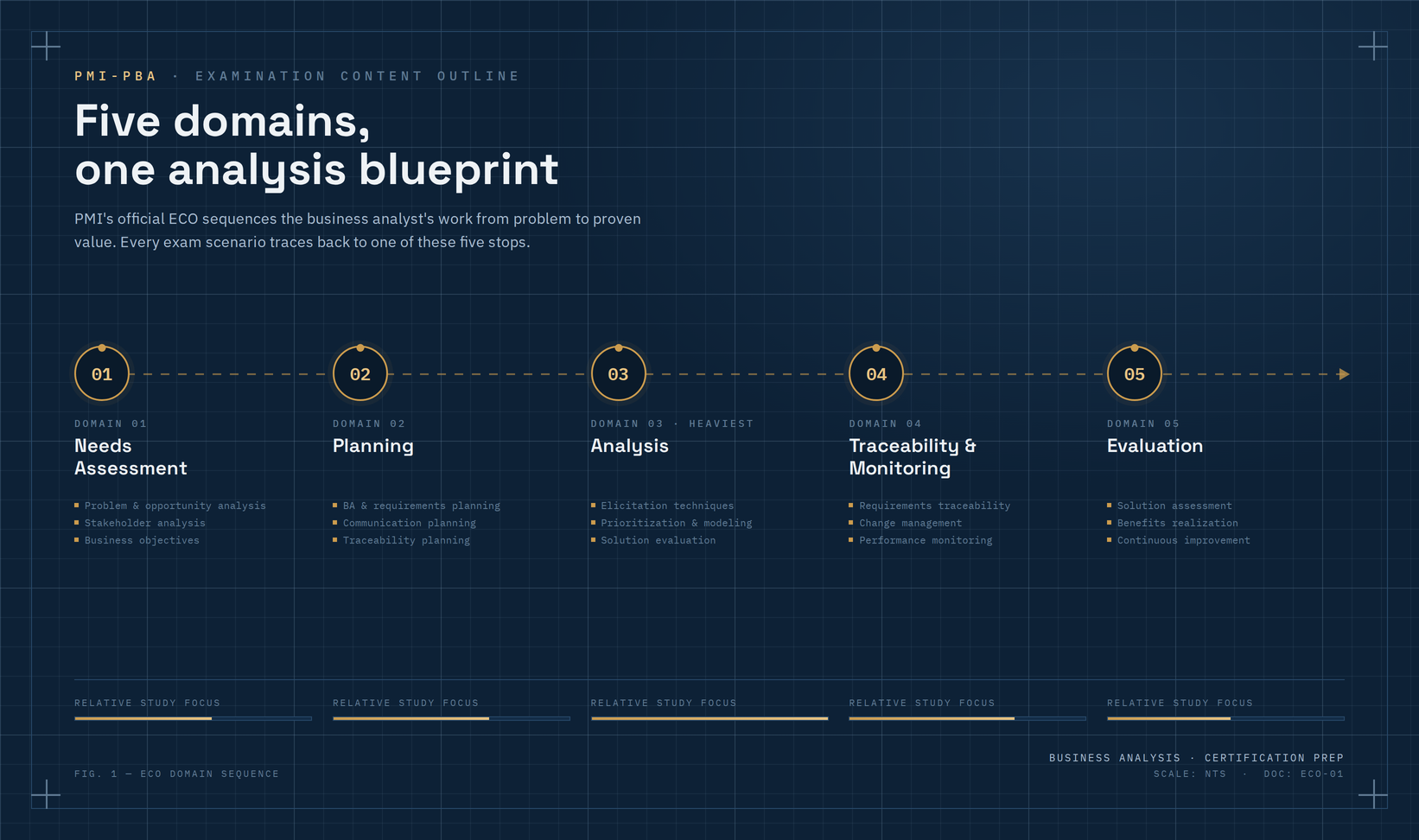
The PMI-PBA ECO is organized into five domains, and understanding how they connect is more valuable than memorizing them in isolation.
Domain 1: Needs Assessment
This domain covers how a business problem or opportunity is first identified and framed. Candidates should be comfortable with business needs identification, problem and opportunity analysis, stakeholder analysis and defining clear business objectives. Everything downstream in a project depends on getting this domain right, which is why PMI treats it as the starting point of the analysis lifecycle.
Domain 2: Planning
Once a need is confirmed, the business analyst plans how the work will be approached. This includes business analysis planning, requirements planning, stakeholder communication planning and traceability planning. This is also where business analysis work intersects most closely with structured PMO delivery, since planning decisions made here often need to align with broader portfolio and governance processes.
Domain 3: Analysis
This is typically the heaviest domain on the exam and covers the core technical work of business analysis: requirements elicitation, requirements analysis, prioritization techniques, process modeling and solution evaluation. Candidates are expected to know multiple elicitation and modeling techniques and understand when each one applies.
Domain 4: Traceability and Monitoring
This domain focuses on keeping requirements aligned with business objectives throughout delivery. Key topics include requirements traceability, change management, requirements validation and performance monitoring all essential for controlling scope as a project evolves.
Domain 5: Evaluation
The final domain looks at what happens after a solution is delivered. It covers solution assessment, benefits realization, business value measurement and continuous improvement, reinforcing that business analysis does not end at handoff it continues until value is confirmed.
How to Use the PMI-PBA Examination Content Outline for Exam Preparation
Build a Domain-Based Study Plan
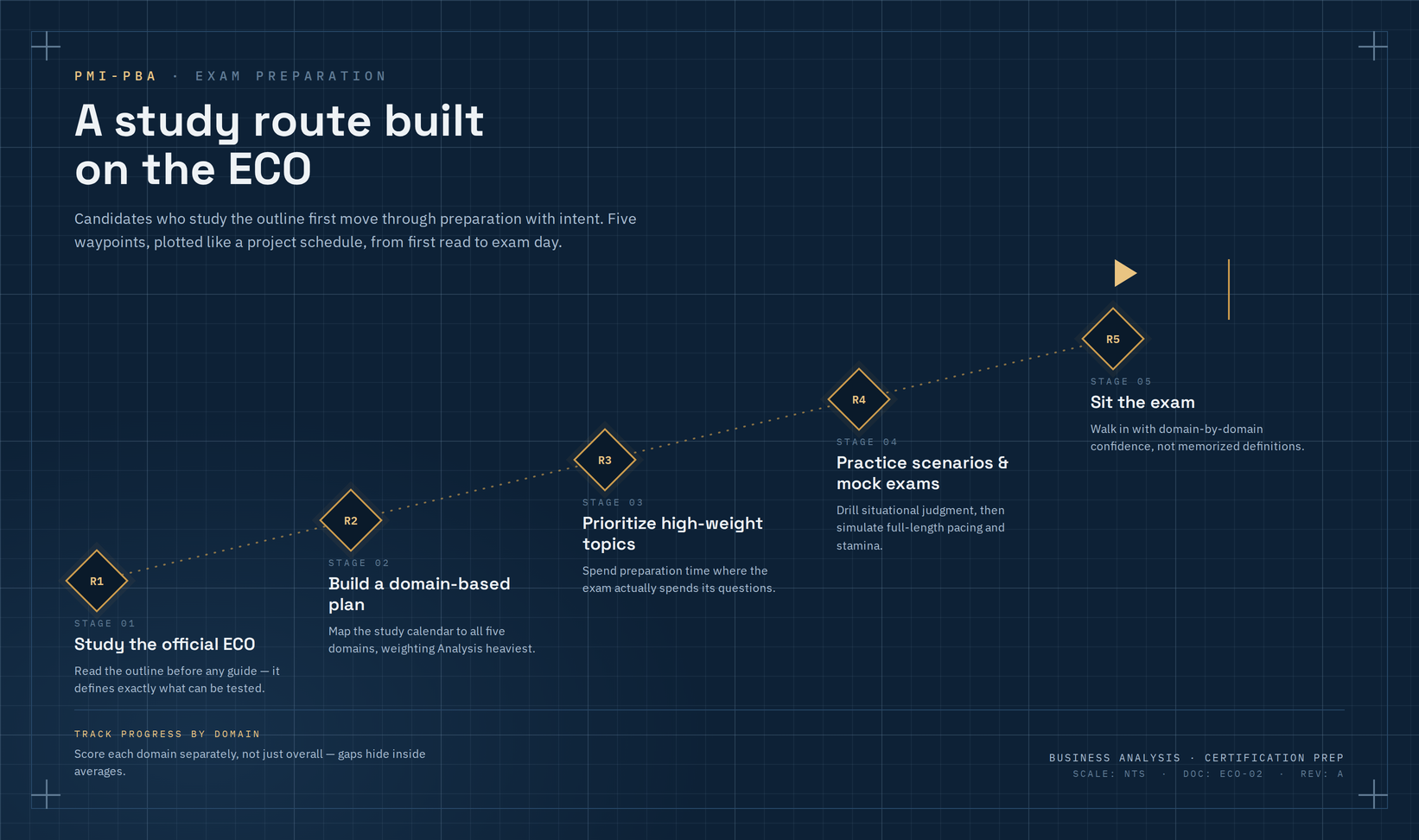
Rather than studying randomly, candidates should map their study calendar directly to the five ECO domains, allocating more time to Analysis given its weight on the exam.
Prioritize High-Weight Topics
Not every topic carries equal exam weight. Reviewing the official ECO percentages helps candidates decide where to spend the most preparation time.
Practice Scenario-Based Questions
Because the PMI-PBA exam is scenario-driven, candidates benefit from practicing situational questions rather than relying purely on definitions and glossaries.
Review Business Analysis Case Studies
Working through real or simulated case studies helps connect ECO domains to practical decision-making, which is exactly what the exam tests.
Measure Your Progress Regularly
Tracking performance by domain not just overall score shows candidates exactly where their preparation still has gaps. Structured, instructor-led PMI-PBA live classes are often the fastest way to close those gaps, since they walk candidates through each ECO domain with guided practice and feedback.
Best Study Resources for the PMI-PBA Exam
Official PMI-PBA Examination Content Outline
This remains the single most important resource, since it defines exactly what can be tested.
PMI Guide to Business Analysis
This companion publication expands on many of the concepts referenced in the ECO and is considered essential reading by most training providers.
PMBOK® Guide
While not business-analysis specific, it provides useful context for how business analysis work fits within the broader project lifecycle.
Practice Questions and Mock Exams
Realistic mock exams help candidates get comfortable with the pacing and scenario style of the actual test. Candidates who prefer flexibility can also work through a self-paced PMI-PBA study bundle at their own schedule.
Instructor-Led Training
Guided training programs help candidates who prefer structured pacing, live discussion and direct access to an instructor for clarifying difficult topics. For candidates who want individual attention, one-on-one PMI-PBA training offers a more personalized alternative to group classes.
Business Analysis Communities and Study Groups
Peer discussion groups often surface practical exam insights that formal study materials do not cover.
Common Mistakes Candidates Make
Many candidates lose valuable preparation time by:
- Ignoring the official Examination Content Outline and jumping straight into random study material
- Memorizing concepts instead of understanding how they apply to business scenarios
- Skipping requirements management techniques because they seem repetitive
- Taking too few practice exams before test day
- Neglecting stakeholder analysis, despite its weight across nearly every domain
- Relying on outdated study materials that do not reflect the current ECO
Candidates who want a broader walkthrough of these pitfalls, alongside a step-by-step preparation timeline, can also refer to this PMI-PBA exam preparation guide for additional context. Avoiding these mistakes alone can meaningfully improve exam readiness, even before adding new study hours.
Tips to Master the PMI-PBA Examination Content Outline
Study One Domain at a Time
Breaking preparation into domain-sized blocks keeps the material manageable and easier to retain.
Practice Real Business Analysis Scenarios
Applying concepts to realistic situations builds the judgment the exam is actually testing.
Focus on Requirements Management
Since requirements-related tasks appear across multiple domains, strengthening this area pays off broadly.
Review Incorrect Practice Questions
Understanding why an answer was wrong is often more valuable than the number of questions attempted.
Take Full-Length Mock Exams
Full-length simulations build the stamina and time management needed for the real exam format.
Real-World Applications of Business Analysis
Digital Transformation Projects
Business analysts play a central role in translating transformation goals into workable requirements.
Process Improvement Initiatives
Analysis techniques from the ECO are used daily to identify inefficiencies and design better workflows.
Product Development
Requirements elicitation and prioritization directly shape what features get built and in what order.
Enterprise Change Management
Traceability and stakeholder communication skills from the ECO help manage change with less disruption. Organizations investing in these capabilities often pair certification with broader corporate training programs to build analysis skills across teams.
Business Value Delivery
Ultimately, every domain in the ECO connects back to one goal: ensuring that delivered solutions create measurable business value. Professionals looking to translate this certification into career growth can also explore career advisory support alongside their exam preparation.
Final Thoughts
The PMI-PBA Examination Content Outline is more than a reference document it is the roadmap that should guide every stage of exam preparation. Candidates who understand its five domains and how they connect are far better positioned to interpret scenario-based questions with confidence. Pairing the ECO with official PMI publications, realistic practice exams and genuine business analysis experience gives candidates a well-rounded foundation for certification success. Rather than memorizing terminology, the goal should be understanding how business analysis concepts play out in real project situations. With a structured, consistent approach built around the ECO, candidates put themselves in a strong position to pass the PMI-PBA exam and apply what they've learned in their day-to-day work.
Frequently Asked Questions (FAQ)
What is the PMI-PBA Examination Content Outline?
It is PMI's official document outlining the domains, tasks and knowledge areas tested on the PMI-PBA certification exam.
What domains are covered in the PMI-PBA exam?
The exam covers five domains: Needs Assessment, Planning, Analysis, Traceability and Monitoring, and Evaluation.
Is the Examination Content Outline enough to prepare for the exam?
The ECO is the foundation, but most candidates also need practice exams, reference guides and structured training to prepare fully.
What are the best study resources for PMI-PBA certification?
The official ECO, the PMI Guide to Business Analysis, practice exams and instructor-led training are commonly recommended together.
How should I prepare using the PMI-PBA ECO?
Build a study plan around each domain, prioritize high-weight topics and reinforce learning with scenario-based practice questions.