PMI PMOCP Exam Preparation
Project Management Offices have moved far beyond their old reputation as reporting desks. In most organizations today, the PMO is expected to guide portfolio decisions, protect strategic investment and prove that projects are delivering real business value. As that responsibility has grown, so has demand for professionals who can show, with a recognized credential, that they understand how a modern PMO actually operates.
This is where the PMI PMO Certified Professional (PMOCP) certification fits in. It was created to validate the specific skill set that PMO leaders, analysts and coordinators need governance, portfolio alignment, benefits tracking and organizational change rather than general project execution skills alone. For professionals who already work inside a PMO or want to move into one, the certification is becoming a practical way to stand out.
Passing the exam, however, still comes down to preparation. This guide walks through what the PMOCP exam actually tests, how to build a study plan around it, which resources are worth the time, and where candidates most often lose marks. Anyone working through this preparation can also review the PMOCP live classes at SNS CCS for structured, instructor-led sessions that follow the same exam blueprint discussed below, Join our PMOCP certification training.
What Is the PMI PMOCP Certification?
Overview of the PMI PMO Certified Professional (PMOCP)
The PMOCP credential is PMI's certification specifically designed around Project Management Office competencies. Where the PMP focuses on running individual projects, PMOCP focuses on the function that oversees many projects at once governance, prioritization, standards and reporting across an organization's portfolio.
Purpose of the certification
PMI built the certification to give PMOs a common language and a common standard. It signals that a professional can set up governance structures, align project selection with strategy and measure whether a PMO is actually adding value rather than just adding process.
Who should pursue the certification?
The certification suits PMO analysts, PMO managers and directors, portfolio coordinators and project managers who are moving into PMO leadership. It's also relevant for consultants who are asked to design or restructure a PMO for a client, since it demonstrates a working knowledge of PMO models and maturity.
Skills validated by PMOCP
The exam and certification confirm that a candidate can build governance frameworks, align project portfolios to strategic goals, track benefits realization, manage stakeholder reporting and support organizational change tied to PMO initiatives.
Career advantages of becoming PMOCP certified
PMOCP holders are often considered for PMO leadership roles ahead of candidates without a PMO-specific credential, since the certification directly maps to the responsibilities those roles carry governance design, portfolio reporting and strategic alignment rather than project delivery alone.
Understanding the PMI PMOCP Exam
Exam objectives
The exam is built to test applied understanding of PMO functions rather than memorized definitions. Candidates are expected to reason through governance scenarios, prioritization conflicts and reporting decisions the way a working PMO professional would.
Exam format
Questions are presented in a structured, scenario-driven format that mirrors real PMO situations a portfolio decision that needs sign-off, a governance gap that needs correcting, a benefits report that doesn't add up.
Question types
Expect a mix of straightforward knowledge questions and situational questions that ask what a candidate would do next, given a specific PMO context.
Exam duration
Candidates should plan for a fixed, timed session and pace themselves so no single scenario question eats into the time needed for the rest of the exam.
Scoring methodology
Scoring is based on overall performance across the domains covered in the syllabus, so weakness in one domain, such as benefits realization, can be offset by strength elsewhere but only up to a point, which is why balanced preparation across all domains matters.
Certification process
After the exam is passed, PMI issues the certification along with continuing education requirements needed to keep it active, discussed later in this guide.
PMI PMOCP Eligibility Requirements
Educational qualifications
A relevant degree or diploma is generally expected, though PMI allows some flexibility for candidates with strong professional experience in lieu of formal education.
Professional experience
Hands-on exposure to project, program, or portfolio environments even in a support or coordination capacity strengthens both eligibility and exam readiness.
Recommended PMO knowledge
Familiarity with governance structures, reporting cadences and portfolio prioritization gives candidates a real advantage, since much of the exam assumes this working knowledge.
Prerequisite certifications
While PMOCP doesn't strictly require another PMI certification first, candidates who already hold a PMP or similar credential often find the transition to PMO-specific content smoother.
Is PMO experience mandatory?
Direct PMO experience is not always mandatory, but candidates without it should expect to spend more time studying governance and portfolio concepts that experienced PMO staff already apply daily.
PMI PMOCP Exam Syllabus
The syllabus is organized around ten core domains that reflect how a mature PMO actually functions:
- PMO Fundamentals — the purpose, structure, and value proposition of a PMO
- PMO Governance — decision rights, escalation paths, and control frameworks
- PMO Strategy Alignment — connecting project selection to organizational strategy
- Portfolio Management — balancing, prioritizing, and sequencing initiatives
- Program Management — coordinating related projects for shared benefits
- Project Governance — oversight standards applied at the individual project level
- Benefits Realization — tracking whether delivered projects produce promised value
- Resource Management — allocating people and budget across competing priorities
- Performance Measurement — KPIs, dashboards, and reporting accuracy
- Organizational Change Management — helping the business absorb PMO-driven change
Candidates preparing for this breadth of content often benefit from a guided curriculum rather than self-study alone; the PMOCP live class schedule works through each of these domains in sequence with an instructor.
PMO Frameworks Every Candidate Should Understand
A recurring exam theme is the ability to identify which PMO model fits which organizational context:
- Supportive PMO — advisory, low control, mainly templates and best practices
- Controlling PMO — enforces compliance with defined standards
- Directive PMO — directly manages projects, highest level of control
- Enterprise PMO (EPMO) — operates at the organizational strategy level
- Agile PMO — supports iterative delivery models and adaptive governance
- Digital PMO — built around data, automation, and digital delivery tools
Candidates who can explain why one model suits a given scenario, not just define each one, tend to do better on the situational questions.
Build an Effective PMI PMOCP Study Plan
Preparation timelines vary depending on how much PMO exposure a candidate already has.
Two-week preparation plan works for candidates with strong current PMO experience who mainly need to review syllabus terminology and sit a few mock exams.
Four-week preparation plan is realistic for most working professionals roughly a week per group of domains, ending with two weeks of mixed practice questions.
Six-week preparation roadmap suits candidates newer to PMO concepts, allowing extra time on governance and benefits realization, which are often the least familiar topics.
Study schedule for working professionals should treat preparation like a project itself fixed weekly blocks, clear milestones and a buffer before the exam date rather than cramming at the end.
Daily revision strategy works best in short, focused sessions rather than long, irregular ones; reviewing one domain a day and revisiting weak areas every few days retains information better than marathon study sessions.
Best PMI PMOCP Study Resources
A well-rounded preparation approach usually draws on several resource types rather than one:
- Official PMI publications for the authoritative definitions and structure the exam is built around
- PMO guides and frameworks that translate theory into how governance and portfolio decisions play out in practice
- Practice questions to get comfortable with the scenario-based style of the exam
- Mock exams to test timing and full-syllabus recall under exam conditions
- Flashcards for quick recall of frameworks, terminology, and domain definitions
- Video training for candidates who retain concepts better through explanation and example than reading alone
- Study communities where candidates can compare notes on tricky governance and portfolio scenarios
Live, instructor-guided prep such as the PMOCP training sessions at SNS CCS combines several of these formats into one structured program, which is often more efficient than assembling resources independently.
Core PMO Concepts You Must Master
Beyond memorizing the syllabus, candidates need working command of concepts that show up repeatedly across exam scenarios: PMO governance structures, strategic alignment between projects and business goals, portfolio governance and prioritization logic, benefits management from planning through realization, risk governance at the portfolio level, KPI development for meaningful reporting, PMO maturity models for assessing organizational readiness, and value delivery as the ultimate measure of PMO success.
Organizations that treat their PMO as a strategic partner rather than a support function tend to apply these concepts consistently a shift explored further in how PMOs move from a support role to a strategic partner, which gives useful real-world context for several exam topics.
PMO Tools and Technologies
Modern PMOs rely on a mix of planning, tracking, and reporting tools and candidates should be familiar with the general category each tool falls into rather than deep technical operation:
- Microsoft Project for scheduling and resource planning
- Jira for agile and iterative delivery tracking
- Microsoft Power BI for portfolio dashboards and reporting
- Smartsheet for collaborative project and portfolio tracking
- Monday.com for workflow and task visibility
- Asana for team-level project coordination
- Planview for enterprise portfolio and resource management
- Project Online for cloud-based project and portfolio management
The exam rarely tests specific software features; it tests whether a candidate understands what category of tool solves what category of PMO problem.
Practice PMI PMOCP Mock Exams
Mock exams are one of the highest-value preparation activities for this certification, mainly because the real exam leans heavily on scenario-based reasoning rather than recall.
Benefits of mock exams include exposure to the exam's phrasing style, practice under time pressure and an honest read on which domains still need work.
Scenario-based questions should be reviewed carefully even when answered correctly, since understanding why an answer is right builds the reasoning skill the exam is testing.
Time management techniques matter because scenario questions take longer to read than straightforward recall questions; candidates should practice pacing so they're not rushing through the final section.
Reviewing incorrect answers is where most learning actually happens treating every wrong answer as a signal about a specific weak domain, not just a point lost.
Measuring exam readiness usually means consistently scoring well above the passing threshold on full-length mocks, not just on isolated domain quizzes.
PMI PMOCP Exam Preparation Tips
- Understand concepts instead of memorizing — the scenario format rewards reasoning, not rote recall
- Focus on governance and strategy — these two domains anchor a large share of the exam's logic
- Study real-world PMO scenarios — case studies make abstract frameworks concrete
- Strengthen leadership knowledge — PMOCP assumes a PMO professional influences without always having direct authority
- Improve analytical thinking — many questions ask for the best answer among several reasonable ones
- Practice consistently — spaced, regular study beats last-minute intensive review
Common PMI PMOCP Exam Preparation Mistakes
Candidates most often lose marks by ignoring governance concepts in favor of more familiar project-execution topics, having a weak understanding of how PMO functions actually operate day to day, skipping mock exams and discovering timing problems only on exam day, managing time poorly across the full exam, relying on outdated study materials that don't reflect current PMI standards and failing to go back and review weak areas identified during practice.
Exam Day Strategy
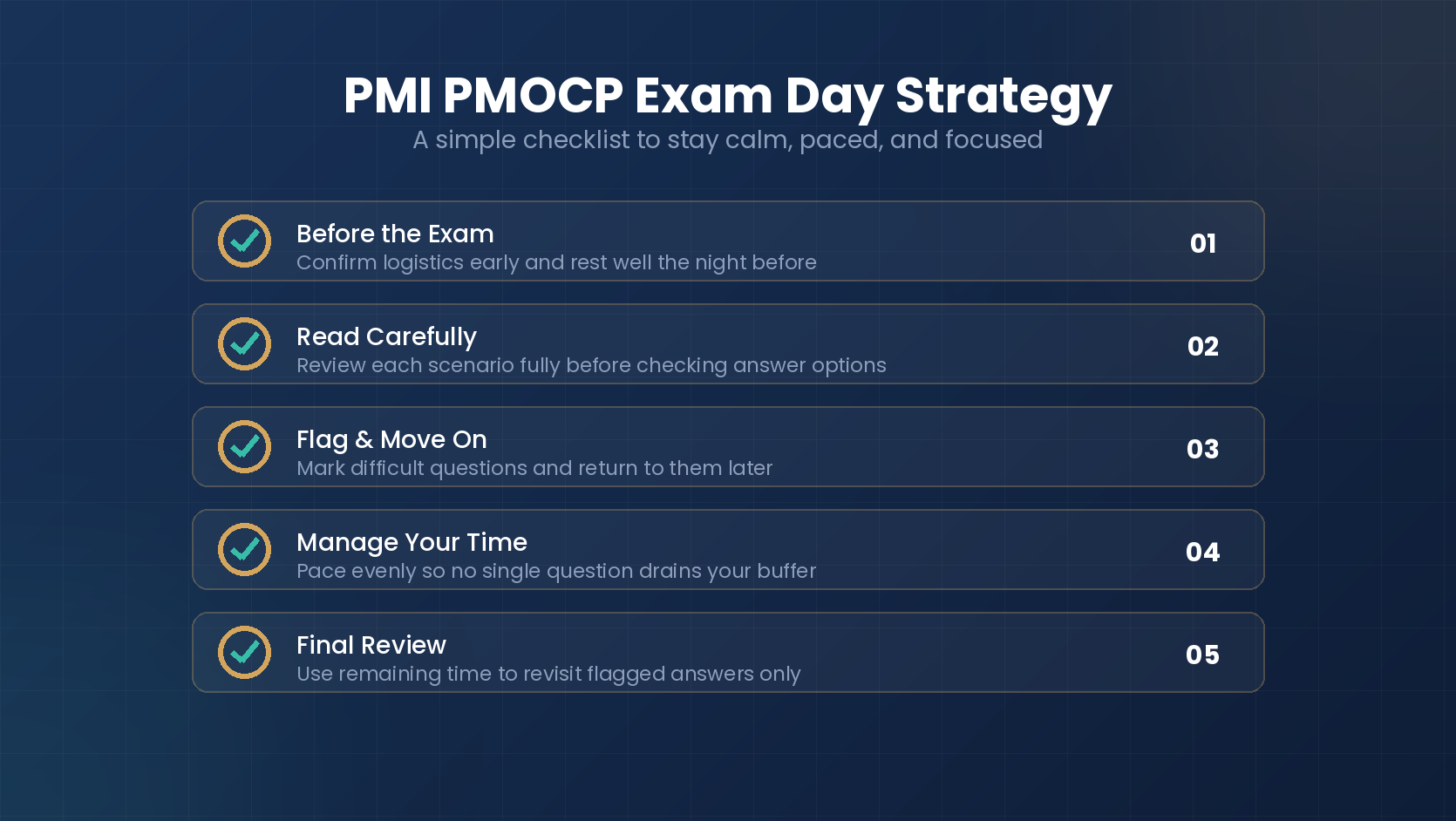
Before the exam, confirm logistics early and get a full night's rest rather than a last review session.
During the exam, read each scenario fully before looking at the answer options, since PMOCP questions are often written to reward careful reading.
Managing difficult questions is easier with a flag-and-move-on approach mark anything uncertain and return to it after finishing the rest of the exam.
Time allocation should leave a buffer at the end for review, not just for finishing the last question.
Final review strategy means using any remaining time to revisit flagged questions rather than second-guessing answers already confirmed.
Maintaining Your PMI PMOCP Certification
Certification doesn't end at the exam. PMI requires continuing professional development to keep the credential active, which typically involves earning PDUs through ongoing learning, staying current with updates to PMI standards as PMO practice evolves and continuing to build PMO leadership skills through real project and portfolio experience. Professionals who want structured, ongoing development beyond the exam itself may also find corporate training programs useful for keeping skills current within a team setting.
PMI PMOCP vs Other PMI Certifications
PMI PMOCP vs PMP — the PMP certification focuses on managing individual projects, while PMOCP focuses on governing and aligning a portfolio of projects across an organization.
PMI PMOCP vs PgMP — PgMP centers on managing related projects as a coordinated program; candidates weighing the two can compare against the PgMP live class details to see which scope fits their current role.
PMI PMOCP vs PfMP — PfMP goes a level higher, into portfolio strategy and investment decisions across an enterprise; more on that distinction is available on the PfMP live class page.
PMI PMOCP vs PMI-ACP — PMI-ACP validates agile delivery skills at the team level, whereas PMOCP validates the governance layer that sits above delivery; the PMI-ACP live class page outlines that certification in more detail.
Which certification fits your career goals? Professionals aiming specifically at PMO leadership roles are usually best served by PMOCP, while those managing delivery, programs or enterprise portfolios may find the other credentials a closer match to their day-to-day responsibilities.
Career Opportunities After PMI PMOCP Certification
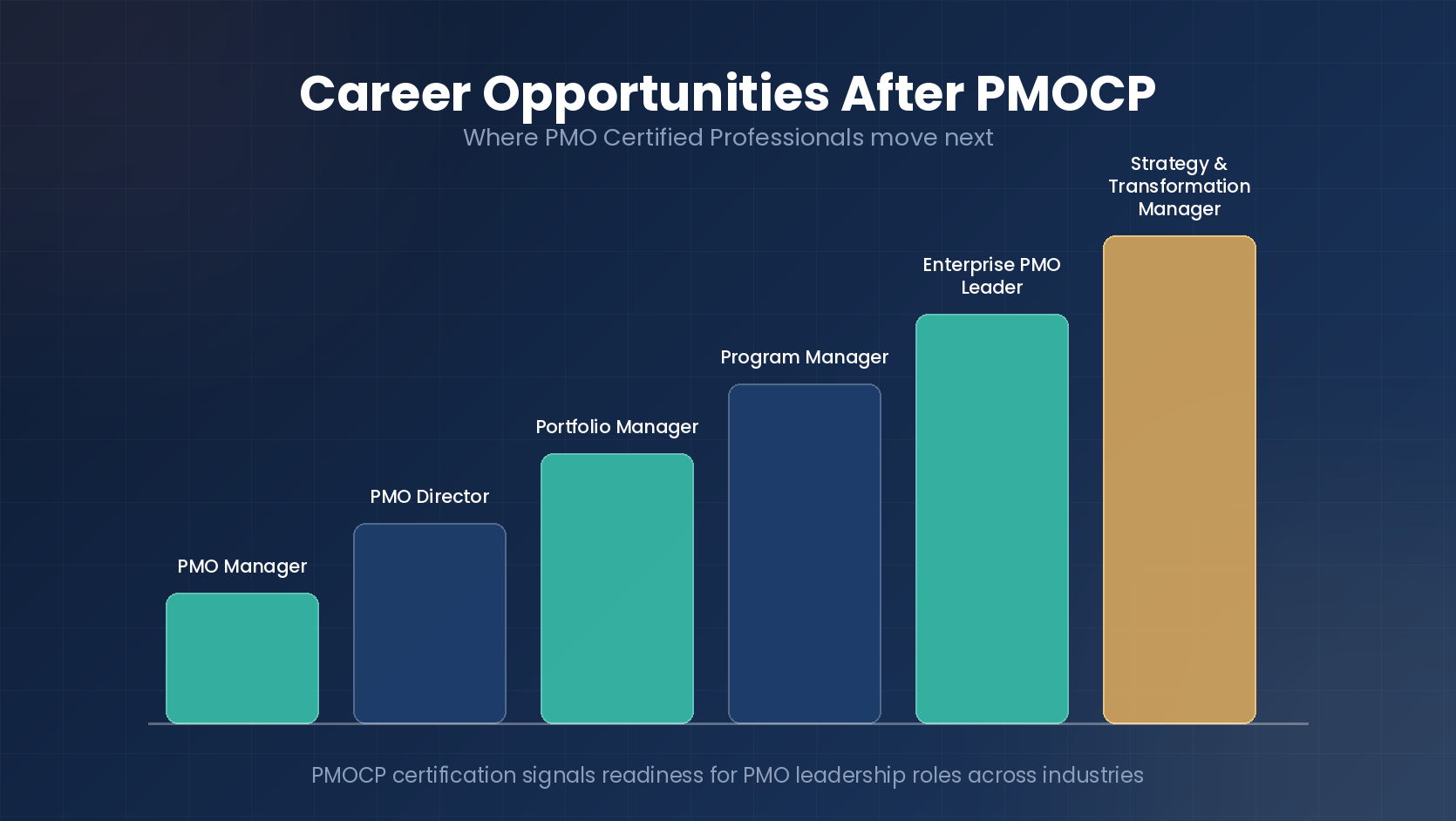
PMOCP certification opens doors to roles including PMO Manager, PMO Director, Enterprise PMO Leader, Portfolio Manager, Program Manager, Project Governance Manager and Strategy and Transformation Manager. In each of these roles, the certification signals that a candidate already understands governance and portfolio alignment rather than needing to learn it on the job. Professionals mapping out this path may also find it useful to speak with a career advisor about how the certification fits their specific trajectory.
Industries That Value PMOCP Certification
PMO structures and the demand for certified PMO professionals span a wide range of sectors: Information Technology, Construction, Healthcare, Banking and Financial Services, Government, Energy, Manufacturing, Telecommunications and Consulting. Each of these industries relies on PMOs to bring order to large, often competing project portfolios, which is exactly the skill set PMOCP validates.
Conclusion
Passing the PMI PMOCP exam comes down to understanding how a modern PMO actually functions its governance, its strategic role and how it proves value through benefits realization and performance measurement rather than memorizing definitions in isolation. A realistic study plan, honest mock-exam practice, and steady review of weak areas give candidates the best shot at passing on the first attempt. For professionals ready to move from self-study to structured preparation, a guided PMOCP training program can pull all of these pieces together under one roadmap.
Frequently Asked Questions
What is the PMI PMOCP certification?
It is PMI's certification for PMO professionals, focused on governance, portfolio alignment and the operational skills needed to run an effective Project Management Office.
How do I prepare for the PMI PMOCP exam?
A combination of structured study across all ten syllabus domains, regular mock exams, and review of real PMO scenarios tends to work best, spread over four to six weeks for most candidates.
Who should take the PMOCP certification?
PMO analysts, managers, directors and project managers moving into PMO leadership are the primary audience, along with consultants who design or advise on PMO structures.
What topics are covered in the exam?
The exam covers PMO fundamentals, governance, strategy alignment, portfolio and program management, benefits realization, resource management, performance measurement and organizational change.
How long should I study?
Most working professionals need four to six weeks of consistent study, though candidates with strong existing PMO experience can prepare in two weeks.
Are mock exams necessary?
Yes. The scenario-based format rewards practice with that specific question style and mock exams are the clearest way to gauge real readiness.
Is PMO experience required?
It isn't strictly mandatory, but candidates without direct PMO exposure should budget extra study time for governance and portfolio concepts.
What study materials are recommended?
A mix of official PMI publications, PMO guides, practice questions, mock exams and instructor-led training generally covers the syllabus most thoroughly.
Is PMI PMOCP worth it?
For professionals aiming at PMO leadership roles, the certification directly validates the skills those roles require and is generally seen as a strong career investment.
How does PMOCP compare with PMP?
PMP validates individual project management skills, while PMOCP validates the governance and portfolio-level skills needed to run a PMO the two are complementary rather than competing.