PMI-RMP Examination Content Outline
Every certification exam has a blueprint and for the PMI Risk Management Professional (PMI-RMP®) credential, that blueprint is the Examination Content Outline. Most candidates spend weeks reading textbooks and practice guides before they ever open this document, even though it is the single resource PMI uses to build every question on the exam. Understanding the PMI-RMP Examination Content Outline early in the preparation journey changes how a candidate studies, not just what they study.
This guide breaks down what the outline actually contains, how its five domains are structured and how professionals preparing for the PMI-RMP certification exam can use it to build a study plan that reflects the real weight of each topic rather than guesswork. It also covers common preparation mistakes, the resources worth prioritizing, and practical tips for turning the outline into exam-day readiness.
What Is the PMI-RMP Examination Content Outline?
Definition of the Examination Content Outline (ECO)
The Examination Content Outline is PMI's official specification document. It lists the domains, tasks and enablers that define what a competent risk management professional is expected to know and do. Rather than a syllabus written by a training provider, it comes directly from PMI and is developed through a Job Task Analysis involving practicing risk professionals from around the world.
Why PMI Uses the ECO
PMI relies on the ECO to keep the exam grounded in real practice rather than academic theory. Every scored question on the PMI-RMP exam maps back to a specific task described in the outline, which is why candidates who study the ECO directly tend to prepare more efficiently than those relying only on general reference material.
Difference Between the ECO and PMBOK® Guide
The PMBOK® Guide explains project management concepts broadly, while the ECO defines precisely what is testable and how much weight each area carries. Many candidates read the PMBOK® Guide cover to cover and still walk into the exam underprepared, simply because they never cross-referenced their reading against the outline itself.
Who Should Use the PMI-RMP ECO?
The outline is not only useful for exam candidates. It is a practical reference for:
- Risk Managers
- Project Managers
- PMO Professionals
- Program Managers
- Portfolio Managers
- Business Analysts
- Governance, Risk, and Compliance (GRC) Professionals
For organizations evaluating whether to sponsor certification, it also helps clarify the career and organizational value of the PMI-RMP credential, since the domains map closely to responsibilities risk professionals already carry day to day.
Understanding the PMI-RMP Examination Content Outline
The current PMI-RMP Examination Content Outline is organized into five domains. Each domain represents a distinct stage of project risk management and together they cover the full lifecycle from early planning through monitoring and reporting.
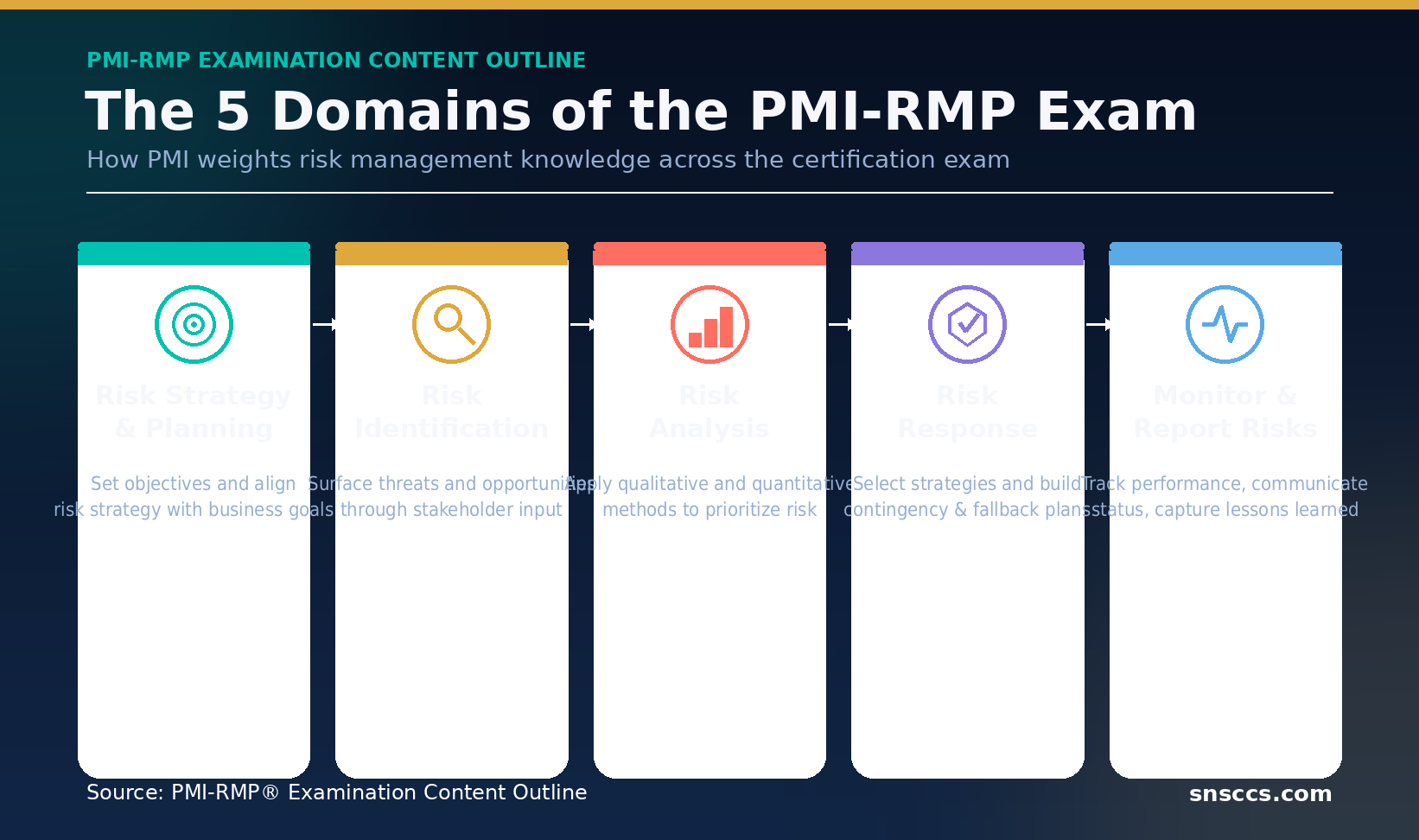
Domain 1: Risk Strategy and Planning
This domain centers on setting the direction for how risk will be managed on a project before work begins. It includes establishing risk management objectives, developing risk management plans and aligning the overall risk strategy with broader business goals so that risk decisions support, rather than conflict with, organizational priorities.
Domain 2: Risk Identification
Risk identification focuses on surfacing threats and opportunities before they affect project outcomes. Candidates are expected to understand structured techniques for identifying project risks, categorizing them appropriately and engaging stakeholders early so that identification is not left to a single person's assumptions.
Domain 3: Risk Analysis
Analysis is where raw risk data becomes decision-useful information. This domain covers qualitative risk analysis for quick prioritization, quantitative risk analysis for numerical modeling and the broader skill of assessing probability and impact to determine which risks deserve the most attention and resources.
Domain 4: Risk Response
Once risks are understood, the next step is deciding what to do about them. This domain addresses selecting appropriate response strategies, developing contingency and fallback plans for high-priority risks and implementing response actions in a way that is tracked and accountable.
Domain 5: Monitor and Report Risks
Risk management does not stop once a response plan is approved. This domain covers continuous risk monitoring throughout the project lifecycle, clear risk reporting and communication to stakeholders, measuring risk performance against expectations and capturing lessons learned for continuous improvement on future projects.
Together, these five domains reflect a full risk governance cycle, from strategy and identification through analysis, response and ongoing monitoring, rather than a single isolated skill.
How to Use the PMI-RMP Examination Content Outline for Exam Preparation
Create a Domain-Based Study Plan
Rather than studying topics in the order they appear in a textbook, candidates get better results by building a study plan around the five ECO domains directly, allocating more time to areas where their professional experience is weaker.
Focus on High-Weight Exam Areas
Not every domain carries equal weight on the exam. Reviewing the outline closely helps candidates identify which domains, such as risk analysis and risk response, tend to require deeper preparation, and adjust their study hours accordingly.
Practice Scenario-Based Questions
The PMI-RMP exam favors applied judgment over memorized definitions. Practicing scenario-based questions tied to each domain helps candidates get comfortable with the kind of situational reasoning PMI actually tests.
Review Risk Management Frameworks
Candidates benefit from revisiting recognized risk management frameworks and comparing them against the tasks listed in each domain, rather than studying frameworks in isolation from the exam blueprint.
Track Progress and Improve Weak Areas
Mapping practice test results back to specific ECO domains makes it easier to identify weak areas early, rather than discovering gaps for the first time on exam day. Many candidates find this process easier alongside structured, instructor-led PMI-RMP training, where progress can be tracked domain by domain with feedback from an instructor.
Best Study Resources for the PMI-RMP Exam
Official PMI-RMP Examination Content Outline
This remains the starting point for any serious preparation plan, since it is the only document that defines exactly what PMI will test.
PMBOK® Guide
Useful for building foundational project management context, though it should be read alongside the ECO rather than as a replacement for it.
Practice Standard for Risk Management
This resource goes deeper into the specific techniques referenced across the ECO's five domains, particularly around analysis and response planning.
PMI-RMP Practice Questions
Regular practice questions, mapped to domains, help reinforce applied reasoning rather than rote recall.
Full-Length Mock Exams
Timed, full-length mock exams build the stamina and pacing needed for the real exam format.
Instructor-Led Training
Structured training adds accountability and expert clarification that self-study alone often lacks. Candidates who want a step-by-step breakdown of preparation timelines can also refer to this detailed PMI-RMP exam preparation guide, which covers scheduling and study sequencing in more depth or explore a free PMI-RMP masterclass session to get a feel for the live class format before enrolling.
Common Mistakes Candidates Make
- Ignoring the official Examination Content Outline and relying only on secondary study guides
- Memorizing definitions without understanding how concepts apply in real project scenarios
- Skipping deliberate practice of qualitative and quantitative risk analysis techniques
- Not taking enough full-length mock exams before the actual test
- Neglecting risk response planning in favor of identification and analysis alone
- Using outdated study materials that do not reflect the current ECO structure
Tips to Master the PMI-RMP Examination Content Outline
Study One Domain at a Time
Working through one domain fully before moving to the next builds depth instead of surface familiarity across all five areas at once.
Understand Risk Processes Instead of Memorizing Definitions
The exam rewards candidates who can apply a process to a scenario, not just recall a definition from a glossary.
Practice Real-World Risk Scenarios
Relating each domain back to actual project situations makes the material easier to retain and apply under exam conditions.
Review Incorrect Practice Questions
Every wrong answer is a signal pointing to a specific domain or task that needs more attention before exam day.
Take Regular Full-Length Mock Exams
Consistent mock testing throughout preparation, not just in the final week, builds both confidence and accuracy.
Final Thoughts
The PMI-RMP Examination Content Outline is the foundation every successful preparation plan should be built on, not an afterthought to review once studying is already underway. Candidates who combine it with official PMI resources, consistent scenario-based practice and real project experience tend to walk into the exam with far more confidence than those who study topics in isolation. Treating the outline as a working study map, rather than a reference to skim once, is what separates a structured preparation strategy from a stressful last-minute scramble.
Frequently Asked Questions (FAQ)
What is the PMI-RMP Examination Content Outline?
It is PMI's official document defining the domains, tasks and enablers used to build every PMI-RMP exam question, serving as the exam's blueprint.
How many domains are included in the PMI-RMP ECO?
The current outline is organized into five domains: Risk Strategy and Planning, Risk Identification, Risk Analysis, Risk Response and Monitor and Report Risks.
Is the Examination Content Outline enough to prepare for the exam?
The ECO defines what will be tested, but candidates still need supporting resources such as the PMBOK® Guide, practice questions and mock exams to prepare fully for each domain.
Which PMI publications should I study?
Alongside the ECO, the PMBOK® Guide and the Practice Standard for Risk Management are the two most directly relevant PMI publications for exam preparation.
How often does PMI update the Examination Content Outline?
PMI reviews and updates the ECO periodically based on ongoing Job Task Analysis research, so candidates should always confirm they are studying the current version before beginning preparation.