A lot of PMOs exist on paper and struggle in practice. They have templates a governance calendar and a status report that everyone reads and nobody acts on.
The difference between that PMO and one that genuinely helps projects land is delivery. This article looks at what a PMO delivery model involves day to day, the ways organizations set one up and how to tell whether yours is working.
What PMO delivery means
PMO delivery is the practical side of the office: the routines, people and tools that get projects planned, tracked, and finished. It is less about defining what a PMO should stand for and more about what it does on a Tuesday morning.
A delivery-focused PMO usually owns a handful of concrete things:
- Intake: how new work is requested, screened and prioritized
- Planning cadence: consistent ways of estimating, scheduling and resourcing
- Tracking: one reliable view of progress, risks, issues and dependencies
- Escalation: a clear path for problems that need a decision
- Benefits follow-through: checking that finished work produced what was promised
If your PMO is mostly producing reports, it's probably a reporting office. Reporting matters, but it is one output of delivery, not the purpose.
Looking for the strategic view instead? See how a PMO can evolve in from PMO support function to strategic partner or the step-by-step PMO transformation roadmap.
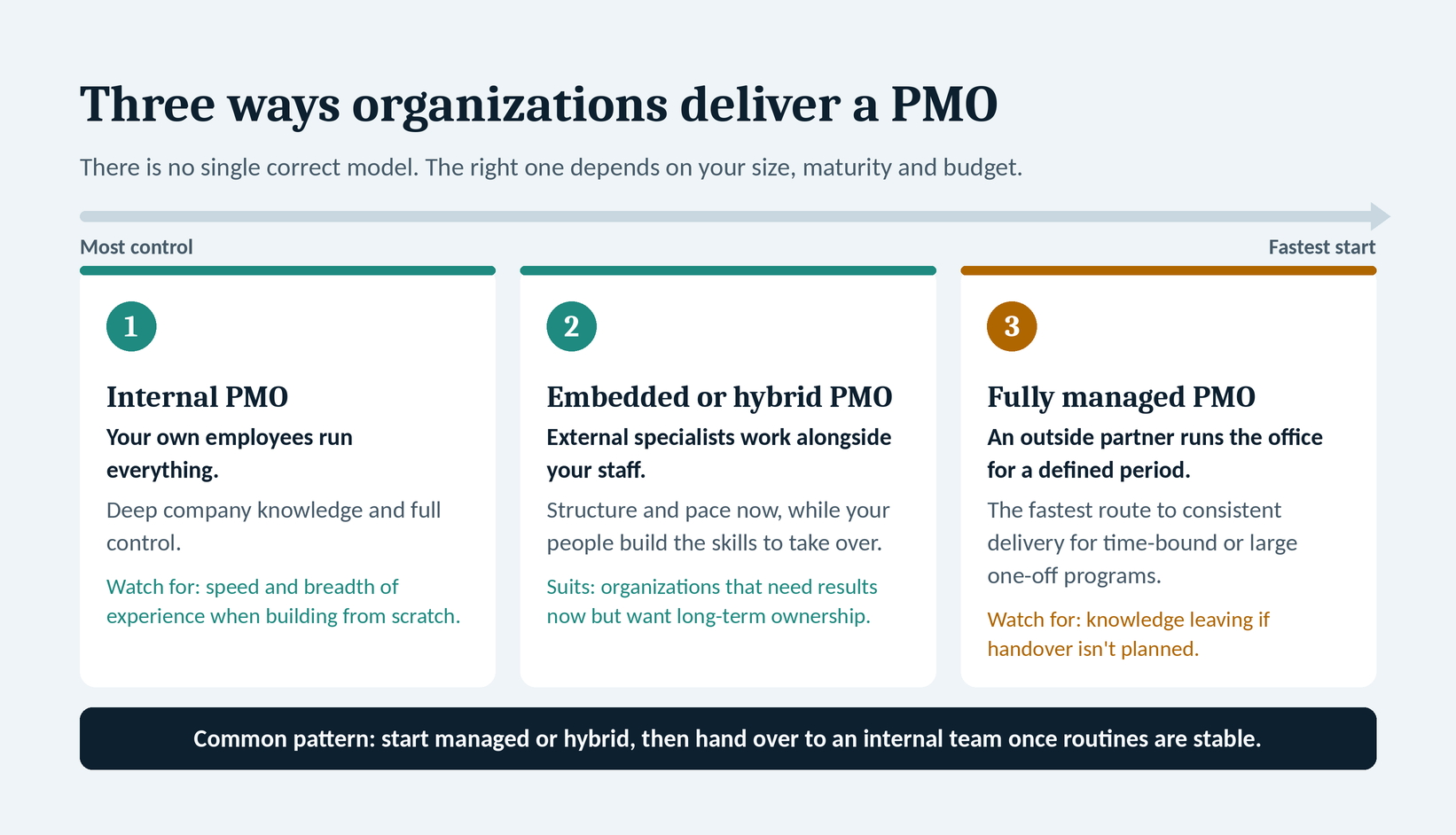
Three ways organizations deliver a PMO
There isn't one correct model. The right one depends on your size, maturity and budget.
1. Internal PMO
Your own employees run everything. You get deep company knowledge and full control. The weak points are speed and experience: building the capability from scratch can take a long time and a small team may not have seen many different approaches.
2. Embedded or hybrid PMO
External specialists work alongside your staff. They bring structure and pace, while your people build the skills to take over. This suits organizations that need results now but want long-term ownership.
3. Fully managed PMO
An outside partner runs the office for a defined period. It's the fastest way to get consistent delivery, and it works well for time-bound programs, large one-off initiatives or organizations without PMO experience. The trade-off is that knowledge can walk out the door if handover isn't planned.
A common pattern is to start managed or hybrid, then hand over to an internal team once the routines are stable.
The first 90 days
Whichever model you use, the early months decide whether the PMO earns trust. A sensible sequence looks like this.
Days 1–30: Understand before you standardize.
Map current projects, who sponsors them, where the pain is, and what people already do that works. Resist introducing templates yet. The fastest way to lose goodwill is to add paperwork before you've proven value.
Days 31–60: Fix the few things that hurt most.
Usually that means a single project list, a simple intake process and a weekly rhythm for risks and dependencies. Keep it light. Two or three consistent practices beat fifteen half-used ones.
Days 61–90: Show results and set the routine.
Publish a short, honest view of portfolio health. Capture early wins, such as a stalled project unblocked or a duplicated effort caught. Then agree with leadership on what the PMO will own going forward.
How to measure whether it's working
Skip vanity metrics. A handful of measures tell you most of what you need:
- On-time and on-budget delivery trends, looked at over quarters rather than weeks
- Decision speed: how long escalations wait before someone decides
- Resource conflicts caught early rather than discovered late
- Stakeholder confidence, which you can simply ask about
- Benefits realized compared with what was approved
If those numbers aren't moving after two or three quarters, the problem is usually the operating model, not the people.
Common reasons PMO delivery fails
Too much process, too soon. Teams comply on the surface and route around it in practice.
No sponsor with real authority. A PMO without executive backing can advise but cannot unblock anything.
Measuring activity, not outcomes. Counting reports produced tells you nothing about projects delivered.
Treating the PMO as a police force. When people see the office as an auditor, they hide problems. When they see it as help, they bring problems early.
Skipping capability building. Without trained people, even a good design fades. Developing your team, through programs such as corporate training, keeps the model alive after the setup phase ends.
When outside support makes sense
You don't have to bring in a partner. But it usually helps when:
- You're launching a major program and need structure within weeks
- Your projects are visible to leadership and failing quietly
- You have no in-house PMO experience to build from
- Your existing PMO is stuck in reporting mode and needs a reset
- You need delivery capacity for a fixed period without permanent hires
In each of these, the value is speed and pattern recognition: someone who has already seen what works and what doesn't.
Building the skills behind the model
Systems matter, but people run them. If you're developing PMO talent internally, formal knowledge helps: for practitioners, the PMO-CP live classes and the guide on why PMO certification matters for the future of the PMO are good places to look. For leaders who sponsor the office, executive training helps align expectations.
A quick self-check
Ask yourself five questions:
- Can leadership see every active project in one place?
- Is there a defined way new work enters the pipeline?
- Do risks get raised early or found late?
- Do escalations get resolved within days, not weeks?
- Do we check whether completed projects delivered their benefits?
If you answered no to three or more your PMO probably has a delivery gap and that is fixable.
Talk to us about PMO delivery
If you'd like help setting up, resetting, or running a PMO, our PMO delivery service is built around the models above. Get in touch with a short description of your situation and we'll help you work out which model fits.