Why Earn the PgMP®? From Managing Projects to Leading Strategic Transformation
Introduction
Organizations today rarely run one project at a time. Most operate several interconnected initiatives that must work together to deliver a larger business outcome and that shift has changed what is expected of experienced project professionals. Managing a single project is different from leading a program made up of multiple related projects, each with its own timeline, team and risks, all pointing toward one strategic goal. This is where the Program Management Professional (PgMP®) certification comes in. It is a credential built for professionals who already manage complexity and are ready to connect that work to broader organizational strategy and measurable business outcomes. This article looks at what the PgMP® actually involves, why program management is growing in importance and how the certification can support a move from project delivery toward strategic transformation leadership.
What Is the PgMP® Certification?
Overview of Program Management Professional (PgMP®)
The PgMP® is a certification offered by the Project Management Institute (PMI) that recognizes professionals capable of managing multiple, related projects as a single coordinated program. It sits above project-level credentials and is designed for people who are already responsible for outcomes that span more than one project team.
What Does a Program Manager Do?
A program manager's role typically includes:
- Coordinating multiple related projects toward a shared objective
- Aligning those projects with organizational strategy
- Managing interdependencies between project teams
- Coordinating shared resources across the program
- Managing program-level risks that individual project managers cannot see on their own
- Delivering the strategic benefits the program was created to achieve
How PgMP® Differs From PMP®
The PMP® credential focuses primarily on project-level delivery: scope, schedule, cost and quality for a defined project. The PgMP® focuses on managing programs, meaning the coordination of multiple related projects, their interdependencies, and the benefits they are meant to produce together. The two credentials serve different professional needs, and one is not simply a higher version of the other; they reflect two different scopes of responsibility.
Why Program Management Is Becoming More Important
Organizations Are Managing More Complex Initiatives
Fewer organizations today run isolated projects. Digital transformation, market expansion, and operational overhauls typically involve several projects running in parallel.
Projects Must Deliver Strategic Value
Boards and executives increasingly ask not just whether a project was delivered on time, but whether it produced the business value it was meant to.
Multiple Projects Often Depend on Each Other
A delay or change in one project can ripple across others, which requires someone watching the program as a whole rather than each project in isolation.
Business Transformation Requires Cross-Functional Leadership
Large transformation efforts rarely sit inside a single department, so they need leaders who can work across functions and stakeholder groups.
Executives Need Better Visibility Into Program Performance
Senior leadership needs a consolidated view of progress, risk and benefit realization across related projects, rather than a series of disconnected status reports. Program management exists to give organizations this coordinated view, helping them manage multiple initiatives together rather than treating each project as a standalone effort.
Why Earn the PgMP®? 7 Key Benefits
1. Move From Project Management to Program Leadership
Earning the PgMP® expands a professional's responsibilities beyond individual projects. It builds the ability to manage interconnected initiatives at once and develops a broader, organization-wide perspective that project-level work does not always require.
2. Strengthen Strategic Thinking
Program managers are expected to connect programs directly to business objectives. The PgMP® reinforces the skill of translating strategy into a coordinated set of initiatives and prioritizing work based on the value it delivers to the organization, not just its individual project timeline.
3. Improve Benefits Realization
A core part of program management is identifying the benefits a program is expected to deliver, monitoring whether those benefits are actually being achieved and adjusting program components as business needs change. This benefits-focused mindset is one of the clearest differences between project and program management.
4. Develop Advanced Leadership Skills
Leading a program means leading multiple project teams at once. It requires managing stakeholders across different organizational levels, resolving conflicts between competing priorities and communicating effectively with senior leadership, skills that go beyond what a single project typically demands.
5. Improve Program Risk Management
Program-level risk management involves identifying risks that cross multiple projects, understanding how those projects depend on one another and developing responses at the program level rather than the project level. This becomes essential as business conditions and priorities shift mid-program.
6. Strengthen Professional Credibility
Holding the PgMP® demonstrates advanced program management knowledge and helps differentiate a professional from peers who hold only project-level credentials. For many, it supports the next stage of career progression toward program or portfolio leadership roles.
7. Prepare for Strategic Transformation Roles
Professionals pursuing the PgMP® are often positioning themselves for roles tied to digital transformation, business transformation, enterprise initiatives, organizational change and other large-scale strategic programs where project-level thinking alone is not enough. Professionals exploring this path can review PgMP® certification training to understand what structured preparation for this credential typically involves.
PgMP® and the Transition From Projects to Strategic Transformation
Managing Projects vs. Managing Programs
| Project Management | Program Management |
|---|---|
| Focuses on a specific project | Coordinates multiple related projects |
| Delivers project outputs | Focuses on outcomes and benefits |
| Project-level risks | Program-level risks and dependencies |
| Project stakeholders | Broader stakeholder ecosystem |
| Defined project objectives | Strategic organizational objectives |
Why This Difference Matters
This distinction matters because program managers are the link between individual project outputs and the broader business outcomes an organization is trying to achieve. A project can be delivered successfully and still fail to move the organization forward if it isn't connected to the right program-level objectives. For professionals whose responsibilities are already expanding beyond a single project, PgMP® certification training can support that shift toward enterprise-level responsibility in a structured way.
What Skills Does a PgMP® Professional Need?
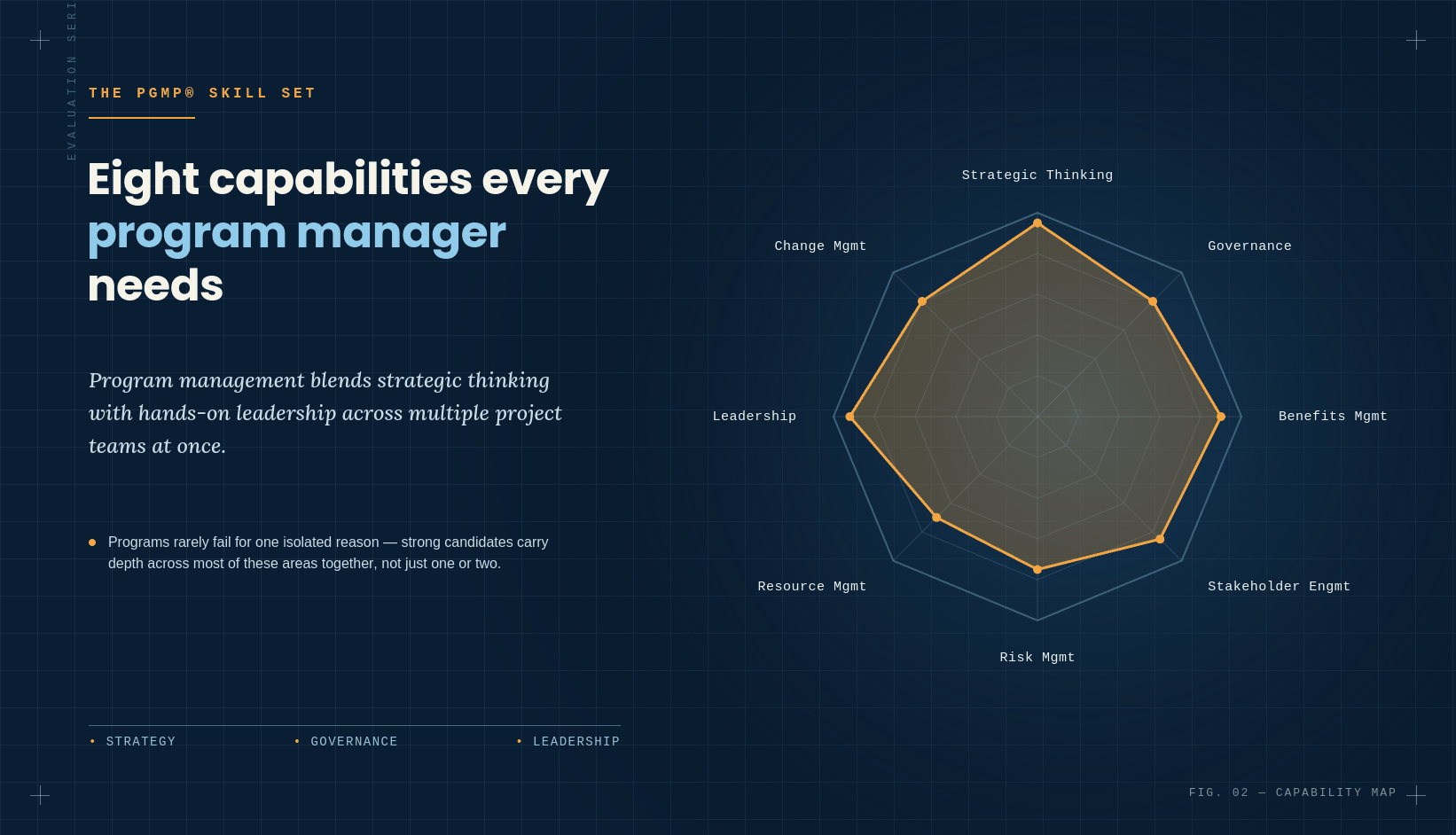
Program management draws on a combination of technical knowledge, leadership capability, strategic thinking, and business awareness. Core skill areas include:
- Strategic thinking
- Program governance
- Benefits management
- Stakeholder engagement
- Risk and issue management
- Resource management
- Leadership and communication
- Change management
No single skill on this list is enough on its own. Successful program managers tend to combine several of these areas at once, since programs rarely fail because of one isolated issue.
Who Should Consider Earning the PgMP®?
The PgMP® is intended for experienced professionals and should not be treated as a beginner-level project management certification. It is generally most relevant for:
- Experienced project managers taking on broader responsibilities
- Program managers already coordinating multiple projects
- PMO leaders overseeing organizational delivery standards
- Portfolio and program professionals
- Transformation leaders driving enterprise-wide change
- Professionals managing multiple related projects that share a common objective
How to Decide Whether PgMP® Is Right for Your Career
Questions Worth Asking
A professional considering this path might ask:
- Am I managing multiple related projects at the same time?
- Do I make decisions based on organizational strategy rather than just project scope?
- Am I responsible for program-level benefits, not just project deliverables?
- Do I regularly work with senior stakeholders across the organization?
- Am I moving toward program or portfolio leadership?
- Do I want to be involved in large-scale transformation initiatives?
When PMP® May Be More Appropriate
Professionals who are primarily managing individual projects, rather than a coordinated set of related projects, may benefit more from strengthening their project-level expertise first, such as through PMP® certification training, before pursuing the PgMP®.
How to Prepare for the PgMP® Certification
Preparing for the PgMP® generally involves several steps:
- Reviewing current PMI eligibility requirements
- Studying the PgMP® examination content outline
- Building a solid understanding of program management concepts
- Practicing with scenario-based questions rather than memorization alone
- Following a structured study plan for PgMP® exam preparation
- Using mock exams and reviewing weaker areas
- Connecting the theory to real program management experience
Candidates should also verify current PMI requirements, examination details, and application procedures directly with PMI before beginning preparation, since these can be updated periodically.
Final Thoughts
The PgMP® represents a shift from project-level delivery toward program-level leadership. It connects strategy, benefits realization, governance, stakeholder management and transformation into a single area of professional practice, rather than treating them as separate concerns. Certification alone is not the goal; it works best when it complements real-world program management experience rather than replacing it. Professionals considering this path should take time to evaluate their current responsibilities and where they want their career to go before committing to preparation.
If you are looking for more than an examination-preparation course, SnSCCS is your one-stop destination for PgMP® certification training. Learn under the guidance of Samia Waqar and prepare not only to earn the certification, but also to apply the knowledge, perform more effectively in your role, prepare for the future of the profession and pursue your next career opportunity.
Frequently Asked Questions (FAQ)
What is the PgMP® certification?
The PgMP® is a PMI credential that recognizes professionals who manage multiple related projects as a coordinated program aligned with organizational strategy.
Who should earn PgMP®?
It is generally suited to experienced project managers, program managers, PMO leaders, and professionals responsible for coordinating multiple related projects rather than a single project.
What is the difference between PMP® and PgMP®?
PMP® focuses on delivering an individual project, while PgMP® focuses on coordinating multiple related projects and the strategic benefits they are meant to deliver together.
Is PgMP® suitable for experienced project managers?
Yes. It is designed for professionals who already have substantial project or program experience, not those new to project management.
How does PgMP® support strategic transformation?
It builds the skills needed to connect multiple projects to a broader business outcome, which is central to most transformation and enterprise-change initiatives.
What skills does a PgMP® professional need?
Strategic thinking, program governance, benefits management, stakeholder engagement, risk management, resource management, leadership, and change management.
How should candidates prepare for the PgMP® exam?
By reviewing PMI's eligibility requirements, studying the examination content outline, practicing scenario-based questions, and following a structured study plan.
Why Learn the PgMP® With SnSCCS
Passing the exam is only part of what a PgMP® credential should offer. At SnSCCS, participants are guided to:
- Prepare confidently for the certification examination
- Understand the principles behind the examination content, not just memorize them
- Apply that knowledge effectively in their current roles
- Prepare for where their profession is heading
- Strengthen their leadership and decision-making capabilities
- Pursue promotions and more senior career opportunities
- Connect the certification to real organizational challenges they are already facing
This reflects how SnSCCS approaches certification training as a whole. Under the guidance of Samia Waqar, participants learn how to understand the discipline itself, apply it in the workplace, prepare for the future of their profession, and use their certification to support long-term career advancement, rather than treating the exam as the end point.
Samia Waqar is the CEO of SnS Coaching and Consulting Services, a PMI Authorized Training Partner, a PMI Authorized Instructor and an active holder of nine PMI certifications. She combines certification knowledge with extensive real-world experience in project, program, portfolio, risk, agile, business analysis, PMO, AI, sustainability, organizational change and enterprise transformation.
SnSCCS offers a distinctive learning experience that combines PMI-authorized content, examination preparation, practical application, career context and guidance from an instructor who personally holds all nine certifications.