PMI-ACP® Examination Content Outline
Introduction
Every candidate preparing for the PMI-ACP® certification eventually runs into the same question: where exactly should study time go? The answer lies in one document that PMI publishes specifically for this purpose the Examination Content Outline, commonly referred to as the ECO. Rather than guessing which topics matter most, candidates who study the ECO closely gain a clear picture of what the exam actually tests and in what proportion.
This article explains what the PMI-ACP® Examination Content Outline is, why PMI created it, and how its four domains are structured. It also walks through practical ways to turn the outline into a working study plan, points out common mistakes candidates make, and answers the questions most frequently asked about this document. By the end, readers will have a clear roadmap for using the ECO as the foundation of their exam preparation.
What Is the PMI-ACP® Examination Content Outline?
Definition of the Examination Content Outline (ECO)
The Examination Content Outline is PMI's official breakdown of the knowledge areas, tasks and skills that the PMI-ACP® exam measures. It is built from research PMI conducts with practicing agile professionals and it reflects what is actually expected of someone working in an agile environment today, not just theory found in textbooks.
Why PMI Uses the ECO
PMI relies on the ECO to keep its certification exams grounded in real-world practice. Instead of testing candidates on abstract definitions alone, the outline ties exam content to tasks that agile practitioners genuinely perform, which keeps the credential relevant to employers.
How the ECO Differs from the PMBOK® Guide
Candidates sometimes confuse the ECO with the PMBOK® Guide, but the two serve different purposes. The PMBOK® Guide is a broader reference on project management practice, while the ECO is exam-specific it tells candidates precisely what will be tested and how much weight each domain carries on exam day.
Who Should Use the ECO?
The ECO is meant for anyone actively preparing for the PMI-ACP® exam, whether they are working through a structured program such as SNS's ACP live classes or studying independently. It is equally useful for professionals who already meet the PMI-ACP certification requirements and are now shifting focus from eligibility to actual exam content.
Understanding the PMI-ACP® Examination Content Outline
The PMI-ACP® ECO is organized around four domains. Each one represents a cluster of tasks and knowledge areas that agile practitioners are expected to demonstrate on the exam.
Domain 1: Mindset
This domain centers on how a practitioner thinks rather than what they memorize. It covers agile values and principles, the broader agile mindset that shapes decision-making on a team, a commitment to continuous improvement, and customer-centric thinking that keeps delivery focused on real user needs rather than internal assumptions.
Domain 2: Leadership
Leadership in an agile context looks different from traditional command-and-control management. This domain addresses servant leadership, where the practitioner's role is to remove obstacles for the team rather than direct every task. It also covers team empowerment, conflict resolution within cross-functional groups and stakeholder collaboration that keeps everyone aligned as priorities shift.
Domain 3: Product
The product domain focuses on how value gets defined and delivered. Topics include building and communicating a product vision, practicing value-driven delivery so that the highest-impact work happens first, prioritization techniques for managing competing demands and using customer feedback loops to validate direction before too much work is invested.
Domain 4: Delivery
Delivery is where agile theory becomes execution. This domain includes adaptive planning that responds to changing requirements, agile estimation techniques for sizing work realistically, quality practices woven into each iteration rather than left until the end and risk management approaches suited to fast-moving, iterative projects.
Together, these four domains give candidates a map of the exam rather than a vague sense of study everything. Anyone comparing this structure to the topics discussed in the PMI-ACP course overview will notice how closely a well-designed training program mirrors the ECO itself.
How to Use the PMI-ACP® Examination Content Outline for Exam Preparation
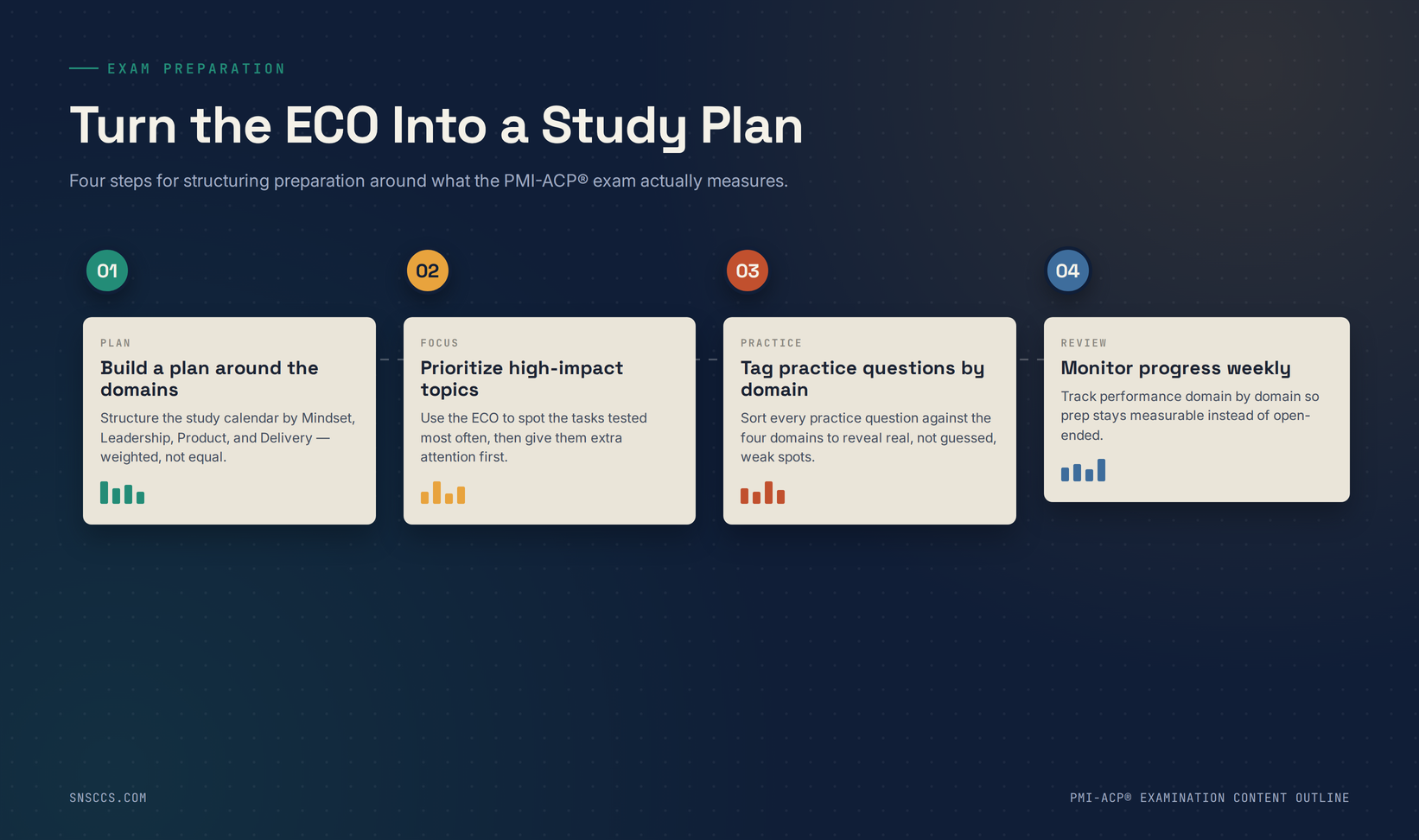
Build a Study Plan Around the Domains
Rather than working through a textbook front to back, candidates get better results by structuring their study calendar around the four ECO domains, allocating time roughly in proportion to how each domain is weighted on the exam.
Prioritize High-Impact Topics
Not every topic carries equal weight. Reviewing the ECO first helps candidates identify which tasks appear most frequently and direct extra attention there instead of spreading effort evenly across unfamiliar and familiar material alike.
Align Practice Questions with ECO Domains
When working through practice tests, it helps to tag each question by domain. This makes it much easier to spot which of the four areas needs more review, rather than treating every wrong answer as a random gap.
Monitor Progress Regularly
Tracking performance domain by domain, on a weekly basis, turns exam prep into a measurable process rather than an open-ended one. Candidates enrolled in a structured program such as PMI-ACP live classes often find this tracking easier, since instructors can point out domain-specific weak spots along the way.
Recommended Study Resources
PMI-ACP® Examination Content Outline
The ECO itself, available directly from PMI, should always be the starting point since every other resource is built to support it.
Agile Practice Guide
Published alongside the PMBOK® Guide, this resource offers practical context for many of the concepts tested under the Delivery and Product domains.
PMBOK® Guide
While not agile-specific, the PMBOK® Guide provides useful background on project management fundamentals that occasionally intersect with ECO content.
Scrum Guide
Since Scrum terminology appears throughout the exam, a careful read of the Scrum Guide reinforces vocabulary and concepts tied to the Mindset and Product domains.
Mock Exams
Timed, full-length mock exams remain one of the most reliable ways to gauge readiness and build the stamina needed for the actual test.
Instructor-Led Training
Structured programs, including live sessions like those covered on the PMI-ACP exam preparation guide, give candidates the chance to ask questions and get real-time feedback that self-study alone cannot always provide.
Common Mistakes Candidates Make
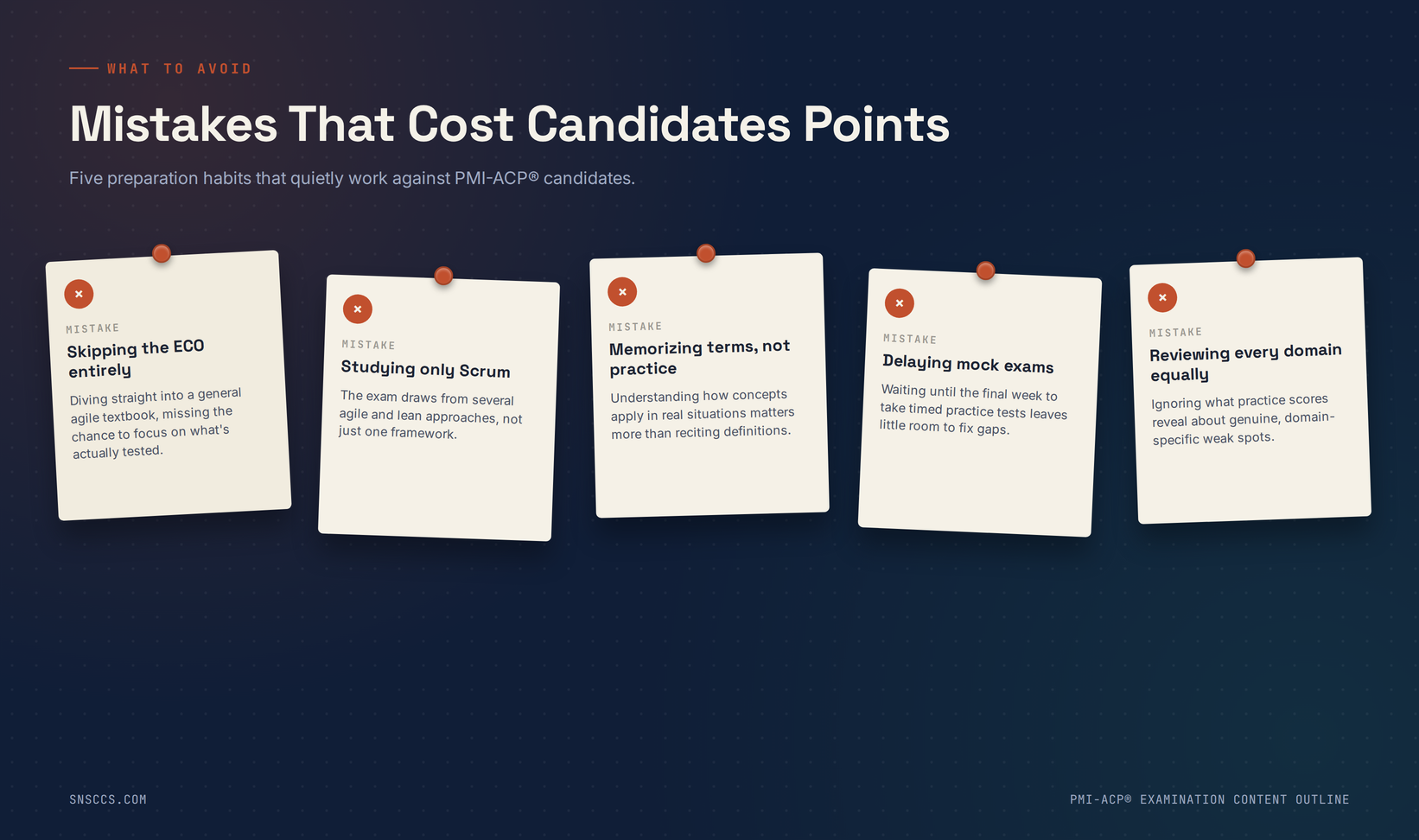
Many candidates lose valuable preparation time by skipping the ECO entirely and diving straight into a general agile textbook, missing the chance to focus on what is actually tested. Others make the mistake of studying only one agile framework, usually Scrum, without recognizing that the exam draws from several agile and lean approaches. Memorizing terminology instead of understanding how concepts apply in practice is another common trap, along with skipping practice exams until the final week of preparation. Finally many candidates review every domain equally instead of spending extra time on the ones where their practice scores reveal genuine weakness.
Tips to Master the PMI-ACP® Examination Content Outline
Study One Domain at a Time
Working through Mindset, Leadership, Product and Delivery separately, rather than jumping between them, helps information stick and makes gaps easier to spot.
Apply Agile Principles in Real Projects
Where possible, applying concepts like adaptive planning or servant leadership to an actual current project reinforces learning far more effectively than passive reading.
Take Full-Length Mock Exams
Simulating real exam conditions, including the time limit, builds both content knowledge and the pacing skills needed to finish on time.
Review Incorrect Answers
Every wrong answer on a practice test is a signal. Reviewing the reasoning behind the correct answer, not just memorizing it, closes the gap for good.
Revise Regularly
Short, regular review sessions in the final weeks before the exam tend to outperform long, infrequent study blocks, particularly for retaining domain-specific detail.
Final Thoughts
The PMI-ACP® Examination Content Outline is more than a reference document it is the blueprint the entire exam is built on. Candidates who study it early and structure their preparation around its four domains consistently find the process less overwhelming than those who study without a clear plan. Pairing the ECO with official PMI resources, regular practice exams and honest self-assessment gives candidates the best chance of walking into the exam room prepared. Most importantly, success on the PMI-ACP® exam comes from genuinely understanding agile concepts and how they apply in practice, not from memorizing isolated facts. Approaching preparation this way builds a foundation that lasts well beyond exam day.
Frequently Asked Questions (FAQ)
What is the PMI-ACP® Examination Content Outline?
It is PMI's official document describing the domains, tasks and knowledge areas measured on the PMI-ACP® exam, based on research into real agile practice.
Is the ECO enough to prepare for the exam?
The ECO is the essential starting point, but most candidates pair it with practice exams, reference guides, and structured training for a complete preparation strategy.
How many domains are included in the PMI-ACP® ECO?
The outline is organized into four domains: Mindset, Leadership, Product and Delivery.
Should I study the PMBOK® Guide as well?
It is not required, but reviewing it can add useful context, particularly for candidates newer to formal project management concepts.
How often does PMI update the Examination Content Outline?
PMI periodically reviews and updates its exam content outlines based on ongoing research into current agile practice, so candidates should always confirm they are using the most recent version before starting their preparation.