PMI's New AI Standard
Artificial intelligence is no longer a side conversation in project management; it has become part of how work gets planned, executed, and delivered. From automated scheduling to AI-assisted risk analysis, project professionals across industries are being asked to use, manage and increasingly govern AI tools inside their portfolios, programs and projects. This shift is exactly why PMI's release of a dedicated AI standard matters so much to the profession right now.
In June 2026, PMI published The Standard for Artificial Intelligence in Portfolio, Program and Project Management, giving the profession its first structured, ANSI-approved framework for responsible AI adoption. For project managers, program managers, portfolio leaders and PMO teams, this is more than another PMI publication it signals that AI governance is now a core project management competency. This guide breaks down what the standard covers, why it matters, and how project professionals can begin applying it.
What Is PMI's New AI Standard?
An Overview of the New PMI Standard
The Standard for Artificial Intelligence in Portfolio, Program and Project Management gives professionals a shared reference point for evaluating and managing AI-enabled work. Rather than tying itself to any specific software or vendor, it takes a technology-agnostic approach, focusing on principles, performance areas and oversight practices that stay relevant as tools change.
Why PMI Introduced an AI Standard
AI adoption inside organizations has outpaced the governance structures meant to manage it. Teams are experimenting with AI for forecasting, reporting, and decision support, often without a consistent framework for oversight or accountability. PMI's standard responds directly to that gap, offering a structured path from ad hoc AI experimentation toward disciplined, accountable practice.
Who Should Read the Standard?
The standard is written broadly enough to serve project managers, program managers, portfolio managers, PMO leaders and executives sponsoring AI initiatives a goal that touches nearly every layer of project delivery, from hands-on execution to executive-level sponsorship.
Why PMI's New AI Standard Matters for Project Professionals
AI Is Changing How Projects Are Managed and Delivered
Scheduling, forecasting, risk scoring, and status reporting are increasingly assisted by AI tools, changing the day-to-day rhythm of project work. Many organizations also now run projects where AI itself is the deliverable a chatbot, a predictive model, an automation pipeline. As one recent SNS CCS piece on why AI projects fail when they're managed the wrong way points out, these initiatives carry different risks than traditional projects, which is part of why a dedicated standard was needed.
Governance and Human Judgment Remain Critical
Understanding how a model works is useful, but it isn't enough professionals also need to interpret outputs, question assumptions and translate technical results into decisions stakeholders can trust. As AI tools take on more decision-support functions, someone still has to own the outcome. AI can support planning and analysis, but people remain responsible for context, stakeholder relationships and final accountability the balance at the heart of the standard.
The Eight Guiding Principles Explained
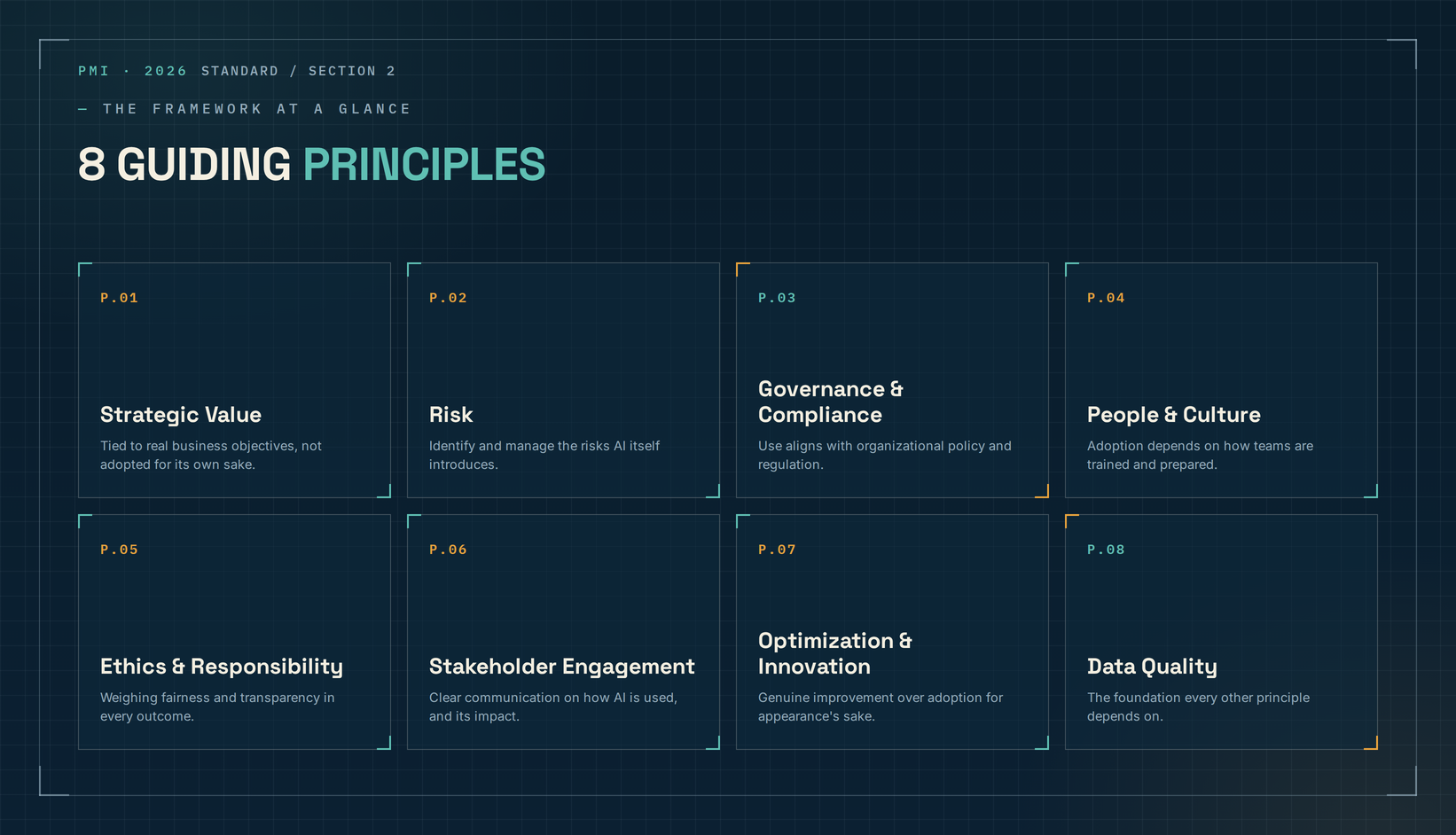
PMI's standard is built around eight guiding principles that help professionals evaluate AI initiatives beyond the technology itself.
Strategic Value asks whether an AI initiative is genuinely tied to business objectives, not adopted simply because the technology is available. Risk requires teams to identify and manage the specific risks AI introduces, from model errors to unintended outcomes. Governance and Compliance ensures AI use aligns with organizational policy and regulation. People and Culture recognizes that adoption depends on how teams are trained and prepared a theme explored further in why AI literacy is now a leadership imperative.
Ethics and Professional Responsibility calls on professionals to weigh fairness and transparency. Stakeholder Engagement emphasizes clear communication about how AI is used and what it means for those affected. Optimization and Innovation encourages teams to pursue genuine improvement rather than adopting AI for its own sake. Data Quality underscores that AI is only as reliable as the data feeding it a foundational concern rather than an afterthought.
Together, these principles connect AI adoption to business value, ethics, and organizational accountability.
Understanding the Five Performance Domains
Alongside the guiding principles, the standard organizes practical AI-related work into five performance domains: managing stakeholder expectations, defining the scope for AI, designing systems for quality and reliability, executing strategic AI goals and managing risk and uncertainty.
These domains give portfolio, program, and project teams a practical structure for organizing AI-enabled work and they map closely to functions many PMO teams already own a connection covered in more detail in this six-step PMO transformation roadmap. Rather than treating AI as a separate discipline, the domains fit within existing delivery frameworks instead of replacing them.
Why Human-in-the-Loop Oversight Is Critical
AI-generated outputs still need human review, interpretation, and correction accountability cannot sit with an algorithm. Not every output needs the same scrutiny, so professionals are encouraged to define which decisions require sign-off versus lighter oversight, build clear escalation paths for issues like inconsistent data, assign decision ownership explicitly rather than by default and build feedback loops so review outcomes improve how AI tools are used over time.
How the Standard Can Be Applied Across Project Work
The standard's guidance isn't limited to projects that build AI products. It applies just as much to teams using AI as a support tool in everyday project work in project planning, risk identification, decision-making, portfolio prioritization and stakeholder analysis. It also applies directly to managing AI-driven projects, where the deliverable itself is an AI system.
A project manager using AI for a scheduling decision and a program manager overseeing an AI product rollout are operating inside the same governance framework, just at different points of the same spectrum. Professionals preparing for AI-focused certification, such as PMI-CPMAI live classes, will recognize many of the same themes of structured methodology and responsible implementation running through the standard.
Key Risks Project Professionals Need to Consider
Several risks recur across AI-enabled projects: poor data quality, which undermines every downstream decision; bias and ethical concerns in outputs affecting people; privacy and intellectual property issues tied to data sourcing; regulatory requirements that vary by industry; overreliance on AI outputs without sufficient human review and lack of clear accountability when something goes wrong.
Data quality in particular is a recurring theme across PMI's AI-related content, including its CPMAI examination content outline, which treats reliable data as foundational. Successful adoption depends on addressing these risks from the start, not after deployment.
How Project Professionals Can Start Using the Standard
Getting started doesn't require an organization-wide overhaul on day one. A practical starting point includes reviewing current AI use, identifying high-value opportunities, establishing governance and accountability structures, defining human oversight requirements, and aligning AI initiatives with business strategy.
For professionals looking to build this expertise formally, structured programs like the PMI-CPMAI live classes at SNS CCS walk through these same concepts data quality, methodology and responsible AI implementation in a live, instructor-led format. Reviewing the CPMAI certification requirements beforehand can help map existing experience against what the credential expects.
The Skills Project Professionals Need in an AI-Driven Future
As AI becomes more embedded in project work, the skills that matter most are shifting. AI literacy, data and analytical thinking, AI governance and risk management are now baseline expectations. Ethical decision-making and stakeholder communication keep AI-driven decisions transparent, while strategic thinking and human judgment remain the skills no algorithm replaces.
AI doesn't eliminate the need for project professionals; it raises the value of leadership and the ability to connect technology decisions with business outcomes a capability explored further in this piece on building AI leadership capability. Professionals preparing for CPMAI exam preparation will find that PMI's new standard reinforces many of the same principles those credentials are built around.
Final Thoughts
PMI's new AI standard arrives at a moment when AI adoption in project-based work is accelerating faster than most organizations' governance structures. Its eight guiding principles, five performance domains and emphasis on human-in-the-loop oversight give the profession a shared, practical framework for responsible AI adoption rather than a purely technical checklist.
For project professionals, the takeaway isn't that AI is replacing their role it's that their role is becoming more central. Translating AI capability into real business value still requires judgment, governance and leadership that only people can provide. Building AI knowledge alongside strong governance and decision-making skills is quickly becoming one of the most valuable combinations a project professional can offer.
Frequently Asked Questions (FAQ)
What is PMI's new AI standard?
It is The Standard for Artificial Intelligence in Portfolio, Program and Project Management, released by PMI in June 2026 as a technology-agnostic, ANSI-approved framework for managing AI-enabled work.
Who should read PMI's AI standard?
Project managers, program managers, portfolio managers, PMO leaders, executives and any professional involved in delivering or overseeing AI-enabled initiatives.
What are the eight guiding principles?
Strategic value, risk, governance and compliance, people and culture, ethics and professional responsibility, stakeholder engagement, optimization and innovation, and data quality.
What are the five performance domains?
Managing stakeholder expectations, defining the scope for AI, designing systems for quality and reliability, executing strategic AI goals, and managing risk and uncertainty.
Why is human-in-the-loop oversight important?
Because AI can support analysis and decision-making, but accountability for outcomes still rests with people who review, interpret, and correct AI outputs when needed.
Does the standard apply only to AI projects?
No. It applies both to projects that deliver AI products and to everyday project work where AI tools support planning, risk analysis, or decision-making.
How can project professionals start applying the standard?
By reviewing current AI use, identifying high-value opportunities, setting up governance and oversight structures and building AI-related skills alongside core project management capabilities.