PMI-CPMAI Certification Requirements
Introduction
Artificial intelligence has moved from a side conversation in project meetings to a core part of how work gets planned, delivered and governed. PMI responded to that shift by launching the PMI Certified Professional in Managing AI (PMI-CPMAI)™, a credential built specifically for professionals who lead or support AI-driven initiatives. Before anyone commits time and money to preparation, it helps to know exactly what PMI expects from a candidate. Understanding the PMI-CPMAI certification requirements upfront prevents wasted study effort, avoids application delays and sets realistic expectations for the exam itself. This guide walks through eligibility, the application process, examination rules and how to prepare, so candidates know precisely what stands between them and the credential.
What Is the PMI-CPMAI Certification?
Overview of PMI-CPMAI™
PMI-CPMAI is PMI's certification for professionals who manage or contribute to AI initiatives. It replaced the earlier CPMAI v7 credential and is built around the CPMAI methodology, a structured approach to taking an AI project from business problem to a deployed, monitored solution.
What Does PMI-CPMAI Focus On?
The certification centers on a handful of practical themes rather than deep technical AI theory:
- Core artificial intelligence concepts and terminology
- AI-enabled project management practices
- Practical application of AI within real project environments
- Responsible and ethical use of AI systems
- Data-driven decision-making across a project lifecycle
Candidates weighing whether the credential is a fit for their role can also review SNS's earlier piece on the PMI-CPMAI AI project management certification for a broader look at what the certification covers.
Who Should Consider PMI-CPMAI?
The certification is aimed at a wide professional audience, including:
- Project and program managers
- Construction and infrastructure professionals overseeing technology-enabled projects
- Portfolio and PMO professionals
- Business leaders sponsoring AI initiatives
- Anyone already working on or transitioning into AI-driven project work
PMI-CPMAI Certification Requirements at a Glance
Educational Requirements
Unlike many PMI credentials, PMI-CPMAI does not tie eligibility to a specific degree or formal education level. There is no minimum diploma, degree or academic prerequisite listed by PMI. That said requirements can be refined over time, so it is worth cross-checking the current criteria on PMI's official certification page before applying.
Professional Experience Requirements
PMI-CPMAI does not require prior project management experience, technical background or AI-related work history to enroll. This is a deliberate design choice on PMI's part, meant to make the credential accessible to professionals moving into AI-enabled roles from different backgrounds. Existing project management or data knowledge is helpful for absorbing the material faster, but it is not an eligibility gate the way it is for credentials like the PMP.
Training or Learning Requirements
The one non-negotiable requirement is completion of PMI's official PMI-CPMAI Exam Prep Course. This training is mandatory, not optional, and candidates cannot schedule the exam until it has been completed. The course is organized around the CPMAI methodology's phases and typically includes scenario-based exercises, case studies and a workbook that mirrors what the exam will test. Professionals who prefer a guided, cohort-based format rather than self-paced study can complete this requirement through live PMI-CPMAI training instead of working through the material alone.
Examination Requirement
Once the prep course is complete, candidates become eligible to schedule and sit the PMI-CPMAI exam through Pearson VUE, either at a test center or via online proctoring. Passing this exam is what ultimately confers the certification.
Important: Certification requirements can be updated by PMI, so the final word on eligibility should always come from PMI's own certification page at the time of application.
Understanding PMI-CPMAI Eligibility Requirements
Who Is Eligible to Apply?
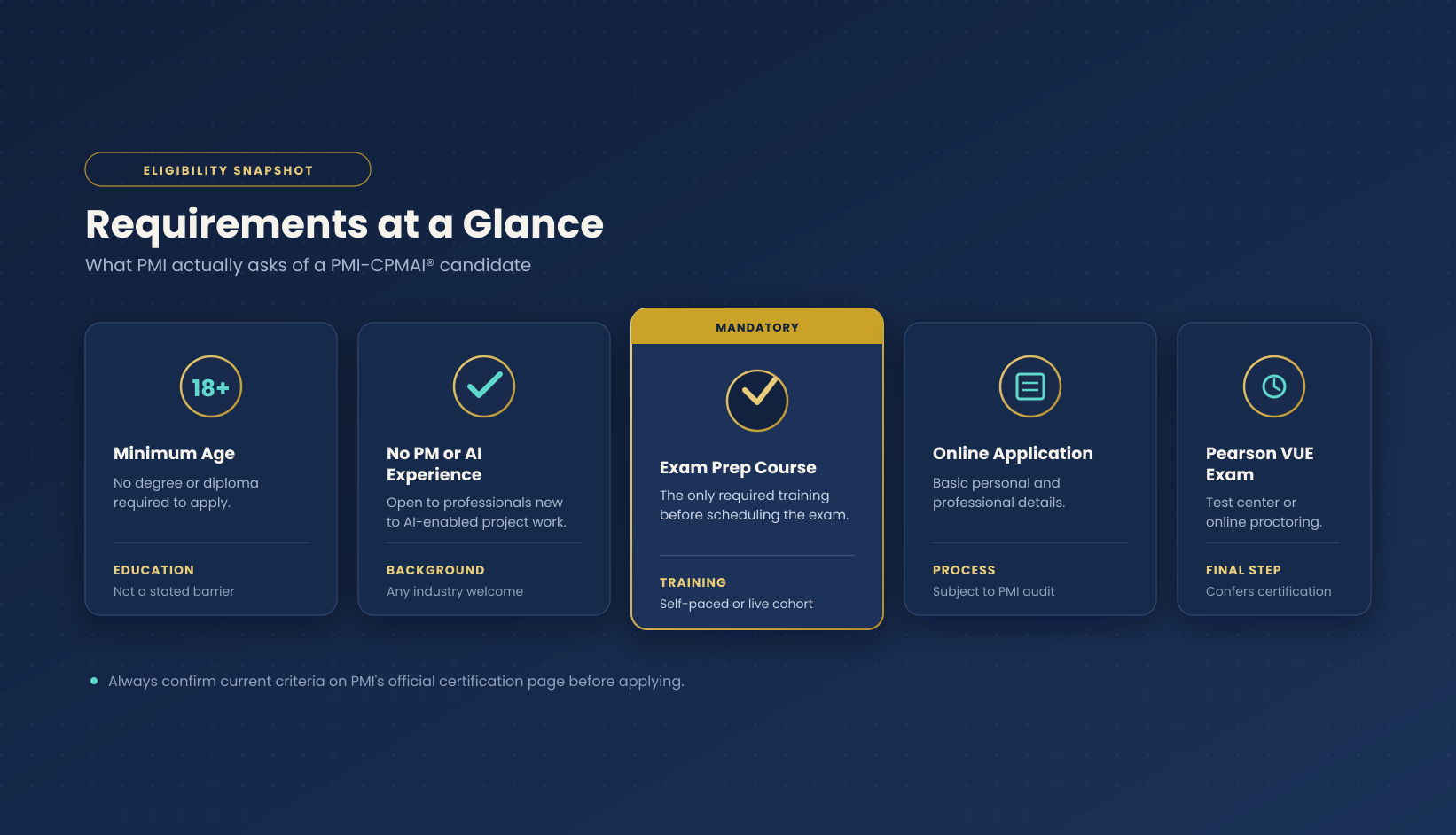
Eligibility is intentionally minimal. A candidate must be at least 18 years old and complete the mandatory Exam Prep Course. Beyond that, PMI does not currently impose additional entry barriers.
Education and Professional Background
There is no degree requirement and no specific professional background needed to apply. This makes PMI-CPMAI more accessible than credentials such as the PMP or PgMP, which carry formal education and experience thresholds.
AI Knowledge and Skills
Deep technical AI expertise is not expected. The certification is built for people who manage AI initiatives, not necessarily people who build the models themselves. Basic familiarity with AI concepts helps candidates move through the prep course more comfortably, but it is not a prerequisite PMI checks before enrollment.
Project Management Knowledge
Formal project management certification or experience is not required. Professionals coming from a traditional PM background will likely recognize the structure of the material, while newer professionals can still complete the course and sit the exam on the same terms.
Construction and Industry Experience
Industry-specific experience, including construction-sector experience, is not a stated eligibility requirement for PMI-CPMAI. Construction and infrastructure professionals working on technology-enabled or AI-assisted projects can pursue the certification the same way any other professional would, since PMI's current criteria apply uniformly across industries rather than singling out sector-specific prerequisites.
How to Check Your Eligibility
Before starting preparation, candidates should:
- Review PMI's current PMI-CPMAI certification page directly
- Compare their qualifications against the stated requirements
- Confirm the Exam Prep Course is the only mandatory training step
- Gather basic identification and professional details needed for the application
PMI-CPMAI Application Process
Applying for PMI-CPMAI follows a fairly linear sequence:
- Create or access a PMI account through PMI's official website.
- Review the current certification requirements listed for PMI-CPMAI at the time of application.
- Complete the application form, providing basic personal and contact information.
- Provide professional and educational information where requested, even though it is not a strict eligibility filter for this credential.
- Submit the application for processing.
- Complete any required verification or audit, if PMI selects the application for review.
- Receive approval, then proceed to complete the Exam Prep Course and schedule the exam.
Accuracy matters throughout this process. Inconsistent or incomplete information can slow down approval, and PMI does periodically audit applications, so candidates should provide consistent, verifiable details from the start rather than treating the application as a formality.
PMI-CPMAI Examination Requirements
Understanding the Examination Content Outline
The PMI-CPMAI exam is built from PMI's official Examination Content Outline (ECO), which defines the domains, tasks and weighting behind every exam question. Candidates who want a full domain-by-domain breakdown of what the exam tests can refer to SNS's detailed PMI-CPMAI Examination Content Outline guide.
Major Areas Candidates Should Study
At a high level, preparation should cover:
- AI fundamentals and terminology
- Practical AI applications within project environments
- Data and analytics considerations
- Responsible and ethical AI practices
- AI implementation and operationalization within projects
Scenario-Based Questions
The exam leans on scenario-based questions rather than simple recall. Candidates are typically asked to identify the best next step in a given situation, which rewards applied understanding over memorized definitions.
Understanding Practical AI Applications
Because the exam is scenario-driven, candidates benefit from connecting each concept to a real or hypothetical project situation rather than studying topics in isolation.
Importance of Mock Exams and Practice Questions
Timed practice exams help candidates get used to the pacing and question style before the real attempt and they make it easier to spot which areas still need review.
How to Prepare for PMI-CPMAI Certification
- Start with the official PMI requirements to confirm nothing has changed since initial research.
- Study the Examination Content Outline rather than relying only on a course syllabus.
- Build a structured study schedule that allocates more time to heavier-weighted exam areas.
- Learn AI fundamentals before moving into project-specific applications.
- Connect AI concepts with project management practice, since the exam tests this intersection directly.
- Practice real-world scenarios to build the judgment the exam is designed to measure.
- Review weak areas before the exam, using practice results as a guide rather than guessing.
Candidates who want a more detailed, week-by-week approach to this stage can pair the checklist above with SNS's dedicated PMI-CPMAI exam preparation guide for pacing and study sequencing.
Professionals who prefer guided preparation over self-study often lean on structured, instructor-led PMI-CPMAI classes to work through the material in sequence rather than navigating a dense outline alone.
Common Mistakes Candidates Should Avoid
- Relying on outdated certification information instead of PMI's current criteria
- Assuming general AI knowledge alone is sufficient preparation
- Ignoring the official Examination Content Outline in favor of a course syllabus
- Focusing on memorization instead of applied, scenario-based understanding
- Underestimating how the exam tests practical AI application, not just theory
- Skipping practice questions before attempting the real exam
- Leaving application documentation and prep-course completion until the last minute
Final Thoughts
PMI-CPMAI certification requirements are lighter than most professionals expect from a PMI credential: no fixed degree, no mandatory prior experience, just a minimum age of 18 and completion of the official Exam Prep Course before sitting the exam. That accessibility is part of what makes the certification attractive to professionals moving into AI-enabled project work from very different starting points. Candidates still need to treat the Examination Content Outline and exam preparation seriously, since eligibility being simple does not mean the exam itself is easy. Combining structured preparation with a genuine understanding of how AI fits into project delivery puts candidates in a far stronger position heading into exam day and as AI continues reshaping how projects get planned and delivered, that preparation carries value well beyond the exam itself.
Frequently Asked Questions (FAQ)
What are the PMI-CPMAI certification requirements?
Candidates must be at least 18 years old and complete PMI's mandatory Exam Prep Course before they can schedule the exam. There is no separate degree or experience requirement.
Do I need project management experience for PMI-CPMAI?
No. Prior project management experience is not required, though it can make the material easier to absorb for candidates who already have it.
Is AI experience required for PMI-CPMAI certification?
No. The certification is designed for professionals who manage AI initiatives, not necessarily those with hands-on technical AI experience. The prep course covers the concepts needed.
Is construction experience required for PMI-CPMAI?
No. PMI's current eligibility criteria apply across industries, so construction-sector experience is not a stated requirement, though construction professionals working on AI-assisted projects are a natural fit for the credential.
What training is required for PMI-CPMAI?
Completion of the official PMI-CPMAI Exam Prep Course is mandatory before the exam can be scheduled. This is currently the only required training component.
How can I prepare for the PMI-CPMAI examination?
Preparation works best when it starts with the Examination Content Outline, builds a study schedule around domain weighting, and includes scenario-based practice questions alongside the prep course material.