PMI-PMOCP Examination Content Outline
Every PMI certification is built around a document that most candidates skim past too quickly the Examination Content Outline. For anyone preparing for the PMI Project Management Office Certified Professional (PMI-PMOCP™) credential, this document is the blueprint the exam is written from.
The PMI-PMOCP Examination Content Outline lays out exactly what the certifying body expects a PMO professional to know, from governance frameworks to performance management to organizational leadership. Candidates who study around this structure, rather than through generic project management material, tend to walk into the exam with a clearer sense of what to expect. This article breaks down what the outline covers, who it is for, and how it can be used to build a domain-by-domain study plan.
What Is the PMI-PMOCP Examination Content Outline?
Definition of the Examination Content Outline (ECO)
The Examination Content Outline is the official framework published for a PMI certification exam. It defines the domains, tasks and competencies the exam is designed to test, developed with input from practicing professionals in the field.
Why PMI Provides an ECO
PMI publishes an ECO for each credential so candidates are not left guessing about scope. Instead of relying on assumptions about what PMO knowledge means, the outline sets defined boundaries around governance, strategy, operations and leadership competencies a certified PMO professional should demonstrate.
Difference Between the ECO and Study Materials
The ECO is not a textbook and it is not a substitute for structured learning. It functions more like a syllabus it tells candidates what to study, not how to study it. A more detailed PMI-PMOCP training guide can help translate the outline into an actual learning path.
Who Should Use the PMI-PMOCP ECO?
The outline is relevant to a broad group of practitioners, including:
- PMO Managers
- PMO Directors
- Project Managers
- Program Managers
- Portfolio Managers
- PMO Analysts
- Business Transformation Professionals
Anyone responsible for building, running or maturing a PMO will find these domains directly relevant to day-to-day work, not just exam preparation. Professionals weighing whether this certification fits their next career move can also work through a career advisory conversation first.
Understanding the PMI-PMOCP Examination Content Outline
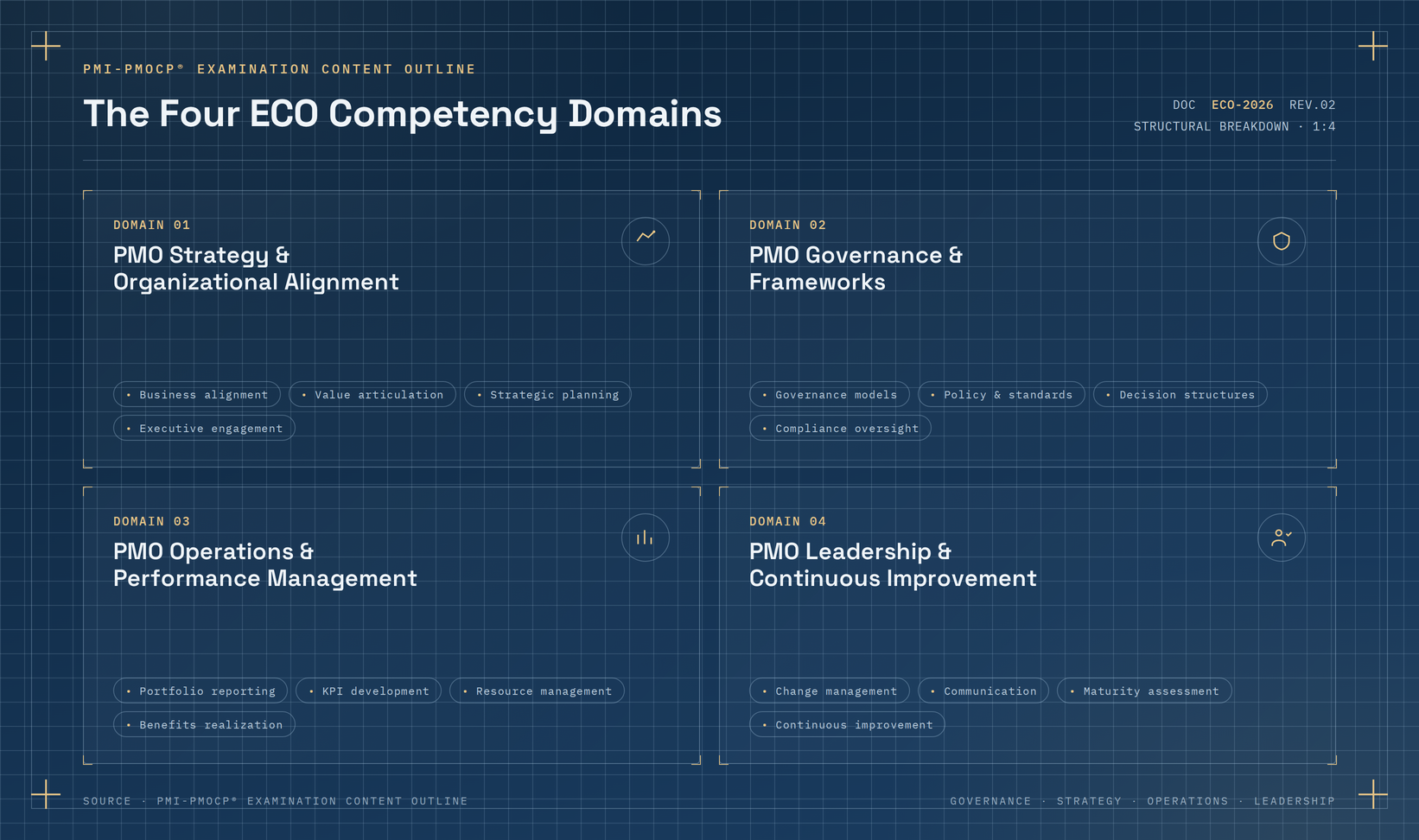
The PMI-PMOCP ECO is organized around four broad areas of PMO competency, each reflecting a different layer of what a mature, well-run PMO does.
PMO Strategy and Organizational Alignment
This domain covers connecting the PMO's work to the wider goals of the organization: aligning PMO objectives with business strategy, articulating the value the PMO creates, contributing to strategic planning, and engaging executive stakeholders.
PMO Governance and Frameworks
Governance is where a PMO earns its credibility. This area covers governance models, the policies and standards a PMO sets and enforces, decision-making structures that keep projects accountable, and compliance and performance oversight. Organizations building this capability internally often lean on corporate training to get governance standards adopted consistently across teams.
PMO Operations and Performance Management
This is the operational core of the PMO portfolio reporting, KPI development, resource management, benefits realization, and performance measurement. These competencies show up in a PMO's daily rhythm and make up a significant share of what the exam evaluates.
PMO Leadership and Continuous Improvement
The final domain shifts toward the human side of running a PMO: change management, leadership and communication, PMO maturity assessment, and continuous improvement. A PMO that governs well but cannot lead people through change tends to stall. Broader context on how leadership gaps show up in project-driven organizations is covered in this piece on PMO transformation and strategic value.
Professionals who want a structured way to work through these domains, rather than piecing them together independently, often turn to a guided PMI-PMOCP certification training program.
How to Use the PMI-PMOCP Examination Content Outline for Exam Preparation
Develop a Domain-Based Study Plan
Rather than studying topics randomly, candidates get better results working through the ECO domain by domain, allocating more time to areas where their real-world PMO experience is thinner.
Focus on High-Value PMO Competencies
Not every topic carries equal weight. Governance, performance management, and strategic alignment appear frequently across scenario-based questions, so they deserve proportionally more preparation time.
Practice Scenario-Based Questions
The PMI-PMOCP exam leans heavily on applied, situational questions rather than pure definitions. Practicing these helps candidates translate ECO concepts into real judgment calls.
Review PMO Case Studies
Case studies bridge the gap between the outline's language and how PMO decisions play out inside an organization, making abstract governance and strategy concepts easier to retain.
Track Learning Progress
Mapping study sessions back to specific ECO domains makes it easier to spot weak areas early. Candidates who prefer working independently before joining live sessions sometimes start with a self-study bundle to build baseline familiarity first.
Candidates who want a deeper look at building this kind of study rhythm may find it useful to read this earlier guide on PMI-PMOCP exam preparation.
Best Study Resources for the PMI-PMOCP Exam
Official PMI-PMOCP Examination Content Outline
This remains the starting point for any preparation plan, since it defines the exact boundaries of what will be tested.
PMBOK® Guide
While the exam is PMO-specific, the PMBOK Guide provides useful grounding in the broader project management vocabulary that governance and performance topics draw from.
PMI Standards and Practice Guides
PMI's supporting standards documents add depth to topics like portfolio management and organizational project management that the ECO references at a higher level.
PMO Framework References
Established PMO frameworks help candidates see how governance and maturity models are applied in practice, beyond the exam's own language.
Practice Questions and Mock Exams
Timed practice questions build the pattern recognition needed for scenario-based items and help candidates get comfortable with pacing.
Instructor-Led Training Programs
For candidates who prefer a structured path with feedback along the way, an instructor-led PMI-PMOCP training course can compress the learning curve considerably, particularly for the governance and leadership domains. Those who want individual attention on specific weak areas can also opt for one-on-one training.
Common Mistakes Candidates Make
A few recurring mistakes tend to show up among candidates who don't clear the exam on their first attempt:
- Ignoring the Examination Content Outline entirely and studying from general PM material instead
- Focusing only on theory instead of real PMO practices
- Skipping governance and performance management topics
- Using outdated study materials that don't reflect the current outline
- Not practicing scenario-based questions until close to the exam date
- Neglecting leadership and organizational strategy concepts
Most of these mistakes come down to treating the ECO as optional reading rather than the actual exam blueprint it is meant to be. Candidates researching certification paths more broadly can find general context in this guide on how to get a project management certification.
Tips to Master the PMI-PMOCP Examination Content Outline
Study One Domain at a Time
Moving through the outline domain by domain, rather than jumping between topics, builds more durable understanding.
Apply PMO Concepts to Real Projects
Mapping ECO concepts to a candidate's own PMO environment makes the material easier to remember and apply under exam conditions.
Review Practical PMO Case Studies
Real examples of governance decisions, KPI structures, and maturity assessments give abstract domains a concrete anchor.
Take Full-Length Mock Exams
Full-length practice exams reveal pacing issues and knowledge gaps that shorter quizzes tend to miss.
Evaluate Weak Areas Regularly
Revisiting weak domains on a set schedule, rather than only once before the exam, keeps preparation balanced across all four areas.
Real-World Applications of PMO Best Practices
Standardizing Project Governance
A well-governed PMO applies consistent standards across projects, reducing variation in how risk and reporting are handled.
Improving Portfolio Visibility
Strong portfolio reporting practices give leadership a clearer, more current view of where organizational resources are going.
Optimizing Resource Allocation
PMOs that apply the resource management competencies from the ECO tend to reduce conflict between competing project demands.
Enhancing Executive Reporting
Better alignment between PMO metrics and executive priorities makes reporting more useful to leadership, not just more frequent.
Driving Organizational Maturity
PMOs that build in continuous improvement, as outlined in the leadership domain, tend to mature faster than those focused only on day-to-day delivery. Organizations exploring how a PMO can be structured around these principles from the ground up can review this related resource on PMO delivery.
Final Thoughts
The PMI-PMOCP Examination Content Outline should sit at the center of any serious study plan, not on the sidelines of it. It defines exactly what the exam is testing, and candidates who study around its four domains give themselves a far clearer path to certification than those relying on generic project management prep.
Combining the outline with practical PMO experience, structured training, and consistent practice questions gives candidates the best chance of covering governance, strategy, operations and leadership in equal measure and that is where real exam readiness tends to begin.
Frequently Asked Questions (FAQ)
What is the PMI-PMOCP Examination Content Outline?
It is PMI's official document defining the domains, tasks, and competencies covered on the PMI-PMOCP exam, developed with input from practicing PMO professionals.
What topics are covered in the PMI-PMOCP exam?
The exam covers PMO strategy and organizational alignment, governance and frameworks, operations and performance management, and leadership with continuous improvement.
Is the Examination Content Outline enough to prepare for the certification?
The outline defines scope, but it is not a study guide on its own. Candidates typically pair it with structured training, practice questions, and PMI standards documents.
What are the best resources for PMI-PMOCP preparation?
The official ECO, the PMBOK Guide, PMI standards and practice guides, PMO framework references, mock exams and instructor-led courses are commonly used together.
How should I build a PMI-PMOCP study plan?
A domain-based plan that allocates time according to each ECO area, paired with regular practice questions and periodic review of weak spots, tends to work best.