Introduction — Why Risk Leadership Matters More Than Ever
Modern organizations rarely operate in stable conditions anymore. Geopolitical shifts, fast-moving technology changes, supply chain disruptions, tightening regulations and evolving customer expectations now shape project outcomes as much as budgets and timelines do. In this environment, risk management can no longer sit quietly with a handful of specialists updating a risk register. It has become a leadership responsibility that touches project managers, functional heads and executives alike a shift closely tied to the broader leadership gap emerging across today's project economy.
This is exactly where the PMI Risk Management Professional (PMI-RMP®) certification fits in. It is a globally recognized credential built specifically around project risk management and it is increasingly viewed as a marker of leadership capability rather than a purely technical qualification. Professionals who complete structured PMI-RMP® live classes tend to build sharper decision-making instincts under uncertainty and that capability is what today's organizations are actively looking for.
What Is PMI-RMP® Certification?
Overview of PMI Risk Management Professional
PMI-RMP® is a certification offered by the Project Management Institute that validates a professional's ability to identify, assess and manage risk throughout the life of a project. Unlike general project management training, it goes deep into one discipline: recognizing uncertainty early and turning it into a manageable, well-communicated part of project planning. Candidates evaluating the credential typically start by reviewing the PMI-RMP® certification requirements before mapping out a preparation timeline.
What Does a Risk Management Professional Do?
A certified risk management professional is typically expected to identify risks before they escalate, analyze both threats and opportunities, plan appropriate responses, monitor ongoing risk exposure, communicate risk information clearly to stakeholders, and support leadership in making informed decisions.
PMI-RMP® vs. General Project Management Knowledge
General project management training covers scope, schedule, cost and quality at a broad level. Risk management, by contrast, deserves focused attention on complex or high-stakes projects, where a shallow understanding of uncertainty can quietly undermine even a well-planned schedule or budget.
Why Risk Management Has Become a Leadership Issue
Project-level risks rarely stay contained at the project level. A delay in one workstream can ripple into strategic objectives, and a single unmanaged risk can shift business priorities overnight. As uncertainty increases, project risks increasingly become organizational risks the kind that land on an executive's desk rather than a project coordinator's. This is part of why complexity is now outpacing many traditional leadership models.
Leaders are also regularly asked to make decisions with incomplete information and risk transparency is what allows them to do this responsibly. Effective leaders do not simply react once a problem surfaces. They identify uncertainty early, assess its potential impact and prepare responses before a risk becomes a crisis. This proactive posture is precisely the mindset that PMI-RMP® is designed to build.
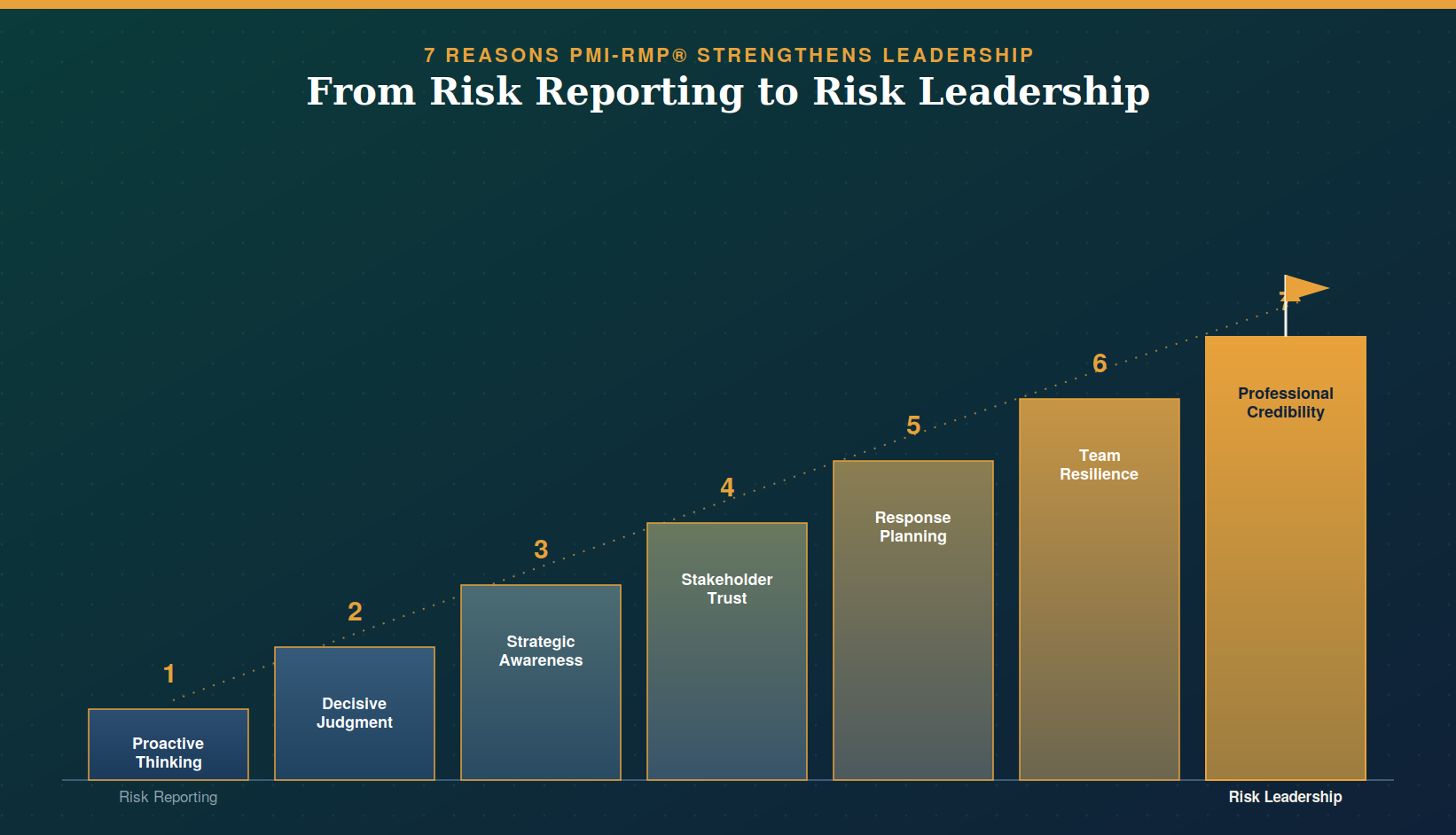
7 Reasons PMI-RMP® Can Strengthen Leadership Capability
1. Develops Proactive Risk Thinking
PMI-RMP® training encourages professionals to identify potential threats before they turn into active issues, take preventive action rather than corrective action and build a genuinely forward-looking approach to managing projects.
2. Improves Decision-Making Under Uncertainty
Certified professionals learn to evaluate both probability and impact, compare available response options and make sound decisions even when complete information isn't available a skill that matters just as much in the boardroom as it does on a project floor.
3. Strengthens Strategic Risk Awareness
Risk management as taught in PMI-RMP® is not limited to a single project. It connects project-level risks with broader business objectives, helps professionals understand organizational consequences, and builds the ability to recognize how interconnected risks influence one another.
4. Builds Stakeholder Communication Skills
Risk is only useful information if it's communicated well. PMI-RMP® preparation strengthens the ability to present risk information to executives, manage differing stakeholder perspectives and create genuine transparency around uncertainty rather than burying it in a spreadsheet.
5. Improves Risk Response Planning
Professionals learn to apply the core risk response strategies avoid, mitigate, transfer, accept and escalate and more importantly, to select the right response based on the nature and potential impact of each individual risk rather than applying a one-size-fits-all approach.
6. Encourages Resilient Project Leadership
Certified professionals are better equipped to prepare for disruptions, develop contingency approaches, adapt when circumstances change and keep project objectives intact even when conditions shift midstream.
7. Strengthens Professional Credibility
Holding PMI-RMP® demonstrates specialized risk management knowledge that sets a professional apart from peers with only general project management training. Organizations investing in their teams often see this reflected in the documented benefits of PMI-RMP® certification for employees and it can meaningfully support career growth into risk-focused and leadership roles.
Taken together, PMI explains that PMI-RMP® builds the ability to identify problems early, manage uncertainty, reduce delays and costs and improve overall project outcomes a combination that maps directly onto what organizations expect from leaders today.
PMI-RMP® and the Modern Project Leadership Role
From Risk Reporting to Risk Leadership
There's a meaningful difference between simply maintaining a risk register and actively influencing decisions with it. Risk reporting documents what could go wrong; risk leadership uses that information to shape what actually happens next much like the shift many PMOs are making from a support function into a strategic partner.
Risk as a Strategic Input
Well-developed risk thinking feeds directly into investment decisions, resource allocation, project prioritization, scheduling choices and procurement decisions all areas where leaders are expected to weigh in with confidence.
Connecting Risk With Opportunity
Effective risk management isn't only about avoiding threats. It also means recognizing opportunities that uncertainty can create and PMI-RMP® preparation places deliberate emphasis on this dual view of risk.
Where PMI-RMP® Knowledge Can Add Value
Risk management principles are not limited to one industry. They apply wherever uncertainty and high-stakes decisions intersect, including complex infrastructure projects, technology and digital transformation initiatives, construction and engineering programs, energy and industrial projects, healthcare and financial services and government and large-scale public programs. Organizations delivering large, multi-stream initiatives often pair this thinking with broader PMO delivery support to keep risk visibility consistent across portfolios. Because uncertainty exists in nearly every project environment, the value of structured risk thinking tends to travel well across sectors.
Skills Professionals Can Develop Through PMI-RMP® Preparation
Preparing for PMI-RMP® typically builds capability in risk identification, qualitative and quantitative risk analysis, risk response planning, ongoing risk monitoring, stakeholder communication, critical thinking, strategic decision-making, and problem-solving. A close read of the PMI-RMP® examination content outline is a useful starting point, since it maps directly to how these skills are tested. Candidates generally get the most value when they focus on understanding how these concepts play out in real project situations, rather than relying purely on memorization.
Who Should Consider PMI-RMP®?
PMI-RMP® tends to be particularly relevant for project managers, risk managers, program managers, PMO professionals, project controls professionals and consultants or project leaders whose responsibilities already include identifying, analyzing, communicating, or managing project risk in some form. Professionals weighing this against other career moves may also find it useful to speak with a career advisory specialist before committing to a certification path and senior leaders looking to build risk fluency across their teams often start with executive training programs or broader corporate training initiatives.
How to Prepare for PMI-RMP® Certification
A structured approach to preparation generally works best: reviewing current PMI eligibility requirements, studying the latest examination content outline, building a solid grasp of core risk management principles, practicing scenario-based questions, taking mock exams, connecting study concepts to real project experience and revisiting weaker knowledge areas before the exam date. A good PMI-RMP® exam preparation guide can help structure this timeline realistically. Because PMI updates its requirements and exam details periodically, candidates should always verify the latest eligibility criteria and application process directly with PMI before beginning preparation. Professionals looking for instructor-led, exam-focused support can review the PMI-RMP® live classes program for guidance and structured practice.
Final Thoughts — From Risk Management to Risk Leadership
The role of risk management inside organizations is shifting. It is no longer a background function confined to a risk register; it is becoming a visible part of how decisions get made. PMI-RMP® offers specialized knowledge that complements broader project management experience, reinforcing proactive thinking, sound decision-making, clear communication, resilience, and strategic awareness.
Certification alone does not create leadership capability that comes from applying these principles consistently in real project situations. But as uncertainty becomes a permanent feature of the modern project landscape, organizations will keep needing leaders who can turn that uncertainty into informed decisions and stronger project outcomes.
Frequently Asked Questions (FAQ)
What is PMI-RMP® certification?
It is a certification from the Project Management Institute that validates specialized knowledge in identifying, analyzing, and managing project risk.
Why is PMI-RMP® important for project leaders?
Because it builds the proactive thinking, decision-making and communication skills needed to manage uncertainty at a leadership level, not just a task level.
Who should pursue PMI-RMP®?
Project managers, risk managers, program managers, PMO professionals and consultants who regularly deal with project uncertainty.
How does PMI-RMP® differ from PMP®?
PMP® covers project management broadly, while PMI-RMP® focuses specifically and deeply on risk management practices.
What skills does PMI-RMP® develop?
Risk identification, risk analysis, response planning, monitoring, stakeholder communication and strategic decision-making.
Is PMI-RMP® useful across different industries?
Yes. Risk management principles apply across infrastructure, technology, construction, energy, healthcare, financial services and government sectors.
How should candidates prepare for the PMI-RMP® exam?
By reviewing PMI's current requirements and exam outline, practicing scenario-based questions, taking mock exams and connecting concepts to real project experience.