PfMP® Examination Content Outline
Introduction
Every candidate preparing for the Portfolio Management Professional (PfMP®) credential eventually runs into the same question: where does the actual exam content come from? The answer is the PfMP® Examination Content Outline, a document published by the Project Management Institute that defines exactly what the exam measures. Rather than treating the exam as a broad review of portfolio theory, PMI builds every question against this outline, which makes it the single most reliable reference for candidates who want to study with purpose instead of guesswork. This guide breaks down what the outline covers, why it matters more than most study guides realize, and how candidates preparing for PfMP® certification training can use it to shape a study plan that actually reflects how the exam is built.
What Is the PfMP® Examination Content Outline?
Definition of the Examination Content Outline (ECO)
The Examination Content Outline is PMI's official blueprint for the PfMP® exam. It lists the domains, tasks, and knowledge areas that examiners draw questions from, along with the approximate weight each domain carries on the test. In practical terms, it is the closest thing candidates have to a map of the exam itself.
Why PMI Uses the ECO
PMI develops the outline through role delineation studies, which involve surveying practicing portfolio managers about the tasks they perform day to day. This keeps the exam grounded in real practice rather than academic theory and it explains why the outline reads more like a job description than a textbook index.
Difference Between the ECO and Study Resources
The outline is not a study guide. It does not explain concepts, offer examples or walk through processes. Instead, it tells candidates what to study and in what proportion, leaving the actual learning to standards documents, courses and practice resources built around it.
Who Should Use the PfMP® ECO?
The outline is most useful for portfolio managers, PMO directors, program managers, senior project managers, business transformation leaders and executives who oversee strategic portfolios. Anyone responsible for aligning multiple projects or programs with organizational strategy will recognize the tasks described in the outline from their own work and many professionals in these roles later turn to career advisory support once certified, to figure out how to position the credential within their broader career path.
Understanding the PfMP® Examination Content Outline
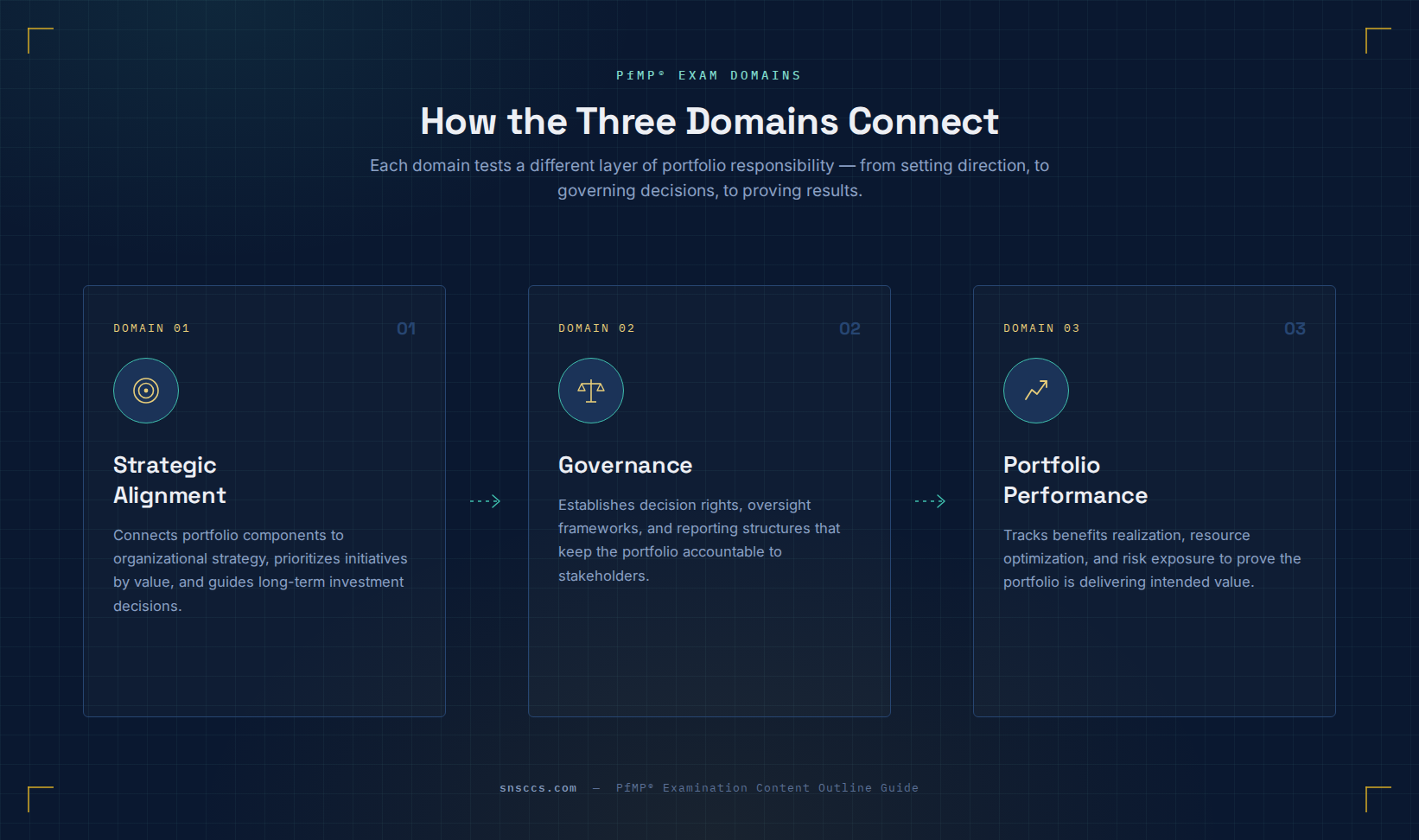
The current outline organizes the PfMP® exam around three domains. Each one reflects a distinct set of responsibilities that a portfolio manager is expected to handle and together they form the backbone of the PfMP exam syllabus. Candidates who are still confirming their eligibility should also review the PfMP certification requirements before mapping out a domain-by-domain study plan.
Domain 1: Strategic Alignment
This domain focuses on how portfolios connect to broader organizational strategy. Candidates are tested on aligning portfolio components with strategic objectives, prioritizing initiatives based on organizational value, optimizing that value across competing investments and making decisions that reflect long-term direction rather than short-term convenience. Strategic alignment is often the domain where candidates with strong project-level experience but limited executive exposure need the most additional study, since it requires thinking several levels above individual project delivery. Organizations working through similar strategy-to-execution challenges at the portfolio level often address them through structured PMO delivery support.
Domain 2: Governance
Governance covers the structures and decision rights that keep a portfolio accountable. This includes designing and applying portfolio governance frameworks, establishing policies that guide decision-making, maintaining compliance with organizational and regulatory requirements and reporting portfolio status to executive stakeholders. Because governance sits at the intersection of process and leadership, this domain tends to reward candidates who have actually sat in governance meetings and made or influenced portfolio decisions. The emphasis PMI places on governance here mirrors how the PMP® Examination Content Outline treats governance at the project level just applied across a full portfolio instead of a single initiative.
Domain 3: Portfolio Performance
The performance domain addresses how a portfolio manager tracks and improves outcomes over time. It includes benefits realization, ongoing performance monitoring, resource optimization across the portfolio, balancing the portfolio against changing conditions and managing risks and issues that could affect overall value delivery. This is typically the most heavily weighted domain, which reflects PMI's emphasis on portfolio performance management as an ongoing discipline rather than a one-time planning exercise. Candidates coming from an agile background may also find it useful to compare this domain against the PMI-ACP® Examination Content Outline, since both credentials weight performance and value delivery heavily just at different organizational levels.
Each domain is assessed through scenario-based questions rather than direct definitions, so the exam is less concerned with whether a candidate can recite a term and more concerned with whether they can apply it under realistic portfolio conditions.
How to Use the PfMP® Examination Content Outline for Exam Preparation
Build a Study Plan Around the ECO
Rather than starting with a textbook and working through it cover to cover, candidates get better results by starting with the outline and mapping study materials to each domain and task. This keeps preparation aligned with what the exam actually measures and it pairs well with a more detailed PfMP exam preparation plan once the domain priorities are clear.
Prioritize High-Weight Domains
Since Portfolio Performance typically carries the greatest weight, it deserves proportionally more study time than a candidate might instinctively give it, especially if their background leans more toward governance or strategy work.
Use Scenario-Based Practice Questions
Because the PfMP certification exam is built on applied scenarios, practice questions that mirror that format prepare candidates far better than flashcard-style review of definitions.
Track Progress by Domain
Logging performance by domain, rather than by overall score, helps candidates see exactly where their gaps sit and adjust their remaining study time accordingly.
Review Weak Areas Regularly
Revisiting weaker domains on a rotating basis, rather than moving on once a topic feels done, helps retention hold up through exam day.
Best Study Resources for the PfMP® Exam
Official PfMP® Examination Content Outline
This remains the starting point for every candidate, since it defines the scope of the exam before any other resource is chosen.
The Standard for Portfolio Management
PMI's standard provides the conceptual foundation behind each domain and is generally considered required reading alongside the outline.
PMBOK® Guide
While the PfMP exam is not built directly on the PMBOK® Guide, it offers useful context on how portfolio, program and project work relate to one another.
Practice Questions and Mock Exams
Simulated exams help candidates get comfortable with the scenario-based question style and build the stamina needed for a long-format exam.
Instructor-Led Training
Structured courses led by experienced practitioners can clarify how each domain applies in real organizational settings, which is often harder to grasp from self-study alone. Candidates comparing formats can review the PfMP live classes program to see how instructor-led sessions are structured around the same three domains covered in this guide.
Professional Study Groups
Discussing scenarios with peers who are also preparing for the exam or who already hold the credential, often surfaces perspectives that solo study misses.
Common Mistakes Candidates Make
Many candidates approach PfMP preparation the same way they approached earlier certifications, and that habit creates avoidable setbacks. The most common mistakes include ignoring the Examination Content Outline entirely and studying general portfolio theory instead, focusing on memorizing definitions rather than understanding how concepts apply, neglecting strategic portfolio management concepts in favor of more familiar project-level material, taking too few mock exams to build real exam readiness, overlooking governance and benefits realization as standalone competencies and skipping scenario-based practice in favor of simpler recall questions. Each of these mistakes shares a common thread: treating the ECO as optional background reading instead of the actual foundation of the exam.
Tips to Master the PfMP® Examination Content Outline
Study One Domain at a Time
Working through one domain fully before moving to the next builds deeper retention than jumping between topics.
Relate Concepts to Real Portfolio Management Experience
Candidates who connect each task statement to a real situation from their own portfolio work tend to retain the material longer and apply it more naturally on exam day.
Practice with Scenario-Based Questions
Consistent exposure to applied questions trains candidates to think the way the exam expects, rather than defaulting to textbook recall.
Review Official PMI Standards
Cross-referencing the outline against PMI's published standards keeps study material accurate and current. Organizations sponsoring multiple candidates at once often manage this through corporate training arrangements rather than leaving each employee to study independently.
Take Regular Mock Exams
Spaced-out mock exams, rather than one attempt right before the test date, give candidates time to correct weak areas before it counts.
Final Thoughts
The PfMP® Examination Content Outline is not just a reference document; it is the actual framework the exam is measured against. Candidates who build their study plan around it, rather than around generic portfolio management material, tend to prepare more efficiently and walk into the exam with a clearer sense of what to expect. Pairing the outline with PMI's official standards, consistent scenario-based practice and honest tracking of weak areas gives candidates a realistic path to certification. Ultimately success on the PfMP® exam comes down to understanding strategic portfolio management as it is actually practiced, not memorizing isolated definitions and that understanding starts with the outline itself.
Frequently Asked Questions (FAQ)
What is the PfMP® Examination Content Outline?
It is PMI's official document defining the domains, tasks and knowledge areas the PfMP® exam is built around, along with how heavily each domain is weighted.
How many domains are included in the PfMP® ECO?
The outline is organized around three domains: Strategic Alignment, Governance and Portfolio Performance.
Is the Examination Content Outline enough to prepare for the exam?
The outline defines what to study, but candidates still need supporting resources such as PMI standards, practice questions and structured training to fully prepare.
Which PMI publications should I study alongside the ECO?
The Standard for Portfolio Management is the primary companion resource, with the PMBOK® Guide offering useful supporting context.
How often does PMI update the PfMP® Examination Content Outline?
PMI periodically reviews and updates the outline based on role delineation studies, so candidates should always confirm they are using the most current version before finalizing a study plan.