PMP Exam in Pakistan
If you are planning to sit the PMP exam in Pakistan, one decision comes up almost immediately: do you walk into a Pearson VUE test center or take the exam from home through online proctoring? Both are PMI-approved and both lead to the same credential. What differs is the experience, the risk and how well each fits your situation.
This guide explains both PMP exam delivery options, shows how PMP exam registration in Pakistan works and helps you choose. If you are still at the start of your journey our PMP certification in Pakistan page covers training, eligibility and support in one place.
How the PMP Exam Is Delivered
The PMP is a computer-based test with 180 questions and 230 minutes, including two 10-minute breaks. PMI works with Pearson VUE, so candidates in Pakistan choose between two formats: an in-person appointment at an authorized test center or a PMP online proctored exam monitored remotely through Pearson's OnVUE platform.
Content, scoring, and the certificate are identical. Nobody reading your credential can tell which format you used.
Before scheduling anything, confirm you qualify, including the 35 contact hours of project management education. Our guide to the requirements for project management professional certification lists everything you need.
Pearson VUE Test Centers: Where Can I Take the PMP Exam in Pakistan?
Pearson VUE operates authorized centers in major cities and Karachi, Lahore, and Islamabad are the most commonly used. Availability of PMP exam centers in Pakistan can change, so confirm current locations and open slots inside your Pearson VUE account instead of trusting old directories.
Advantages of a test center
- The computer, internet and power are managed by the center, so you are not exposed to load-shedding or a router failure.
- No family noise, doorbells or household interruptions.
- Lockers for your belongings and a clear break routine.
- A formal environment that helps some candidates focus.
Drawbacks
- Candidates outside the big cities may travel for hours, sometimes overnight.
- Popular dates fill quickly, especially before PMI exam updates.
- Less flexibility with timing.
PMP Online Proctored Exam: Can I Take the PMP Exam Online in Pakistan?
Yes. PMI allows you to take the PMP exam online in Pakistan through OnVUE. You test from home or an office while a live proctor watches through your webcam.
The PMP online exam requirements generally include:
- A private, quiet, clutter-free room with nobody else present.
- A computer with a working webcam, microphone, and stable internet. Run Pearson's system test days before, not on exam morning.
- A valid government-issued ID that matches your PMI profile name exactly.
- A check-in process where you photograph your ID and your room.
- No phones, notes, second monitors or watches within reach.
Rules are updated from time to time, so read the latest OnVUE instructions before exam day.
Advantages: no travel, easier slot availability and the comfort of your own setup.
Drawbacks: internet or power failures are a real concern in many Pakistani cities, the rules are strict and a proctor can pause your session if you move out of frame or something looks suspicious. That stress can cost focus.
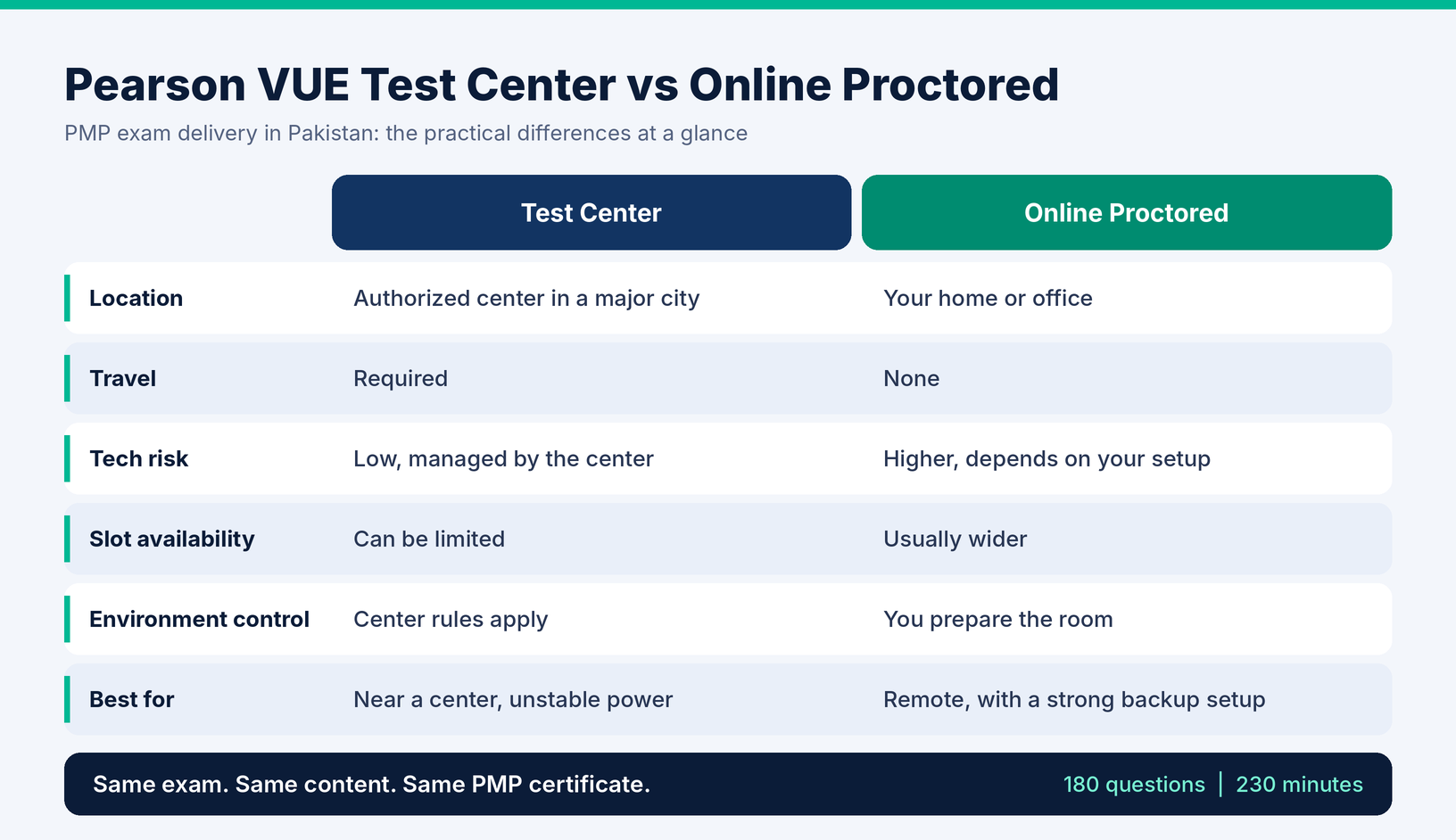
Pearson VUE vs Online PMP Exam: Side-by-Side
| Factor | Test Center | Online Proctored |
|---|---|---|
| Location | Authorized center in a major city | Your home or office |
| Travel | Required | None |
| Tech risk | Low, managed by center | Higher, depends on your setup |
| Slot availability | Can be limited | Usually wider |
| Environment control | Center rules | You must prepare the room |
| Best for | Candidates near a center, unstable power | Remote candidates, strong backup setup |
PMP Exam Cost in Pakistan
PMI sets fees in US dollars, so the PMP exam cost in Pakistan is the same for both formats. At the time of writing, members pay about USD 405 and non-members about USD 575, but fees change, so verify them on PMI.org before paying. What you actually pay in rupees depends on the exchange rate and your card's charges.
Hidden costs differ by format. Test center candidates may spend on travel and accommodation, while online candidates may need a UPS, a backup connection or a quieter space. PMI membership often pays for itself through the exam discount, so compare the numbers before choosing the non-member fee.
How to Book the PMP Exam in Pakistan
The process for how to book the PMP exam in Pakistan is straightforward:
- Create a PMI account on PMI.org and decide whether to become a member.
- Submit your PMP application with your experience and training hours. A random audit is possible, so keep your documents ready.
- Pay the exam fee once the application is approved.
- Open the Pearson VUE scheduling link you receive from PMI.
- Choose your format. Select a test center or the online option, then pick a date and time.
- Confirm and prepare. Check your ID name, and if you chose online, complete the system test.
Your eligibility period lasts one year from approval and you get three attempts in that window. Schedule with enough buffer to prepare properly. Our PMP certification full timeline for 2026 helps you plan the dates and the PMP exam changes for 2026 explain what to watch for in the current exam.
Best Way to Take the PMP Exam in Pakistan
There is no single best PMP exam option in Pakistan. The right choice depends on three things: where you live, how reliable your home setup is and how you handle pressure.
- Choose a test center if you live in or near Karachi, Lahore or Islamabad, deal with frequent outages, or want a controlled environment. It is also the safer pick for first-time test takers who are nervous about technology.
- Choose online if the nearest center is far away, your schedule is tight and you have stable internet plus a backup plan.
Whichever you pick, your result depends far more on preparation than on format. If you are wondering what you are signing up for, read how hard the PMP certification test really is before booking.
Prepare Before You Schedule
Many candidates book first and panic later. A better order is to complete your 35 hours of training, study the PMP examination content outline, take mock exams, and only then schedule your date. Our PMP study plan for working professionals and guide on how to prepare for the PMP exam show how to fit this around a full-time job.
If you are ready to enroll in a PMP exam preparation course in Pakistan, you have options:
- Live PMP classes for instructor-led learning and accountability.
- The self-study bundle for flexible, self-paced preparation.
- One-on-one training for personalized coaching.
Not sure which suits you? Try the PMP class preview first and see why choosing a PMI Authorized Training Partner matters. To see how everything fits together, from eligibility to exam day, visit our PMP exam and certification support page for Pakistan.
Frequently Asked Questions
Can I take the PMP exam online in Pakistan?
Yes. PMI offers an online proctored option through Pearson VUE's OnVUE platform. You need a private room, a working webcam, stable internet and valid ID.
Where can I take the PMP exam in Pakistan?
You can test at authorized Pearson VUE centers, mainly in major cities such as Karachi, Lahore and Islamabad. Check your Pearson VUE account for current locations and available slots.
What are the PMP online exam requirements?
You need a quiet private space, a computer with webcam and microphone, reliable internet, a matching government ID and a completed system test. Prohibited items must stay out of reach.
How do I register and book the PMP exam in Pakistan?
Apply through PMI.org, wait for approval, pay the exam fee, then use the Pearson VUE link to choose a test center or online format and book your date.
Is the online exam easier than the test center exam?
No. Content, difficulty, and scoring are identical. Only the environment differs, so choose the setting where you can concentrate best.
Final Thoughts
Choosing between a Pearson VUE test center and the online proctored option comes down to practical realities: distance, power, internet and your own comfort. Pick the format that removes the most risk from your exam day, then spend your energy where it counts, which is preparation. A calm candidate with a solid study plan will do well in either setting.