Introduction — AI Projects Need More Than Technical Expertise
Organizations across nearly every industry are folding artificial intelligence into their operations, customer experience, analytics, and day-to-day decision-making. Yet leading an AI initiative involves far more than choosing the right model or the right vendor. Most AI projects stumble over the same issues: unclear objectives, inconsistent data, stakeholders who expect results before the groundwork is done, governance gaps, ethical blind spots and no agreed way to measure whether the project actually worked.
This is the gap PMI-CPMAI™ was built to close. The certification focuses on applying structured project management thinking to AI work specifically, rather than treating AI as just another IT deliverable. The professionals best equipped to lead AI transformation are the ones who can pair disciplined project management with a working understanding of how AI initiatives actually behave and who can implement that understanding responsibly.
What Is PMI-CPMAI™ Certification?
Understanding PMI-CPMAI™
PMI-CPMAI™, the PMI Certified Professional in Managing AI, is a credential aimed at professionals who plan, oversee or contribute to AI-related projects. It doesn't ask candidates to become data scientists; instead, it builds the judgment needed to manage AI work from a business and delivery standpoint. Professionals exploring this path often start with the PMI-CPMAI live classes, which walk through the certification's core phases in a structured, instructor-led format rather than self-paced reading alone.
Why AI Project Management Is Different
AI initiatives carry a level of uncertainty that traditional projects rarely face. Requirements can shift once real data enters the picture. Models need repeated testing and refinement before they're reliable enough to trust. Outcomes aren't always predictable at the outset and business stakeholders frequently need help understanding what a model can and cannot do before they can set realistic expectations.
Connecting AI With Project Management
Structured project practices give teams a way to move an AI idea from concept to a governed, implemented and evaluated business solution rather than a proof of concept that never leaves the lab.
Why AI Initiatives Need Specialized Project Leadership
AI Is Not Just Another Technology Project
AI projects tend to reshape processes and decision-making, not just automate a task. They usually require experimentation and results often continue to evolve as models and data are refined after initial deployment.
Business Objectives Must Come First
Before any technical work begins, the problem needs to be defined clearly, the expected outcomes need to be agreed upon and someone needs to honestly assess whether AI is even the right tool for the job. Skipping this step is one of the most common reasons AI projects fail to deliver value.
Multiple Stakeholders Are Involved
AI initiatives typically pull in business leaders, data professionals, IT teams, project managers, legal and compliance staff and the end users who will actually work with the output. Leading this kind of initiative means constantly aligning technical possibilities with business expectations a skill that sits at the center of what PMI-CPMAI training is designed to build.
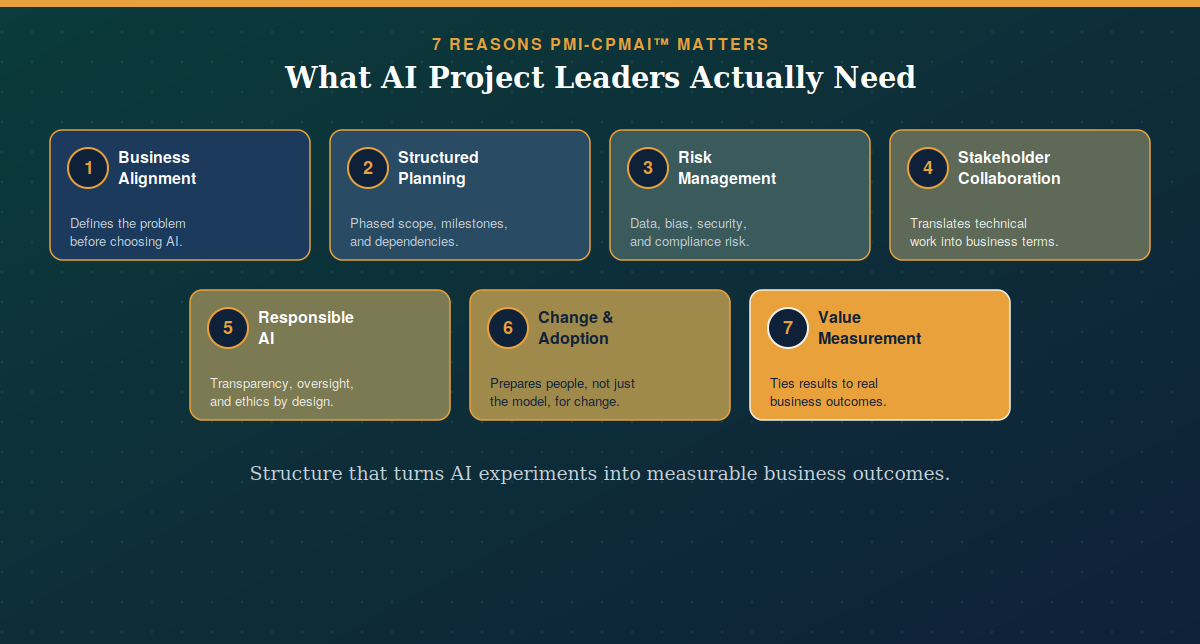
7 Reasons PMI-CPMAI™ Matters for AI Project Leaders
1. Helps Connect AI Projects With Business Objectives CPMAI-trained professionals learn to define the business problem clearly, establish measurable outcomes, and resist the temptation to implement AI simply because it's a trending technology.
2. Supports Structured AI Project Planning That includes defining scope, setting realistic milestones, identifying resources, managing dependencies, and planning implementation in phases rather than all at once.
3. Strengthens AI Risk Management AI projects carry risks tied to data quality, model performance, security, privacy, bias, compliance and adoption. These risks don't appear only at launch they need attention throughout the entire project lifecycle, a theme covered in more depth in this guide on PMI's new AI standard for project professionals.
4. Improves Stakeholder Collaboration Leaders trained in CPMAI principles learn to translate technical concepts into business language, manage expectations honestly, build reliable communication channels and earn stakeholder confidence over time.
5. Supports Responsible AI Practices Transparency, accountability, human oversight, ethical considerations and responsible data use aren't afterthoughts they're built into how AI projects should be planned from the start.
6. Helps Manage AI Change and Adoption Even a technically sound AI solution fails if employees resist it. Preparing people for change, addressing resistance directly and communicating both benefits and limitations honestly all matter as much as the model itself.
7. Focuses on Measuring AI Value Cost savings, productivity gains, new revenue opportunities, improved customer experience, better decision quality and operational efficiency are the real markers of success not simply whether the technology got deployed. For a closer look at why this matters heading into next year see why PMI-CPMAI certification matters in 2026.
From AI Idea to Business Value: The AI Project Lifecycle
An AI initiative generally moves through a recognizable sequence: identifying the business problem and confirming AI can meaningfully address it, defining the AI opportunity in terms of expected outcomes, users, data requirements and constraints, planning the project around scope, resources, stakeholders and risk, developing and validating the solution through model testing and refinement, deploying it while actively managing adoption and finally monitoring performance and business outcomes after go-live.
In short: Business Problem → AI Opportunity → Planning → Development → Validation → Deployment → Value Measurement. Each phase maps directly to the material covered in the PMI-CPMAI examination content outline, which breaks down how the certification structures this lifecycle for exam preparation.
How PMI-CPMAI™ Can Help Bridge Business and Technical Teams
The Communication Gap
Business leaders tend to focus on outcomes revenue, efficiency, customer satisfaction while technical teams focus on models, data pipelines and infrastructure. Left unaddressed, that gap creates friction and mistrust on both sides.
Creating Shared Understanding
AI project professionals need to be able to explain what a solution does, what it cannot do, what data it depends on, what risks exist and what results can realistically be expected in language both sides understand.
Managing Expectations
Better communication, built on that shared understanding, reduces misunderstandings before they turn into missed deadlines or lost stakeholder confidence.
AI Risk, Governance, and Responsible Implementation
Responsible AI implementation touches several areas at once: data quality and governance, privacy and security, bias and fairness, model reliability, transparency and explainability, human oversight and regulatory or organizational requirements. AI project leaders who treat these as ongoing considerations rather than a checklist to complete right before launch tend to avoid the costly rework and reputational risk that come from treating governance as an afterthought.
Interestingly, this concern shows up frequently in practitioner conversations outside formal training too. On community forums where certified professionals discuss the credential, several note that while the certification's market recognition is still developing, the framework itself and the discipline of thinking through governance, data lifecycle and human oversight from day one has real value for anyone actually running AI initiatives, regardless of whether a specific job posting names the certification.
Who Can Benefit From PMI-CPMAI™?
The certification is relevant to a fairly broad range of roles: project managers handling AI-related projects, AI and technology professionals moving into project leadership, business analysts translating business needs into AI opportunities, PMO and program professionals overseeing AI initiatives and portfolios, consultants and transformation leaders helping organizations adopt AI and business leaders responsible for AI-driven transformation and outcomes. Professionals who already hold a PMP certification often find CPMAI a natural extension, since it applies familiar project discipline to AI-specific challenges. For PMO teams specifically, understanding how AI initiatives fit into broader portfolio governance connects closely with the work covered under PMO delivery services, and the certification requirements are worth reviewing before applying.
How Professionals Can Prepare to Lead AI Initiatives
Preparation generally comes down to five areas: building enough AI literacy to understand fundamental concepts without needing to become a data scientist, strengthening core project management skills around planning, risk, stakeholders, scope and delivery, learning responsible AI principles covering governance, ethics, privacy and human oversight, developing data and analytical thinking to understand how data quality shapes AI outcomes, and consistently tying AI implementation back to measurable business value. Professionals mapping out this path may also find it useful to speak with a career advisor about how CPMAI fits alongside other certifications already on their resume.
Final Thoughts — Leading AI Requires More Than Implementing Technology
AI success depends on far more than the technology itself. Business alignment, careful planning, risk management, honest stakeholder communication, responsible AI practices, thoughtful change management, and clear value measurement all play a role in whether an initiative actually delivers what it promised. PMI-CPMAI™ gives professionals a structured way to think through all of this, though it works best alongside real project experience and ongoing learning rather than as a stand-alone credential. In the end, the professionals who lead AI transformation successfully will be the ones who can consistently connect AI capabilities to real business problems and outcomes that can be measured.
Frequently Asked Questions (FAQ)
What is PMI-CPMAI™ certification?
It's the PMI Certified Professional in Managing AI credential, focused on applying project management discipline to AI initiatives from planning through value measurement.
Why is PMI-CPMAI™ relevant to AI project leaders?
Because it addresses the parts of AI projects that pure technical training doesn't business alignment, risk, stakeholder communication, governance, and adoption.
Who should consider PMI-CPMAI™?
Project managers, business analysts, PMO professionals, consultants, technology professionals moving into leadership and business leaders overseeing AI transformation.
Is PMI-CPMAI™ only for technical AI professionals?
No. It's built for anyone involved in planning, overseeing, or delivering AI initiatives, technical or not.
How does AI project management differ from traditional project management?
AI projects involve more uncertainty, iterative model testing, and data-driven shifts in requirements that traditional projects don't typically face to the same degree.
Why is responsible AI important in project management?
Because unmanaged risks around bias, privacy, security and transparency can undo the business value an AI project was meant to create.
How can PMI-CPMAI™ knowledge help organizations?
It gives teams a shared, structured approach to moving AI initiatives from idea to measurable business outcome, rather than leaving that process to chance.